
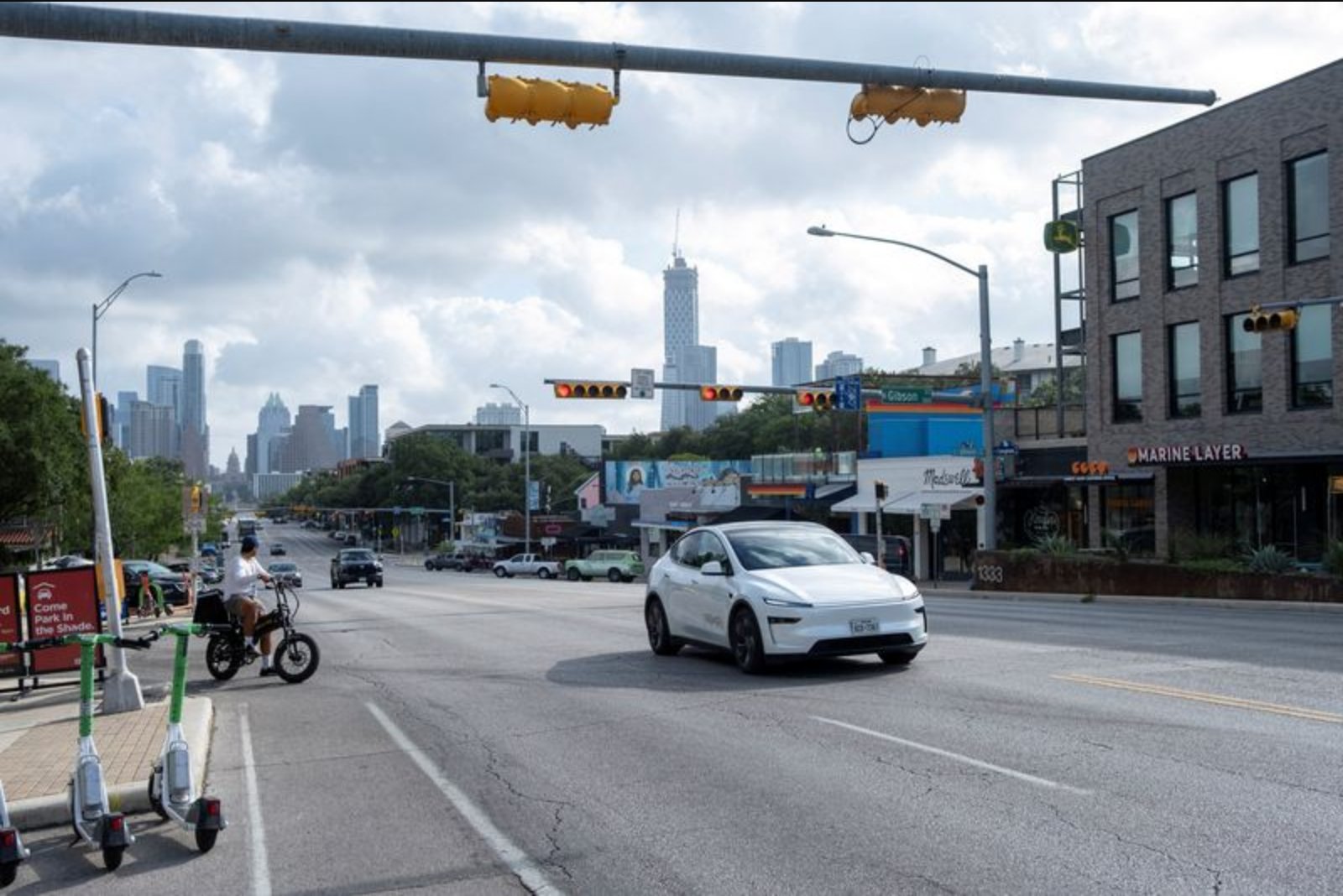
When Tesla expanded its robotaxi offering into Dallas and Houston last month, some investors framed the move as evidence of progress toward CEO Elon Musk’s long-running goal of transforming the company into an AI-driven, driverless-technology leader. Journalists who recently used the service in those Texas markets found a system that appears to be in a live testing stage rather than a fully operational ride-hailing alternative.
Across multiple rides, the service produced long wait times, instances of no availability, and drop-off points located well away from riders' intended destinations. The company did not respond to requests for comment for this article.
Dallas: lengthy waits and distant drop-offs
On a recent Monday afternoon in Dallas, one journalist attempting a roughly 20-minute, 5-mile (8.05 km) trip from the Southern Methodist University campus to Dallas City Hall experienced nearly two hours to complete the journey. At 4:55 p.m., a ride was requested through the Tesla Robotaxi app, which functions similarly to other ride-hailing apps but initially returned a message indicating "high service demand." Around the same moment, the competing service Uber showed an 8-minute wait for a 22-minute trip to City Hall.
For roughly 36 minutes after the initial request, the Tesla app alternated between the high-demand notice and messages saying "no rides available nearby." When a vehicle eventually appeared in the app, the displayed wait time was 19 minutes. Once picked up, the vehicle avoided North Central Expressway, the main route into downtown, and instead spent nearly 35 minutes traversing surface streets. The car dropped the passenger at a parking lot that required a 15-minute walk to reach City Hall.
When the rider used the in-car "support" button, a remote agent said the area was "restricted," despite the location appearing inside the service area map Tesla had posted on social media the prior month. The agent added: "We’re still in the beta version." Subsequent rides to other downtown destinations also indicated drop-offs that would require about 15 minutes of walking to the final point. On a trip to a downtown farmers’ market, the robotaxi deposited the passenger on the opposite side of a freeway and suggested a route that required walking under overpasses littered with trash and smelling of urine.
On another downtown trip, the vehicle failed to execute a left turn on four successive attempts. The intersection in question sat in front of a freeway off-ramp bearing "do not enter" signs, an unusual configuration that appeared to confuse the car. Rather than completing the left turn, the vehicle continued straight and used right turns to circle the block, repeatedly missing the intended maneuver. After the rider described the problem to a remote attendant, the car eventually completed the turn.
Houston and Austin: constrained footprints and intermittent availability
In Houston, Tesla is operating its robotaxis in a compact suburban zone on the city’s northwest side. A journalist testing the service on a weeknight was able to secure one ride. When the same person tried to request a second trip, the same vehicle initially appeared as 13 minutes away but the app later canceled the booking. Subsequent attempts to find another car over the next 30 minutes were unsuccessful, prompting the rider to order an Uber instead.
Even in Austin, where Tesla’s pilot has been in place for nearly a year, the service can be inconsistent. City officials recently presented a slideshow indicating Tesla operates about 50 vehicles in Austin; by contrast, the slideshow noted more than 250 Waymo vehicles in the same market. Some Tesla robotaxis in Austin continue to carry human safety monitors in the front passenger seat. The company said it has increased the number of fully driverless vehicles in Austin but did not provide a specific figure.
One journalist tracked Tesla wait times in Austin across a three-week period in April, measuring availability eight times per day from morning into evening. The checks found wait times exceeding 15 minutes in roughly half of observations and at least 25 minutes on more than one-quarter of checks. In 27% of those checks, no cars were available at all.
Safety reporting and regulatory interactions
Austin police say Tesla has had no major crashes in the city and no traffic citations tied to the robotaxi operations, according to the official who oversees autonomous-vehicle safety for Austin. Since August, Tesla has reported 15 crashes in Austin to the U.S. National Highway Traffic Safety Administration, which operators of autonomous vehicles are required to notify even for minor incidents. Most of those reports did not involve injuries; one incident resulted in a person being sent to the hospital. Unlike other autonomous-vehicle operators, Tesla has asked regulators to redact all crash information.
The Austin official said Tesla generally has been responsive to the city’s questions but raised concerns about the vehicles’ approach to speed limits. On test rides conducted last year, he consistently observed Tesla robotaxis traveling about 5 mph above posted speed limits. The company told the official it believed it was safer for vehicles to keep pace with surrounding traffic. The official responded: "At no time would we ever advocate that you program your vehicles to speed."
Market expectations and company positioning
A large portion of Tesla’s roughly $1.6 trillion market value is tied to investor expectations that the company will deploy a widespread fleet of robotaxis. That valuation stands at more than five times that of any other automaker. CEO Elon Musk has publicly stated that Tesla’s self-driving technology "works anywhere," and he has criticized the slower, mapping-heavy market entry employed by Alphabet’s Waymo.
Last July, Musk predicted Tesla robotaxis would serve half the U.S. population by the end of 2025. Despite that forecast, the robotaxi service remains limited to Dallas, Houston and Austin, where Tesla first introduced a pilot last June. Following the company’s first-quarter earnings report on April 22, several analysts concluded the robotaxi expansion was advancing more slowly than expected. On that earnings call, Musk said Tesla is taking a "cautious approach" to deployment to avoid injuries or fatalities.
Service limitations and operational reality
The Texas tests illustrate several practical constraints: long and variable wait times, intermittent vehicle availability, operational behaviors that result in distant drop-offs, and navigation difficulties at certain intersections. In Austin, the relatively small fleet size and the continued presence of human safety monitors in some vehicles underscore that the program is not yet at the scale or level of autonomy some investors have anticipated.
For consumers seeking reliable, on-demand trips in these markets, the robotaxi experience remains uneven. For investors and market observers, the contrast between Tesla’s ambitions and the current operational reality highlights uncertainties about the timeline and scope of a broader robotaxi rollout.
Investment product mention
The article included a product mention concerning TSLA and an AI-driven stock selection product that evaluates companies monthly using financial metrics. That product description noted it uses AI to identify stock ideas and cited historical example winners. The product's claims and examples are presented in the original material accompanying the reporting.