
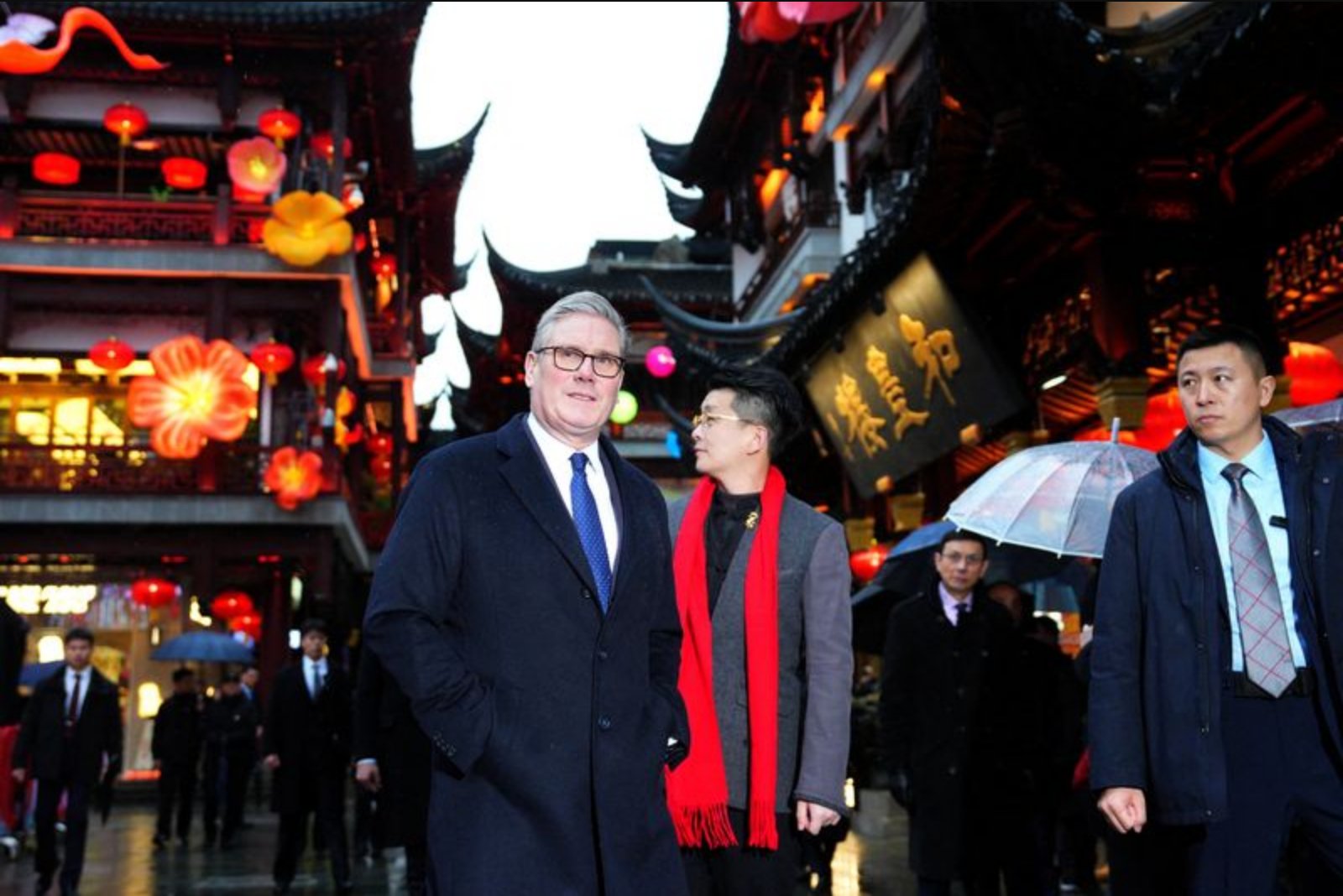
British Prime Minister Keir Starmer’s recent visit to China offered Beijing another diplomatic victory to showcase in its contest with Washington, while simultaneously exposing the narrow gains that middle powers can realistically extract when recalibrating relations amid global tensions.
Starmer followed a string of high-level western trips to Beijing. Canadian Prime Minister Justin Trudeau’s counterpart Mark Carney conducted his own visit weeks earlier and left with trade expectations, and other European leaders as well as India’s Narendra Modi have engaged with China since President Trump began his second term. Those visits signal to the United States that allies may be exploring alternatives if pressure from Washington continues on issues ranging from territorial questions to trade renegotiations.
Yet analysts caution that these visits are more symbolic than structurally transformative. John Quelch, an expert in global strategy at Duke Kunshan University, said traditional U.S. allies feel "hard done by" and are hedging their bets, but they are neither able nor willing to replace the United States with China as their primary partner. Alicia Garcia-Herrero, chief Asia-Pacific economist at Natixis, called such diplomatic trips "superficial gestures amid stalled global growth," arguing that they underscore the severe limitations of any concerted 'pivot' to China. She said middle powers risk chasing marginal gains while confronting the volume of Chinese exports that pressure their domestic industries.
Concrete outcomes and their limits
From London’s perspective, the tangible outcomes of Starmer’s trip were narrow in scope but politically useful. Britain secured 30-day visa-free travel for its citizens visiting China, negotiated lower tariffs on whisky, and welcomed a $15 billion investment announcement by British drugmaker AstraZeneca. On more sensitive issues - including Beijing’s increasingly assertive posture on Taiwan, its strengthened ties with Russia since the Ukraine invasion, and civil liberties concerns in Hong Kong - the talks produced what officials described as frank dialogue rather than concrete policy shifts.
Starmer faced domestic criticism, with some British and U.S. politicians raising accusations of espionage and human rights abuses that Beijing rejects. Parallel dynamics played out after Carney’s trip: Ottawa was left expecting Beijing to reduce or lift tariffs on items such as canola, lobsters, crabs and peas, a prospect that immediately drew a sharp reaction from Washington. President Trump warned Canada about admitting Chinese electric vehicles into North America and even threatened 100% tariffs in response.
Even before Starmer concluded his engagement, President Trump publicly cautioned Britain against expanding commercial ties with China, following the prime minister’s comments about the economic advantages of resetting relations.
Trade flows and structural imbalances
The broader economic backdrop tempers the appeal of deeper trade integration with China. Official data showed China’s imports for the year were flat at $2.6 trillion, with much of the demand focused on energy and commodities from emerging markets rather than western economies. Meanwhile, China’s trade surplus increased by a fifth to a record $1.2 trillion as its exporters moved aggressively into global markets in response to U.S. tariffs, often at the expense of domestic producers elsewhere.
That scale of surplus growth has prompted commentators to project continued expansion: at the current pace, some analysts suggest the surplus could approach the size of a $3-trillion economy by 2030 and a $5-trillion economy by 2033. In the most recent year, China’s exports to the European Union rose 8.4% while its imports from the bloc fell 0.4%. Exports to Britain increased by 7.8% even as China’s purchases from Britain declined by 4.7%. Trade with Canada showed a similar divergence - sales to Canada rose 3.2% while Canadian exports to China plunged 10.4%.
Eswar Prasad, former China director at the International Monetary Fund, warned that such dynamics make it risky for countries seeking to protect or expand their manufacturing bases to substantially deepen trade ties with China. He argued that China does not represent a safe refuge for nations attempting to offset the negative impacts of U.S. tariffs.
Political messaging and economic trade-offs
Analysts say Beijing benefits from high-profile visits by Western leaders because they help to bolster Beijing’s narrative of being a "reliable partner" in contrast to what is portrayed as erratic U.S. tariff policy and growing demands of partners. Noah Barkin, an expert on Europe-China relations, described the recent trips as a "propaganda coup for Beijing," while stressing that they do not amount to a wholesale pivot away from the United States. Instead, he said, these engagements are aimed at reducing tensions with Beijing. "No country wants to be in open conflict with the two superpowers at the same time," Barkin added.
For middle powers, the calculus is therefore about balancing limited commercial gains against geopolitical and economic vulnerabilities. Some analysts contend that modest trade wins and efforts to reset relations may be the best realistic outcomes available right now. Prior deterioration in ties, they note, exposed critical supply chain dependencies on China. Re-engagement could therefore deliver value by addressing some vulnerabilities even if it does not significantly reverse widening two-way trade imbalances.
Implications for sectors and markets
The immediate beneficiaries of recent diplomatic deals include sectors such as pharmaceuticals, where AstraZeneca’s announced investment represents a major capital commitment, and food and beverage sectors affected by tariff adjustments - for example, whisky exporters. Agricultural exporters such as canola and seafood producers were central to Canada’s expectations from Beijing. Manufacturing sectors in Western economies, however, face heightened competition as Chinese exporters expand their global reach.
Overall, analysts stress that while diplomatic visits can yield headline-making concessions and investment pledges, they do not by themselves resolve deeper structural imbalances in trade or remove the security dilemmas posed by growing geopolitical competition.
Conclusion
Starmer’s trip to Beijing illustrates the constrained toolbox available to medium-sized democracies trying to navigate between Washington and Beijing. The agreements struck offer short-term economic benefits and political messaging value, but they also underline persistent vulnerabilities: the scale of China’s export machine, asymmetric trade outcomes, and the potential for escalating responses from the United States. For policymakers, the challenge remains how to extract practical economic advantages while avoiding the strategic costs of closer integration with a partner whose economic expansion can imperil domestic industries.