
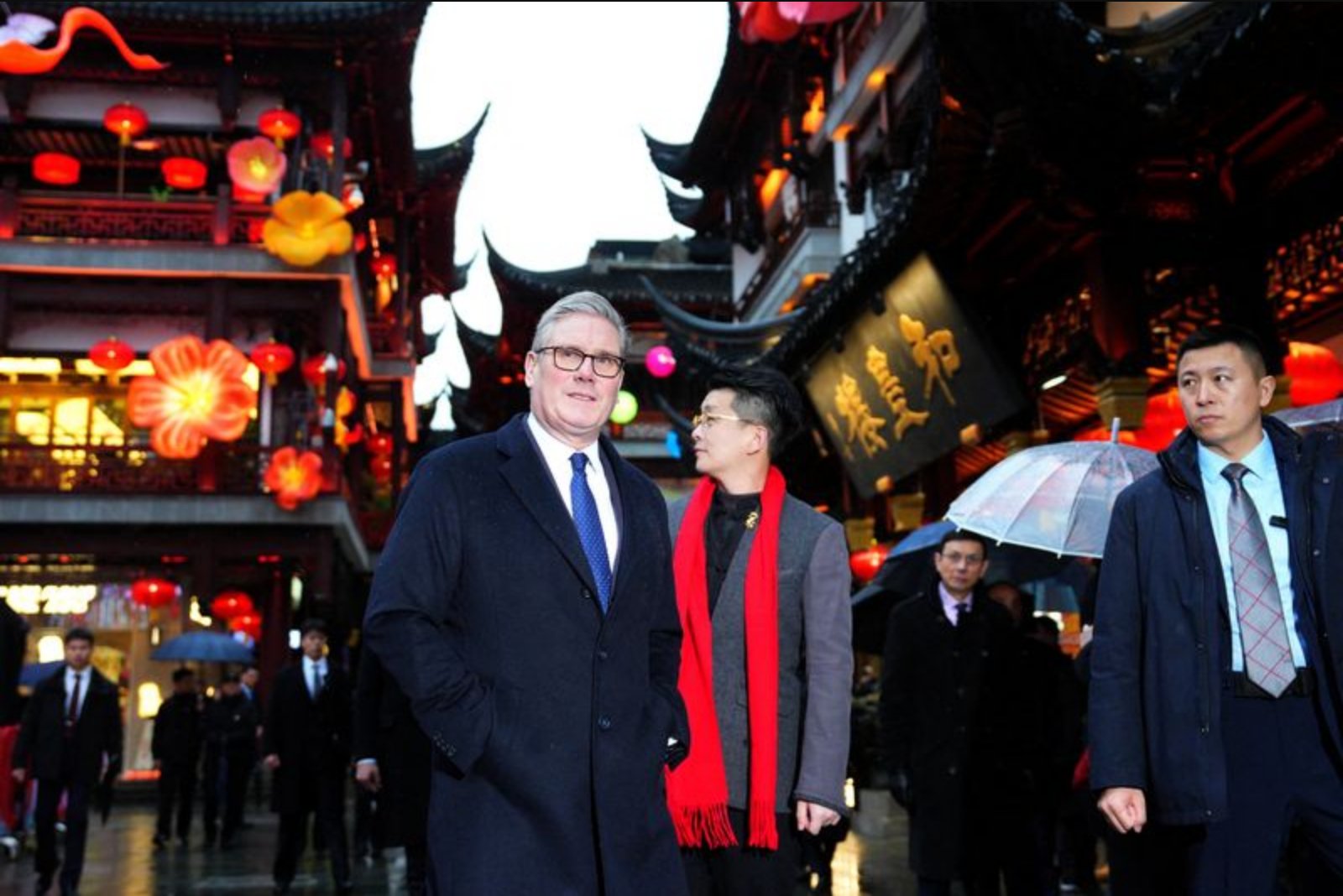
British Prime Minister Keir Starmer's visit to China provided tangible wins that Beijing can use to demonstrate diplomatic momentum against Washington - yet the details of the agreements also highlight how limited a so-called pivot to China can be for middle powers.
Starmer's trip followed a recent visit by Canadian Prime Minister Mark Carney, who secured a trade deal on a similar itinerary weeks earlier, and came as global leaders head to Davos amid disruption to long-standing U.S. alliances under President Donald Trump. European leaders and other figures, including India's Narendra Modi, have also travelled to Beijing since the start of Trump's second term a year ago.
For capitals such as London and Ottawa, these visits signal to Washington that alternatives exist if relations with the United States remain strained - from disagreements over Greenland to the renegotiation of the USMCA trade pact among the United States, Canada and Mexico. Yet analysts argue the substance of these engagements is often limited.
"Traditional U.S. allies feel hard done by and are now hedging their bets, but they are far from being able or willing to substitute China for the United States," said John Quelch, an expert in global strategy at Duke Kunshan University.
Alicia Garcia-Herrero, chief Asia-Pacific economist at Natixis, described the diplomatic activity as offering little in the way of deeper economic revival. "These are superficial gestures amid stalled global growth," she said. "These visits highlight the severe limits of any 'pivot' to China. They expose middle powers' vulnerability, chasing scraps while China's export flood overwhelms their industries."
Beijing benefits from the optics. Each visit can be portrayed as reinforcing China as a dependable partner, standing in contrast to Trump's tariff policies and his expanding list of demands and threats toward both partners and rivals. "President Trump's efforts to decouple the United States from China are also decoupling the United States from the world," Quelch added.
On substance, the package Starmer secured in Beijing included 30-day visa-free travel for Britons visiting China and lower tariffs on whisky. British drugmaker AstraZeneca also announced a $15 billion investment in China during the trip. Beyond these commercial and travel measures, Starmer obtained what officials described as "frank dialogue" on a range of security and human rights issues, but no binding concessions on contentious topics.
Areas of friction where Britain sought clarity but received limited commitments included China's firmer posture on Taiwan, its deepening ties with Russia following the invasion of Ukraine, and concerns about rights restrictions in Hong Kong. Politicians in both Britain and the United States who opposed the trip publicly raised allegations concerning espionage and human rights abuses, allegations that Beijing rejects.
Carney's earlier visit produced expectations that Beijing would reduce or remove tariffs on agricultural products such as canola, lobsters, crabs and peas. However, those developments prompted sharp pushback from Washington, with President Trump threatening 100% tariffs and warning Ottawa about allowing Chinese electric vehicles into the North American market.
Even as Starmer was still in China, Trump cautioned Britain about the risks of increased commercial engagement with Beijing, following Starmer's comments on the economic upside of resetting relations.
Underlying the diplomatic choreography are deeper structural trends in China's trade picture that complicate hopes for broad-based gains by Western partners.
China's imports last year were effectively flat at $2.6 trillion, but much of that demand was for energy and commodities sourced from emerging markets rather than Western economies. Meanwhile, China's trade surplus rose by a fifth to a record $1.2 trillion as its manufacturers expanded into global markets in response to U.S. tariffs, often at the expense of domestic producers elsewhere.
At that pace, analysts note, China’s trade surplus is on track to approach the size of the $3-trillion French economy by 2030 and the $5-trillion German economy by 2033. Recent trade flows illustrate this dynamic: China's exports to the European Union climbed 8.4% last year while its imports from the EU fell 0.4%. Shipments to Britain rose by 7.8% even as Chinese purchases from Britain fell 4.7%. With Canada, Chinese sales increased 3.2% while purchases from Canada plunged 10.4%.
"This makes it an especially risky proposition for countries trying to protect or grow their own manufacturing industries to substantially increase trade integration with China," said Eswar Prasad, a former China director at the International Monetary Fund.
Prasad, who now teaches trade policy at Cornell University, added that China does not provide a simple refuge for countries coping with the fallout of U.S. tariffs. Instead, Beijing's countermeasures have tended to widen bilateral imbalances rather than correct them.
Some analysts temper the critique by noting that large trade concessions may be unrealistically ambitious for countries such as Britain or Canada at this moment. For those governments, recalibrating ties with China - even if only to reduce tensions and shore up supply-chain vulnerabilities exposed by earlier deterioration in relations - may represent the most attainable outcome.
"The visits by Starmer and Carney are a propaganda coup for Beijing," said Noah Barkin, a Europe-China expert at the German Marshall Fund and Rhodium Group. "This is not a pivot to China. It is about reducing tension with Beijing." He added, "No country wants to be in open conflict with the two superpowers at the same time."
The diplomatic engagements thus play a dual role. They offer middle powers a way to demonstrate independence from Washington's pressure while simultaneously providing Beijing with a narrative of expanding global partnership. Yet the deals obtained - visa waivers, tariff reductions on select goods, and large corporate investments - do not currently amount to broad rebalancing of trade relations that would offset the competitive pressures from China's export-driven growth.
As governments weigh the economic and political trade-offs of closer engagement with China, the balance of risks and rewards appears constrained. The short-term diplomatic headline wins are real and can be framed as strategic alternatives to the United States, but deeper structural shifts in trade flows and industrial competition mean that such visits may have limited ability to protect domestic industries or deliver sustained economic reciprocity.
For now, the record suggests these high-profile trips provide political leverage and public relations value more than comprehensive economic solutions - a reality that middle powers must reconcile with if they continue to seek a path between Washington and Beijing.