
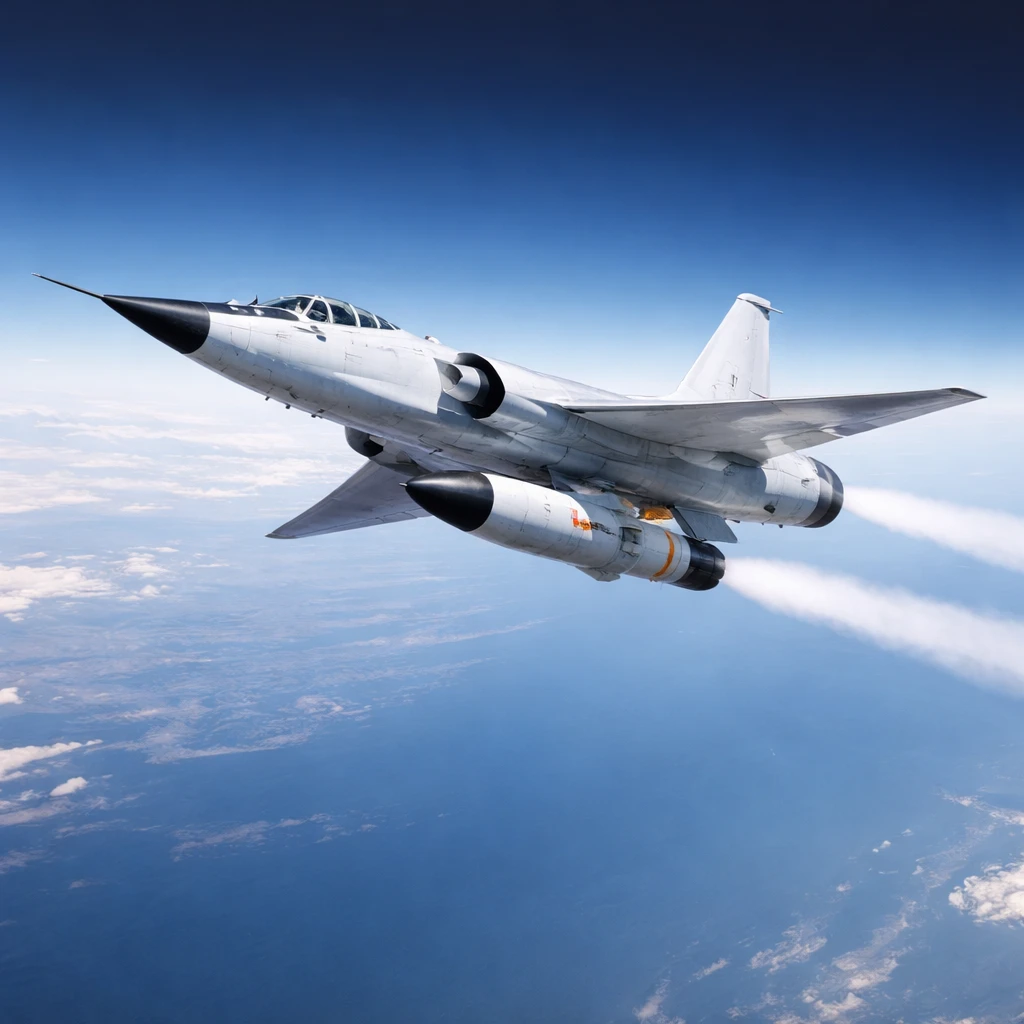
Starfighters Space Inc started public trading on the NYSE American in December 2025. Since that debut the company saw an early post-IPO surge in its share price followed by a substantial pullback - shares are down roughly 38% year-to-date. Despite the market volatility, the company under its new chief executive has reaffirmed its commitment to expand operations in two distinct mission areas: supersonic flight testing and suborbital air-launched missions.
The leadership change at the company took place earlier this year. Founder Rick Svetkoff stepped down as CEO in February, and Tim Franta assumed the top executive role. Franta moved into the position after serving as Vice President of Development, where he was responsible for overseeing the STARLAUNCH air-launch system.
Two mission categories: how they differ and why both matter
Franta frames Starfighters’ work as split between two related operational streams. The first is supersonic atmospheric flight testing. In this mode, customers obtain a repeatable Mach 2-plus flight environment by mounting payloads under the wing of Starfighters’ aircraft. Those flights support propulsion development, systems validation, and aerodynamic testing in real atmospheric conditions. The commercial value proposition Franta highlights is access - customers can purchase contracted, commercially operated flight campaigns that are flexible, repeatable, and are not constrained by the availability limits of traditional government test ranges.
The second is a set of suborbital missions, including the STARLAUNCH 1 program. These flights move beyond captive-carry atmospheric tests into rocket-powered, high-altitude profiles intended to deliver short-duration microgravity and data-gathering opportunities. In these suborbital profiles, payloads are not placed into sustained orbit; instead they reach a high point in altitude and return to Earth. That operational distinction means orbital parameters such as inclination have different relevance compared with orbital launches.
Franta noted that more precise performance characteristics for STARLAUNCH 1 will be defined after the program completes its Critical Design Review. At that milestone the company intends to finalize key parameters including total vehicle mass, fuel volume, launch altitude, and separation or release speed at air launch. Typical customer objectives for a suborbital flight can vary and may include maximizing altitude or time in microgravity, minimizing or maximizing g-forces depending on experiment needs, and accommodating payloads that cannot be exposed directly to sunlight. According to Franta, final performance metrics will be validated during flight testing.
Work with the Department of Defense and government alignment
Starfighters positions itself as a small, specialized provider that can complement larger government infrastructure. The company argues its commercial, mission-specific flight services are rapidly repeatable and can help defense and aerospace programs iterate faster than relying solely on government ranges that often have long lead times and limited availability.
Franta pointed to a recent example to illustrate that dynamic: a GE Aerospace ATLAS flight campaign that was funded by the Department of Defense under Title III of the Defense Production Act. In that campaign Starfighters’ aircraft were used to conduct multiple supersonic captive-carry flights to support propulsion technology advancement. The company views that kind of work as a clear case where a commercial platform supplements government testing capability.
At the same time, Franta emphasized that when a company works with government entities it must align closely with their requirements, policies, and funding realities, which can change. Starfighters’ public filings explicitly acknowledge that business with governmental entities is subject to policy, regulatory, mandate, and funding changes and that such shifts could negatively affect operations. From the company’s perspective the upside of participating in DoD-backed programs includes durable demand signals, credibility, and potential follow-on work. The countervailing risks are concentration and volatility - changes in priorities, contracting timelines, or funding levels can alter program cadence.
To manage those risks Franta described a disciplined approach focused on program execution, milestone documentation, and diversifying the customer base over time.
Commercial customers and the company’s role in space-adjacent missions
Beyond government contracts, Starfighters serves a mix of customers in aerospace and defense development who require exposure to a supersonic flight environment with underwing payload carriage and repeatable mission profiles. The company’s filings also identify ancillary revenue streams such as pilot training and equipment testing.
Franta characterized Starfighters as offering contracted flight services tied to customer missions rather than pursuing speculative technology development. In commercial space initiatives the company aims to act as a bridge from atmospheric testing to space-adjacent missions: operating from facilities such as Kennedy Space Center, flying Mach 2-plus aircraft for supersonic testing, and advancing STARLAUNCH 1 through validated separation work and formal engineering gates toward suborbital payload missions. Over the longer term the company expresses intent to develop infrastructure and capability for orbital launch following successful suborbital demonstrations.
Scaling plans and constraints
Franta described recent milestones as efforts to de-risk programs and build a repeatable operating cadence across both flight services and STARLAUNCH 1 program execution. He laid out a three-layer scaling framework.
- Operational scaling - increase aircraft utilization by delivering repeatable customer campaigns and shortening turnaround times between missions.
- Program scaling - advance STARLAUNCH 1 through structured engineering gates such as wind tunnel validation, procurement of instrumented demonstrators or drop articles, and a critical design review so build and test activities follow a disciplined plan.
- Commercial scaling - expand the customer base and mission mix while preserving safety, reliability, and regulatory compliance.
Franta stressed that the primary constraints to growth in this area are rarely demand alone. Instead, they are often regulatory approvals, safety and range coordination, supply chain challenges, and capital availability. The company’s filings state that Starfighters is pursuing a launch waiver and license for initial suborbital payload launches and intends to develop orbital launch infrastructure after successful suborbital flights. Those filings also disclose going concern risk and note the need to secure additional funds to execute the longer-term plan.
Given those constraints, the company’s operational posture is methodical: document engineering milestones, build a track record through contracted missions, and scale capacity in step with regulatory progress and financing.
Support for astronaut and pilot training
Operating from Kennedy Space Center, Starfighters provides training services that support both flight and operational procedures relevant to human spaceflight programs and the broader commercial space ecosystem. Practically, this work can include providing high-performance flight experience, developing mission procedures, and delivering flight operations support that is useful to human spaceflight programs.
Franta expects that as commercial human spaceflight activity matures, demand will grow for flexible, commercially scheduled training capacity that is integrated with testing and operations. He noted the actual growth rate will be a function of how frequently commercial human spaceflights occur, evolving customer needs, and how training requirements change over time. The company views that long-term direction as supporting greater demand for specialized providers like Starfighters.
Market position and near-term outlook
Starfighters’ market position combines a niche operational capability - repeatable Mach 2-plus flight testing with underwing payload carriage - with a nascent progression toward suborbital missions via STARLAUNCH 1. The company faces a conventional set of risks for firms operating at the intersection of aerospace and defense: regulatory approvals, reliance on government contracting cycles, supply chain and capital constraints, and the operational rigour required to validate new vehicle performance through test flights.
While its shares have retreated from their post-IPO highs, the company continues to present a roadmap centered on disciplined engineering gates, documented milestones, and calibrated scaling tied to regulatory and financing milestones.
Key takeaways
- Starfighters operates two principal mission types - supersonic atmospheric flight testing and suborbital air-launched missions - and plans to evolve toward orbital capability over time.
- The company emphasizes repeatability and contracted service delivery as its core commercial proposition, serving government and commercial aerospace customers.
- Scaling is planned across operational, programmatic, and commercial dimensions, with regulatory approval, safety coordination, supply chain, and capital availability identified as principal constraints.