
Overview
Across the western United States, a mild winter that delivered record-low snowfall in many basins has transitioned into a blistering spring, leaving ski areas scrambling to maintain operations. Resorts from New Mexico to Colorado and Utah have resorted to moving remaining snow with heavy equipment to keep runs serviceable. In other locations, exposed dirt, puddles and only a handful of open trails have become the norm as operators wind down seasons earlier than usual or shuttered entirely.
Scale of closures and snow shortfalls
More than half of the roughly 120 ski resorts in the U.S. West have already closed, announced early closures, or never opened this season, according to a Reuters tally. That contrasts with a typical winter in which only around a dozen facilities might close early for weather-related reasons. In several of the most popular destinations, available terrain has been dramatically reduced - for instance, Vail reported that fewer than 20% of its trails remained open at one point this season.
Temperature anomalies and measured impacts
In the week through Thursday, March 26, temperatures across the Western U.S. ran about 20-30 degrees Fahrenheit (11-17 Celsius) above normal, breaking daily records in more than 150 locations, according to the National Weather Service. Climate researcher Daniel Swain warned that snowpack was on track to be the lowest on record at nearly every western ski destination, calling the season "remarkably bad" across most basins and attributing the trend to long-term climate change. "It’s really just been a tale of astonishing warmth throughout the West," he said.
Operational responses and human stories
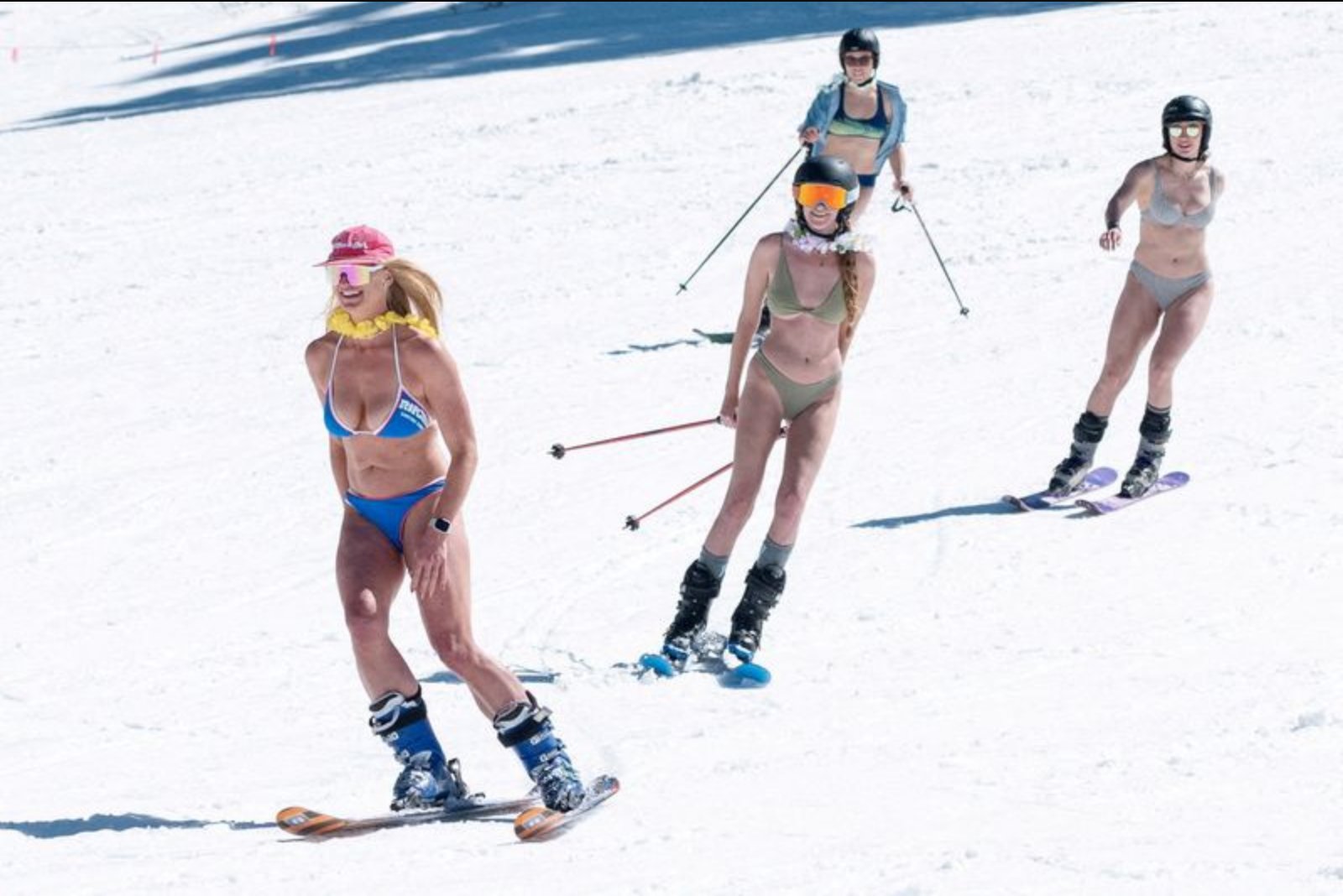
Operators and workers have been improvising to keep amenities and trails open where possible. At Taos Ski Valley in New Mexico, staff pushed remaining snow with bulldozers from sheltered areas onto runs to create passable surfaces. In some locations, skiers confronted rock fields and mud as they navigated reduced terrain. At one resort base, shirtless skiers were observed "water skiing" across a large puddle forming from runoff. An 80-degree (26.6 C) day at Taos saw a 19-year-old skier, Maylyn Bubala, take to the slopes in an athletic bikini top in the days before the resort closed; Bubala is a student at Oregon State University who has written about environmental impacts of early snowmelt.
Elsewhere, visitors accustomed to bustling streets and crowded restaurants found quieter conditions. In Park City, Utah, where the total seasonal snowfall measured 158 inches (401 cm) - less than half the area's long-term average - streets that typically host spring break visitors were notably subdued. Park City officials aimed to remain open through April 20, but large swaths of terrain were inaccessible, prompting visitors to describe the environment as "otherworldly" and "like a sci-fi landscape." One young skier described dodging rocks and navigating 15-foot-wide (4.57 meters) puddles while skiing.
Economic effects on operators and local businesses
The weak snow season has translated into tangible financial effects for operators and businesses that rely on end-of-season traffic. Vail Resorts - the company that manages Park City, Vail, Beaver Creek and Keystone among other sites - characterized the season as a "worst-case weather scenario" for many of its 37 North American resorts. On March 9, the company trimmed its fiscal 2026 net income guidance to a range of $144 million to $190 million, which represents a roughly 30% reduction at the midpoint compared with its Dec. 10 guidance of $201 million to $276 million. Chief Executive Rob Katz called it "the most challenging winter across the Rockies that we have ever experienced," citing the lowest snowfall levels in more than 30 years for the company's Colorado and Utah resorts.
Local businesses reported revenue declines tied to lower visitation. In Silverthorne, Colorado, owner Allison Buffum said her restaurant, Saved by the Wine, experienced a 10%-15% drop in business. Buffum described the winter as "pretty horrific," saying it was the worst since 1976 and noting that some visitors opted to sun on her patio rather than ski. At Breckenridge, volunteer efforts and manual labor were required to keep cross-country trails navigable; volunteers at the Breckenridge Nordic Center moved snow from forested areas onto slushy trails until staff opted to close the center three weeks early.
Broader risks and regional stress points
The conditions present secondary risks beyond lost lift ticket sales and quieter restaurants. A reduced snowpack elevates wildfire risk at higher elevations that normally remain snow-covered well into spring; with little protective snow, soils and vegetation are drying earlier and could become fuel for blazes. Diminished snowmelt also threatens downstream water supplies for major cities that depend on Colorado River runoff, including Phoenix and Las Vegas, heightening concerns about water availability later in the year.
Industry scale and labor
The U.S. ski and snowboard industry is significant in both economic and employment terms, supporting roughly $20 billion in activity and more than 190,000 jobs. The season's contraction has prompted veteran ski patrollers and others in the industry to question the long-term sustainability of current business models if high winter temperatures become the norm.
Local responses and last efforts
At smaller operations and volunteer-run centers, personnel undertook strenuous, manual work to eke out a few more days of operations. Anton Artemenko and his wife volunteered at the Breckenridge Nordic Center to move snow from the forest onto trails; their efforts were physically demanding and, in the end, the center closed earlier than planned. Such efforts illustrate the strain on community-level resources as operators balance safety, costs, and dwindling snow coverage.
Conclusion
The combination of record-low snowfall and an unusually warm spring has disrupted traditional season patterns across the western U.S. ski industry. From mechanical redistribution of snow to early closures and downgraded corporate financial outlooks, the effects have rippled through resort operators, local businesses, and regional resource concerns such as wildfire potential and water supply. Industry participants and communities face an uncertain path forward if similar seasons recur.
Source limitations
The article reflects conditions and statements provided by industry participants, local observers, a climate scientist, and public weather data cited for the period ending March 26. Where available, operator guidance and quantified snowfall totals are included.