
Silver prices experienced a significant leap on Friday, surpassing the $100 per troy ounce mark as the metal extended its exceptional upward trend that began in 2025 into the new year. The surge has been propelled by robust retail investor activity coupled with persistent constraints in the availability of physical silver, a commodity valued both for its industrial uses and its status as a precious metal.
Following in the footsteps of gold's soaring prices, technical analysts who utilize chart patterns from prior price movements to forecast future trends have indicated that silver's swift ascent could be a precursor to a considerable price correction. StoneX analyst Rhona O’Connell characterized the current market conditions as a "self-propelled frenzy," noting that ongoing geopolitical tensions are enhancing gold's appeal, which indirectly benefits silver due to its relatively lower unit price. She further cautioned that although widespread participation is evident, investors should heed "amber wealth warnings," as emerging market vulnerabilities could quickly escalate into severe downturns.
On Friday, spot silver prices climbed 5.1% to $101 per ounce. Since the outset of 2026, silver has appreciated by 40%, following a remarkable 147% rally throughout 2025. During the same session, gold achieved a record peak of $4,988 per ounce. Michael Widmer, a strategist at Bank of America, suggested that silver's price, from a fundamental standpoint, justifies a figure near $60 per ounce, warning that demand from solar panel manufacturers may have reached its zenith in 2025, while widespread industrial demand is likely to be hampered due to historically elevated prices.
In a notable development reflecting silver's relative strength, it now requires only 50 ounces of silver to exchange for one ounce of gold — the lowest ratio in 14 years, dropping from 105 ounces in April. This ratio, a key metric for traders and analysts, signals that silver’s gains relative to gold have reached an extensive level.
Investment Dynamics and Market Supply
The silver market's growth in 2025 constitutes the largest yearly increase since 1983, according to data from the London Stock Exchange Group. This expansion has been supported by strong investment demand across all precious metals and persistent thinness in liquidity within the London silver market. Concerns over U.S. tariff policies have spurred substantial inflows into U.S.-based silver stocks.
Analysts note that several waves of retail buying, ranging from purchases of small silver bars and coins to inflows into physically backed silver exchange-traded funds (ETFs), have bolstered demand particularly since October. Approximately 20% of the annual one-billion-ounce silver supply is derived from recycling activities. Although recycling has intensified given the record price levels, the rate at which recycled silver re-enters the market remains limited by a bottleneck in high-grade refining capacity, according to precious metals consultancy Metals Focus.
The importance of available stock and secondary supply has increased after five consecutive years of structural supply deficits, a trend expected to persist throughout 2026. The combination of these supply shortages, outflows to U.S. markets, and ETF inflows has caused the quantity of quickly deployable silver held in London commercial vaults to fall to a historic low of approximately 136 million ounces by the end of September. Although stocks partially rebounded to nearly 200 million ounces by the end of 2025, helping to reduce lease rates from an October peak, they remain well below the roughly 360 million ounces available during the height of the Reddit-fueled rally in early 2021.
Market Outlook and Liquidity Considerations
Looking ahead, market observers anticipate accelerated outflows from U.S. silver stocks that could enhance liquidity within more traditional trading venues. This expectation follows Washington's decision not to impose tariffs after releasing findings from its critical metals review in mid-January. COMEX silver inventories peaked at 532 million ounces on October 3 but have since declined by 114 million ounces to approximately 418 million ounces, marking the lowest since March. This inventory depletion represents around $11 billion worth of silver withdrawn from storage.
To revert to inventory levels seen before the 2016 U.S. presidential election, COMEX stocks would require an additional 113 million ounces to be drawn down, equivalent to nearly 11% of the total annual supply. BNP Paribas senior commodities strategist David Wilson highlighted the likelihood of profit-taking in the near term given the investor-driven nature of the recent rally and indications of easing conditions in the physical silver market.
In summary, silver's extraordinary price movement is heavily influenced by retail buying enthusiasm and ongoing supply constraints. However, underlying industrial demand pressures and potential market corrections warrant cautious observation going forward.
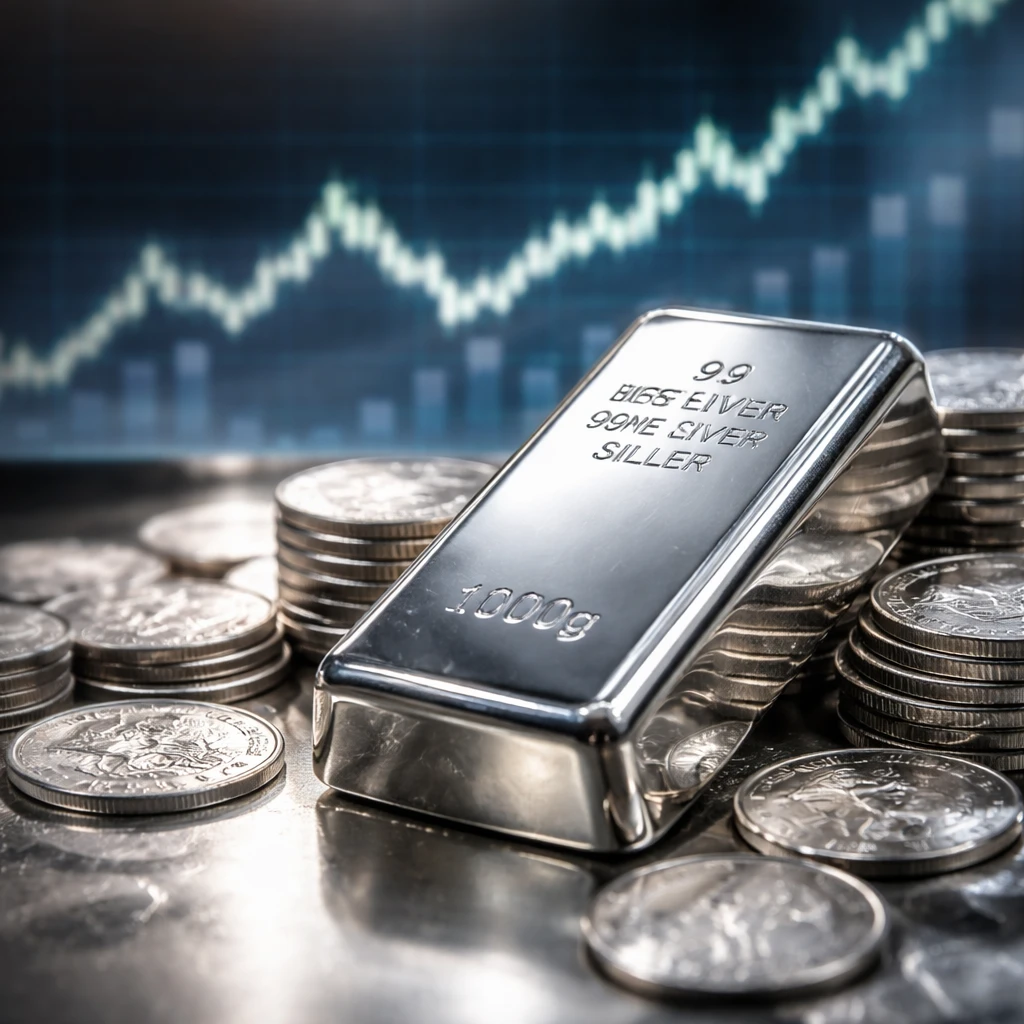
Silver prices skyrocketed above $100 per ounce in early 2026, continuing an extraordinary rally that began in 2025. This price surge is driven largely by active retail investment and sustained scarcity in physical markets for silver, a precious and industrial metal. Technical analysts caution that the rapid appreciation could prompt a future correction. The silver-to-gold ratio has shifted dramatically, underscoring silver's sharp outperformance relative to gold. Market dynamics, including limited refining capacity and inventories, remain critical factors influencing silver's trajectory.
Key Points
- Silver prices have surged above $100 per ounce early in 2026, continuing a prolonged rally driven by retail investor demand and scarcity in physical markets.
- The silver-to-gold ratio has reached a 14-year low, illustrating silver's strong relative performance compared to gold, with significant implications for precious metals markets.
- Supply challenges remain due to limited refining capacity and structural deficits over multiple years, impacting availability and market liquidity.
Risks
- The rapid price increase has led technical analysts to warn of a potential sharp correction, posing risks to investors attracted by momentum-driven gains.
- Industrial demand may face headwinds given record-high prices and a possible peak in solar panel-related silver consumption, affecting manufacturers dependent on silver.
- Liquidity constraints in physical silver markets persist due to low inventories and refining bottlenecks, which could exacerbate price volatility if supply-demand imbalances shift abruptly.