
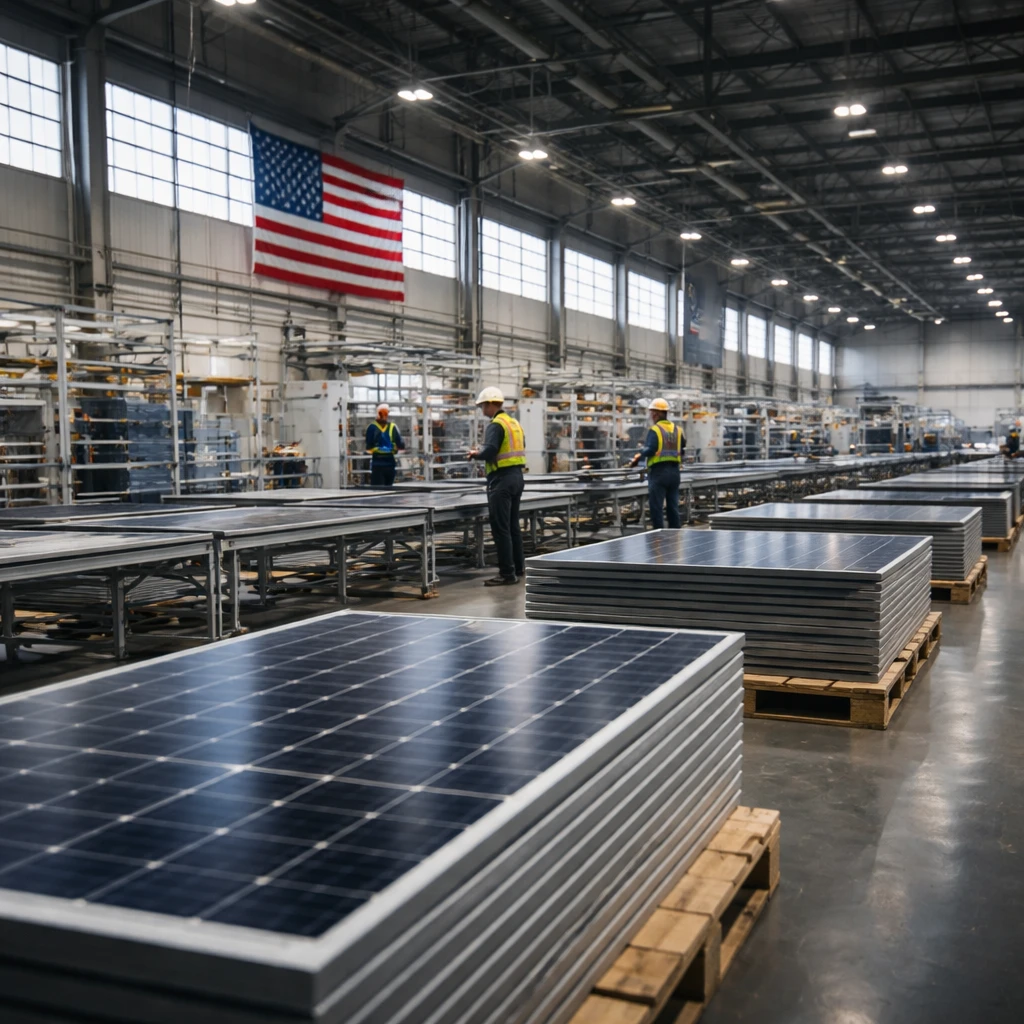
Top solar developers, installation firms, banks and insurers have begun refusing to engage with at least six U.S. solar-panel factories opened in recent years because of questions about whether those plants' links to Chinese companies will disqualify them from federal clean-energy subsidies. Industry executives and corporate documents reviewed for this report show the uncertainty stems from new rules embedded in legislation supported by former President Trump and enacted by a Republican-controlled Congress in 2025.
The withdrawal of business from these factories places at risk more than a third of the nation’s operating solar module manufacturing capacity - plants that were originally built by China-linked companies. The effects have emerged across multiple corners of the industry, with installers paring back approved supplier lists, banks pulling back tax-equity financing and insurers declining coverage tied to the risk of losing tax credits. The details of how this uncertainty is prompting market participants to steer clear of certain domestic factories have not been widely reported until now.
Policy backdrop and immediate market response
The 2025 legislation, described by supporters as an effort to reorient U.S. industrial policy, significantly reduced prior Biden-era clean-energy subsidies and introduced restrictions aimed at limiting the role of certain foreign countries - including China - in receiving the subsidies that remain. Key elements of the law include caps on foreign ownership for facilities seeking federal incentives, sourcing requirements and a prohibition on "effective control" by Chinese firms. The Treasury Department has not yet issued full guidance on how these provisions will be implemented, and a spokesperson declined to give a timeline for publication.
In the absence of Treasury's detailed rules, several large players have taken precautionary steps. Sunrun, the largest residential solar installer in the United States, circulated a shortened list of approved panel suppliers in January, removing manufacturers with China links and keeping only suppliers without such ties. Sunrun Deputy Chief Financial Officer Patrick Jobin told industry outlets that the company had "taken a conservative stance and do not procure equipment from manufacturers that would raise compliance concerns."
Other installers have made similar moves. Palmetto, a North Carolina-based rooftop solar seller, is avoiding China-linked manufacturers despite those firms' attempts to restructure ownership to comply with the law, according to statements from the company's general manager, Sean Hayes.
Banks, insurers and financing hang in the balance
Financial institutions have also grown cautious. Three people familiar with the matter said major banks, including Morgan Stanley, JPMorgan and Goldman Sachs, have scaled back tax-equity financing for certain solar projects amid concern that Treasury interpretations issued later could retroactively disqualify credits. The banks declined to comment for this report.
Insurers have been even more stringent. Brokers and specialists report that insurers are refusing to provide coverage that would protect companies against the risk those projects could be barred from receiving the clean-energy tax credits. Antony Joyce, a tax-insurance specialist at the broker Marsh, described a reluctance among insurers to take on the risk of future Treasury decisions that might invalidate incentives.
Attorney Keith Martin of Norton Rose Fulbright, who advises on renewable energy tax matters, said the uncertainty is already "holding up financings of desperately needed solar and storage projects." The effect is to slow or stall projects that rely on tax-equity structures and insurance products to secure financing and manage risk.
Scope of factory exposure and corporate responses
China accounts for a dominant share of global solar-equipment manufacturing, estimated in industry analyses at roughly 80 percent. Chinese companies such as LONGi and Trina were among the quickest to establish U.S. factories after the 2022 climate law introduced incentives for domestic clean-energy manufacturing. Since then, solar equipment makers announced nearly $43 billion in U.S. investments tied to an expected 48,000 jobs, according to industry data.
Domestic manufacturing capacity has grown to roughly match U.S. demand for panels, in effect reducing the immediate need for imports. However, that equilibrium could be upset if a substantial portion of factories caught up in the regulatory uncertainty are excluded from federal subsidies or otherwise lose market access. Factories originally built and operated by China-linked producers represent at least 25 gigawatts of the nation's roughly 66 gigawatts of operating solar module manufacturing capacity.
In response to the law, several China-linked companies have tried to restructure ownership or corporate agreements to conform to the new limits. Tactics have included selling down stakes in U.S. plants, seeking outside investors and renegotiating supply and intellectual property arrangements. Yet many of these restructured relationships retain financial links - profit-sharing deals, supply contracts or other arrangements - that industry officials say could leave the factories vulnerable to disqualification under the law's emphasis on substantive control.
Illuminate USA, a joint venture between LONGi and Invenergy that opened an Ohio plant in 2024, reduced LONGi's ownership below the 25 percent threshold and altered its intellectual property agreement with the Chinese partner. Sources say the plant employs around 1,700 workers, but Invenergy has said it is unsure whether the plant will survive given the policy uncertainty. In comments filed with the Internal Revenue Service urging clearer rules, the company warned that "the continued operation of Illuminate USA and other U.S. manufacturers remains at risk." Illuminate and LONGi did not provide comment for this report.
Industry arguments and potential consequences
Industry executives and analysts warn that the policy, while intended to curb Chinese influence in U.S. clean-energy sectors, could have unintended consequences by undermining the very domestic manufacturing growth it aims to foster. Without clear, workable pathways for China-linked firms to divest or otherwise sever disqualifying ties, a significant share of U.S. capacity could be sidelined. That outcome, executives say, would leave the United States with fewer options for expanding renewable power other than importing panels - a shift that would raise prices.
Aaron Halimi, chief executive of Renewable Properties, said his company mostly sources from First Solar in Tempe, Arizona, in order to avoid suppliers with China links. He warned that the evolving dynamics are likely to raise U.S. power costs: "This is undoubtedly going to continue to increase the cost of power in the United States."
Supporters of strict enforcement argue that the clearest path forward is for companies to effectuate full separations from entities in countries of concern rather than rely on complex financial or contractual arrangements that leave open questions of influence or control. The Solar Energy Manufacturers for America Coalition, representing non-Chinese manufacturers with U.S. factories such as First Solar and Hanwha's Qcells, has urged the Treasury Department to adopt a rigorous interpretation.
Accounting and regulatory advisors note that firms without clear ownership ties to restricted countries are better positioned under current uncertainty. "The companies that are best positioned right now are certainly the ones that didn't have clear ownership ties to a country of concern," said Peter Henderson, a principal at accounting firm Baker Tilly. Many industry participants say Treasury guidance will be decisive in determining which factories can safely access subsidies and which cannot.
Broader policy tensions and near-term outlook
The unfolding standoff highlights the practical challenge of attempting to decouple U.S. clean-energy supply chains from Chinese-dominated global manufacturing. Much of that dominance stems from Beijing's own industrial policy and subsidies that helped scale Chinese firms rapidly. U.S. policymakers face a trade-off: restricting Chinese influence may protect national security objectives, but imposing stringent limits without clear compliance pathways risks hobbling domestic production and increasing costs for projects and consumers.
The policy debate is occurring as U.S. leaders press to expand electricity generation to serve rapidly growing demand, including from data centers and artificial intelligence infrastructure. Power-industry experts contend that solar plus battery storage represents among the fastest ways to add generation capacity because such projects can be built more quickly than gas, coal or nuclear plants. Some administration officials, including former President Trump, have expressed skepticism about renewable energy's reliability and cost and have pursued policies favoring fossil fuel expansion. A spokesperson for China's embassy in Washington criticized the restrictions as discriminatory and said Beijing would defend the interests of its companies.
Ultimately, the trajectory for many recent U.S. solar factories now hinges on the specifics Treasury provides. Until that guidance arrives, installers, financiers and insurers are likely to maintain conservative stances to avoid potential retroactive disqualification of tax credits, prolonging the current slowdown in project financings and factory offtake.
Industry participants across the manufacturing, finance and insurance sectors say the coming Treasury guidance is the single most important near-term development for resolving the uncertainty. In its absence, plants with residual ties to Chinese firms face an increasingly precarious path to remaining competitive in the domestic market and retaining the projects and financing essential to their survival.