
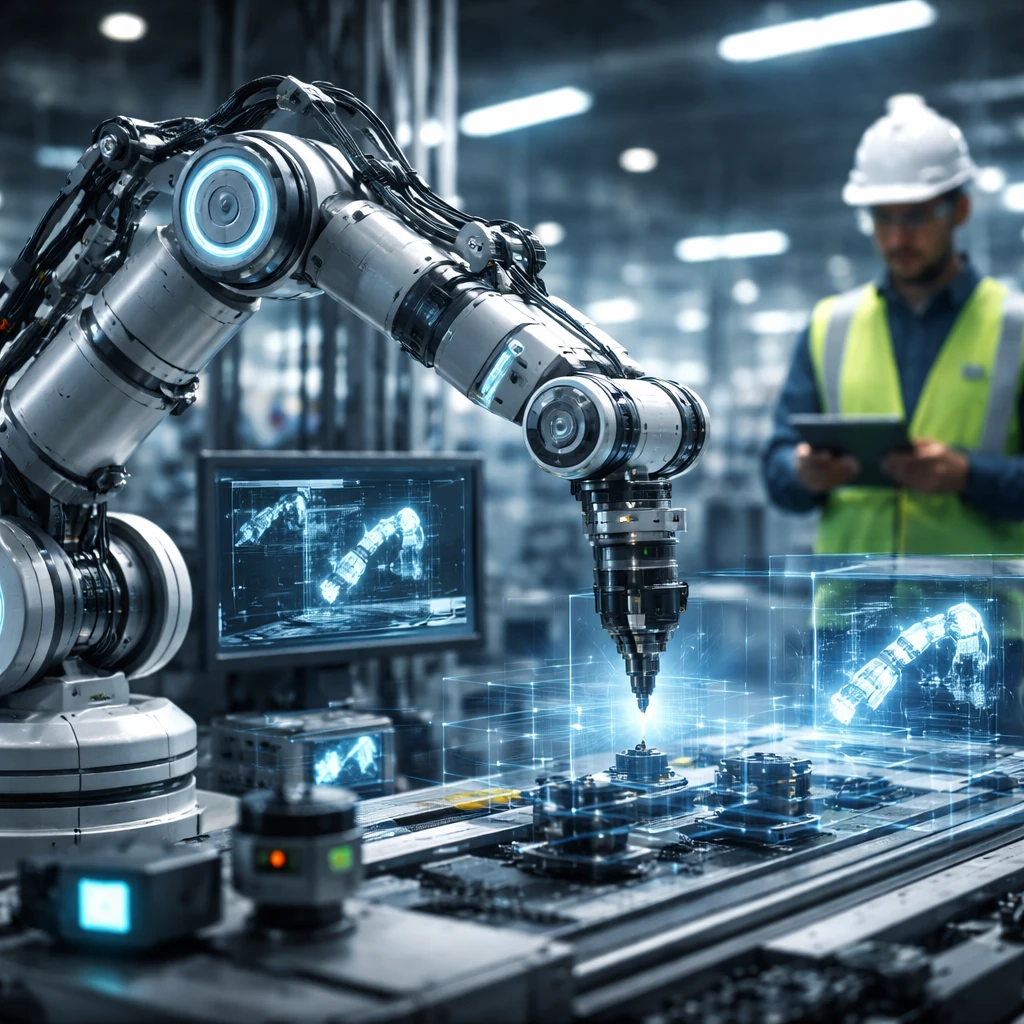
Industrial robots have accelerated in adoption over recent years, with momentum increasing sharply since roughly 2020 as factory automation evolves from rigid, fixed-path systems to more adaptable and intelligent configurations. That first evolution - a shift away from pre-programmed paths toward real-time, flexible path planning - enabled robots to broaden their responsibilities on production lines. Bernstein analysts note this transition opened opportunities for tasks such as machine tending, palletizing and smart welding, and it established a foundation for wider use across manufacturing operations.
Yet Bernstein cautions that flexible path planning by itself may not sustain above-single-digit growth indefinitely. Analysts argue the industry needs a further step: the move from flexible path planning into complex task planning. This second phase applies higher-level "brain" capabilities to industrial robots, allowing them to sequence long operations, manage activities requiring fine dexterity, handle soft or deformable materials, and support deeper interactions both between machines and between machines and people.
According to analysts led by Jay Huang, the absence of these more sophisticated uses would likely cause industrial robot growth to decelerate materially. With both flexibility in motion paths and enhanced task planning in place, Bernstein projects a ten-year compound annual growth rate of 12% for global industrial robot shipments, and expects strong demand to extend well beyond that horizon.
Bernstein frames the technical advance enabling this next phase as "physical AI." Rather than characterizing it as a single new class of "AI robots," the analysts describe physical AI as a multilayer ecosystem built around traditional industrial robots. Key components of that ecosystem include the robot hardware and its digital twin, task and path planning software increasingly driven by multimodal AI models, a range of sensors that collect physical data from the robot and its surroundings, and digital representations of the physical environment able to simulate interactions governed by real physics.
The analysts highlight several clarifying points about how physical AI changes the competitive and operational landscape. First, enhancing robots with a "brain" and a simulated "world" does not replace established manufacturers. High-precision motion control algorithms that run on existing robots remain essential, and the new intelligence layers are additive rather than substitutive.
Second, Bernstein emphasizes that the "brain" and the "world" tend to be distinct layers frequently served by different providers. This separation implies an environment where robot makers may extend into higher-level software while also pursuing partnerships, open platforms and simulation tools to integrate complementary capabilities.
Third, the rising need for richer physical data is likely to drive substantial demand for sensors. That demand will cover both vision-based technologies and non-vision modalities such as tactile sensing, because more detailed input from the real world becomes necessary for reliable task planning and world modeling.
Bernstein names Fanuc Corp. (TYO:6954), Keyence (TYO:6861), and Mech-Mind as companies positioned to benefit from the onset of physical AI as it reshapes the next stage of industrial automation. The analysts suggest that as robots gain more capable planning and world models, industries and processes with low current robot penetration could see adoption narrow toward higher levels of automation.
Context and implications
For manufacturing sectors and markets tied to industrial automation, the advancement to complex task planning represents a potential inflection point. If physical AI delivers on its promise, it could enable robots to take on roles previously considered too intricate for automation, expanding addressable use cases across production lines and supply chains.