
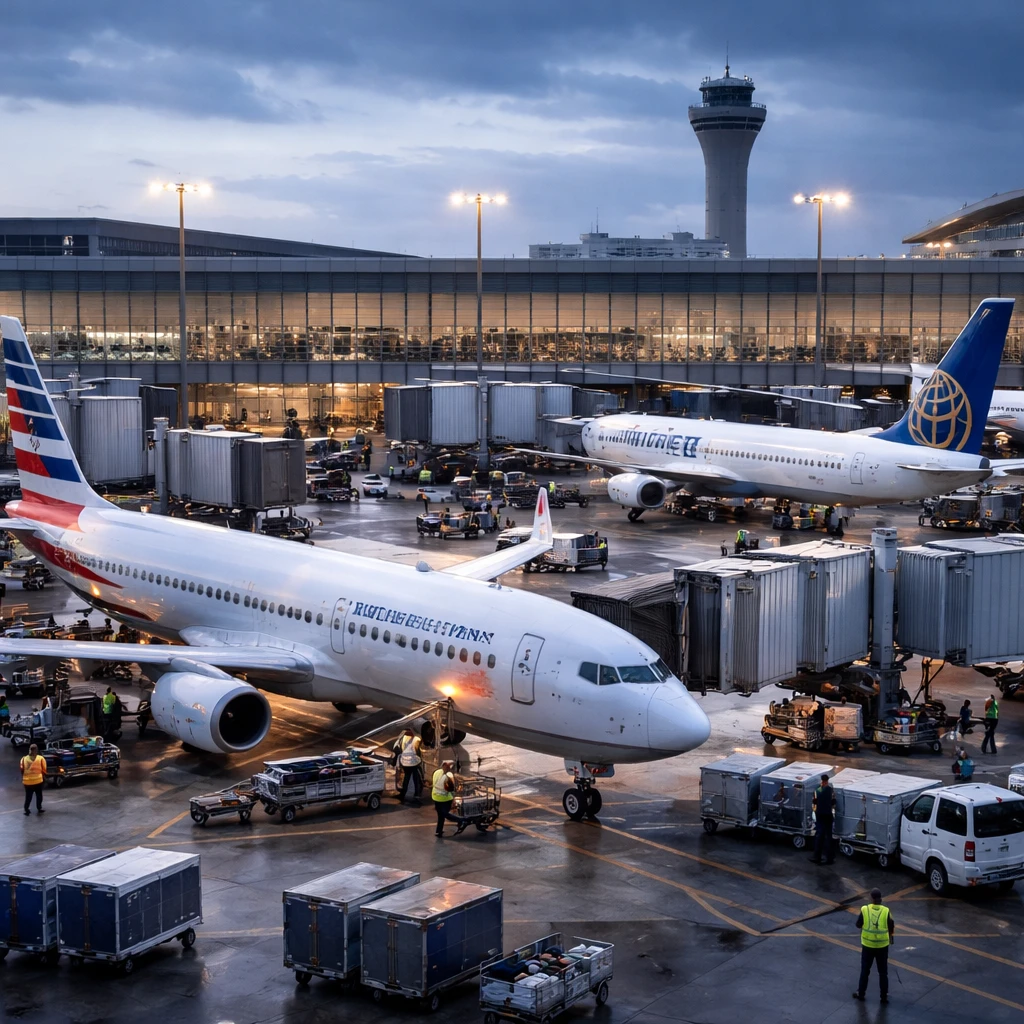
American Airlines is attempting to demonstrate to investors that it can close a persistent profitability gap with its largest rivals while sustaining a turnaround into 2026. At the center of that effort is a rising competitive confrontation with United Airlines at Chicago’s O’Hare International Airport, a market where gate allocation and schedule intensity materially shape the economics of service.
The Texas-based carrier has laid out a dual play: continue upgrading premium cabins and customer-facing products while scaling up its flying from O’Hare to capture more local demand. That approach requires balancing investment and operational discipline - improving services and network breadth without allowing a ramp-up to undermine reliability or margins.
Analysts caution the strategy contains real risks. If the Chicago expansion turns into a lengthy margin compression, the earnings improvement American expects in 2026 could be undercut. For Chief Executive Robert Isom, the O’Hare push comes amid heightened scrutiny from labor groups following recent operational disruptions, so execution in Chicago carries both financial and workforce-management stakes.
Financial context and competitive gap
American has lagged Delta Air Lines and United on adjusted pre-tax profitability for some time. On an adjusted pre-tax basis in 2025, American generated $352 million, a fraction of Delta’s about $5 billion and United’s $4.6 billion. Market response has reflected that underperformance: American’s shares have fallen about 14% over the past year, compared with gains of roughly 3% for Delta and 1% for United.
Company executives attribute a portion of last year’s shortfall to American’s high exposure to a softer domestic market, broader economic uncertainty and a federal government shutdown that affected bookings. At an employee town hall after the company’s most recent earnings release, Chief Financial Officer Devon May told staff it was "actually pretty amazing" that American managed to post any profit at all, according to an audio recording of the meeting.
Despite those headwinds, Isom has sought to reassure employees that the turnaround strategy is gaining traction. "We will deliver on producing what I hope is a year of solid profitability … and really making our company more valuable," he told workers.
Why Chicago matters
Chicago is a particularly consequential battleground. A Deutsche Bank analysis cited by company and market observers estimated United generates about $10 billion of annual revenue tied to Chicago, compared with just over $5 billion for American. The same analysis put United’s 2025 operating margin in the Chicago market at about 5%, versus an estimated negative 9% to negative 10% for American.
United’s chief executive, Scott Kirby, told analysts last month the airline earned about $500 million in Chicago in 2025 while American lost a similar amount, and he warned those losses could swell to $1 billion this year. American has rejected those calculations as "inconsistent" and "unsubstantiated," and said it expects Chicago to return to the average profitability of its hub network, though it has not provided a timeline for that recovery.
In public comments to Reuters, CFO Devon May said American is restoring its pre-pandemic scale at O’Hare and that the ramp-up has driven roughly 20% growth over the past nine months in its frequent-flier program, co-branded credit-card sign-ups and local customers. Those customer metrics are central to the carrier’s argument that the investment in capacity and product will yield better yields over time.
Gates, capacity and competitive dynamics
Control of gates and schedule breadth is increasingly a determinant of competitive success, particularly among business travelers. At large U.S. hubs there is typically a clear hierarchy - Delta dominates Atlanta, United controls Houston and American leads Dallas - but Chicago stands out as one of the few hubs where two legacy carriers still compete at scale.
Gate access at O’Hare remains a strategic lever because the city’s reallocation process rewards utilization. Cirium data show United controls roughly half of scheduled flights at the airport, with American operating about a third. American’s commercial leadership has described its planned network build at O’Hare as an "audacious schedule," an explicit bet that a larger footprint will strengthen its position in future gate reviews.
United has been expanding as well, aiming to blunt American’s gains. The dynamic is likely to intensify: bankrupt Spirit Airlines has sought court approval to transfer two O’Hare gates to United, after shifting two others to American in December. Deutsche Bank projects departures for both carriers at O’Hare will rise about 23% this summer from a year earlier, and cautions that such a spike in capacity could weigh on their results in the Chicago market.
That increase in capacity raises a structural risk: if competition at O’Hare morphs into a sustained price confrontation, fare pressure in Chicago could ripple into other markets. Conor Cunningham, an analyst at Melius Research, warned the largest risk for American in 2026 is a full-on fare war in Chicago that gradually impacts other routes. "If history is any guide, competitive skirmishes are rarely contained," he said.
Operations, labor and reliability
Operational strain is a central concern as both airlines expand service. Airport authorities report congestion remains manageable, but labor leaders and internal critics point to vulnerabilities exposed by recent weather-related disruption. After a winter storm last month triggered widespread cancellations and a difficult recovery, unions accused management of being unprepared.
Flight crews and other staff reported chaotic conditions during the disruption, including crews struggling to find hotel rooms and in some cases sleeping in terminals. The pilots’ union spokesperson, Dennis Tajer, said, "There’s no strategy to put American back anywhere near on top, let alone close the gap on Delta and United." The flight attendants’ union added to worker pressure, telling members last week, "American’s workforce is not the problem. Leadership is," and calling the carrier’s lagging results a "pattern of failure" under Isom and the board.
Company executives are hoping the competitive fight helps galvanize employees. Chief Commercial Officer Nathaniel Piper framed the schedule expansion as a rallying objective, telling staff the plan is an "audacious schedule" intended to improve American’s standing in gate allocation. At the town hall Piper added, "We can win in Chicago, team, but it’s got to be a big team effort," and argued a shared opponent can be unifying: "Common enemy is one of the things that throughout life and history has been a very effective rallying cry."
American executives say customers have responded strongly to the expanded schedule and that the company is approaching operations cautiously to avoid repeat disruptions. May told Reuters the airline is taking a "very thoughtful" approach aimed at running the operation smoothly as capacity grows.
What is at stake
The outcome of the O’Hare confrontation will have direct consequences for American’s profitability profile, employee relations and strategic positioning. If American can scale without eroding reliability and if the market returns to the average hub profitability the company cites, the airline could make progress toward narrowing the profitability gap with rivals. If, instead, Chicago becomes a prolonged margin squeeze or a flashpoint for operational breakdowns, the carrier’s 2026 earnings outlook could be weakened and labor tensions could deepen.
For now, the contest at O’Hare is one of the most visible measures of whether American’s simultaneous push for product investment and capacity growth can be executed without sacrificing reliability or financial performance.