
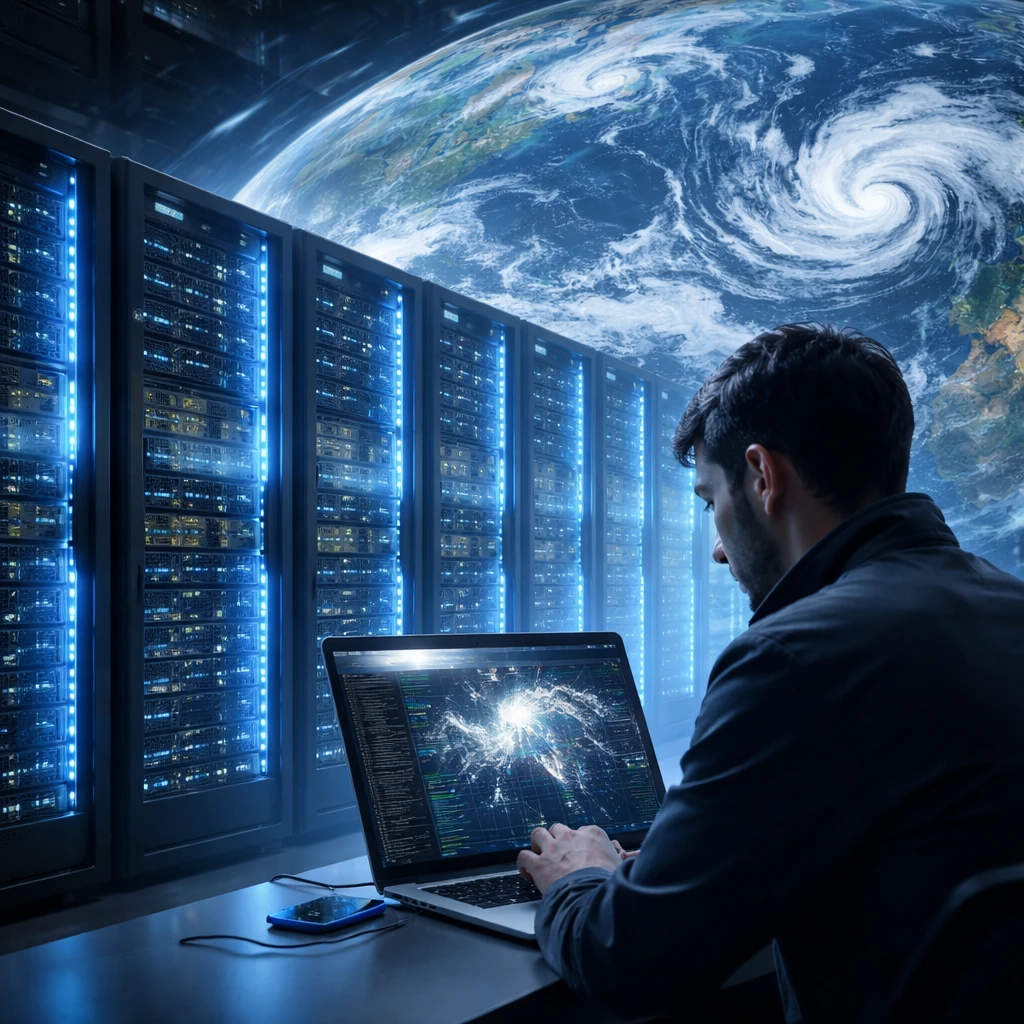
Nvidia unveiled a new lineup of open weather AI models and supporting tools at the American Meteorological Society's Annual Meeting on Monday, positioning the package as the world's first fully open, accelerated weather AI software stack. The company says the Earth-2 family is intended to broaden access to advanced weather and climate prediction capabilities for researchers, startups, developers, enterprises and government agencies worldwide.
The Earth-2 portfolio is designed to speed up all stages of forecasting - from pre-processing initial observation data to producing global forecasts out to 15 days or generating short-term, local storm predictions. Nvidia states this AI-centric workflow reduces the computational time and costs associated with conventional physics-based forecasting systems that typically run on supercomputers.
The newly announced components include Earth-2 Medium Range, built on Nvidia's Atlas architecture; Earth-2 Nowcasting, powered by StormScope; and Earth-2 Global Data Assimilation, which uses HealDA. These additions complement existing models in the Earth-2 stack, such as Earth-2 CorrDiff and Earth-2 FourCastNet3.
Early adopters and evaluators span public weather services, private weather-tech firms, energy producers and financial risk teams. AI weather provider Brightband is operating Earth-2 Medium Range to publish daily global forecasts. The Israel Meteorological Service reports it uses Earth-2 CorrDiff in operations and that the model delivers a 90% reduction in compute time relative to traditional methods.
Energy companies including TotalEnergies, Eni, GCL and the Southwest Power Pool are testing or implementing Earth-2 models to enhance forecasting tied to their operations. Financial firms such as S&P Global Energy and AXA are applying the technology for risk assessment and scenario generation.
Availability varies across the stack. Earth-2 Medium Range and Earth-2 Nowcasting are accessible now through NVIDIA Earth2Studio, Hugging Face and GitHub. Nvidia expects Earth-2 Global Data Assimilation to be released later this year.
The offering is presented as a way to democratize access to accelerated weather AI tools while reducing reliance on large-scale physics-model compute runs. Organizations quoted by Nvidia and those deploying the stack highlight reduced compute time and broader operational use cases, from daily global forecasts to enterprise risk modeling.
Key points
- Earth-2 is described as the first fully open, accelerated weather AI software stack, aiming to make advanced forecasting tools widely available.
- The new models, including Medium Range (Atlas), Nowcasting (StormScope) and Global Data Assimilation (HealDA), join existing Earth-2 models like CorrDiff and FourCastNet3.
- Adoption spans weather providers, energy companies and financial firms, with reported compute-time reductions and operational deployments.
Risks and uncertainties
- Timing of full availability - Earth-2 Global Data Assimilation is expected later this year, so complete stack access is not immediate.
- Operational validation - while several organizations are testing or implementing Earth-2 models, wider operational performance and long-term cost impacts across different users and use cases remain to be seen.
- Integration and adoption hurdles for enterprises and agencies - implementing a new AI-centric forecasting stack may require changes to existing workflows and infrastructure.