
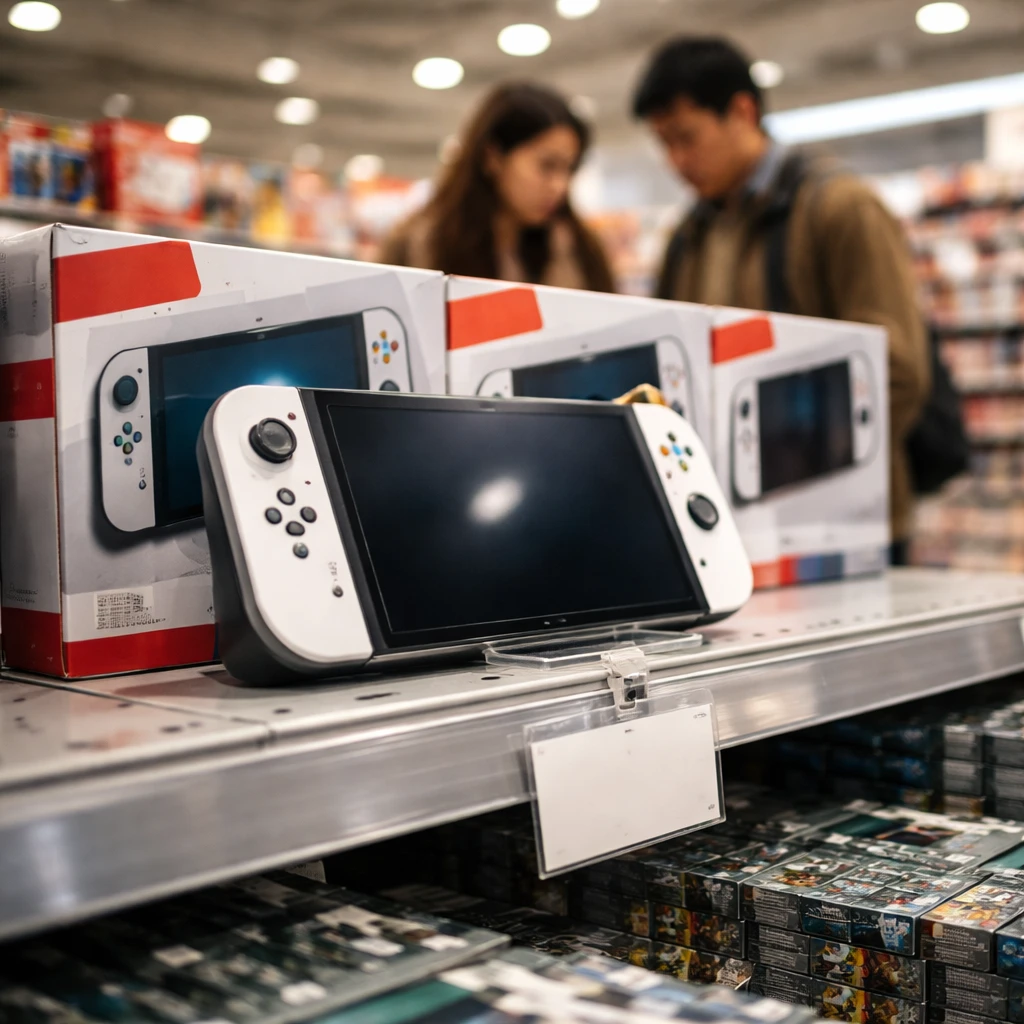
Nintendo on Monday suffered a heavy sell-off after reporting annual results that, while showing strong year-on-year gains, failed to meet market expectations and were followed by a cautious forecast for the coming fiscal year.
Shares dropped as much as 9% to 6,895.0 yen and were among the weakest performers on the Nikkei 225, even as the broader index rose 0.8%.
Earnings and guidance
For the year ending March 31, Nintendo recorded operating profit of 360 billion yen, an increase of nearly 28% from the previous year. That result was supported by an almost 100% rise in net sales. Despite the advance, the operating profit figure did not reach market expectations.
Looking ahead, the company projected operating profit for the current fiscal year at 370 billion yen, notably short of market forecasts of 480 billion yen. Nintendo also anticipates sales will decline 11.4% year-on-year to 2.05 trillion yen.
Switch 2 outlook and pricing impact
Nintendo said it expects softer demand for its new console, the Switch 2, as a result of higher retail prices that are being put in place to reflect rising component costs. The company plans to raise the Switch 2 retail price in Europe, the United States and Japan by 7% to 20% later this year, citing elevated costs for components, and singling out memory as a key driver.
Management guided fiscal 2027 Switch 2 unit sales to 16.5 million, below the 19.86 million units sold in the prior year. At the same time, Nintendo expects videogame software sales to gain, but warned that margins on the Switch 2 will compress as a result of higher component expenses.
Product lifecycle and supply constraints
Sales of the original Switch are forecast to diminish through the current year as the installed base shifts to the new platform. The Switch 2, which produced a blockbuster launch and was among the fastest-selling consoles at the time of release, is now expected to lose momentum because of the planned price increases.
The company attributed the higher component costs primarily to a severe shortage of memory chips, driven by outsized demand from the artificial intelligence sector. Nintendo also said its slate of upcoming first-party game releases in 2026 was generally underwhelming, while noting a number of third-party titles scheduled for release in the months ahead.
Market reaction
Investors reacted quickly to the earnings miss and the weaker-than-expected guidance, sending the stock sharply lower on Monday. The combination of a reduced profit outlook, anticipated sales declines, and margin pressure on the Switch 2 informed the market sell-off.
As the company navigates higher component costs and the transition to its new console, Nintendo faces a period of adjustment in both hardware sales and profitability.