
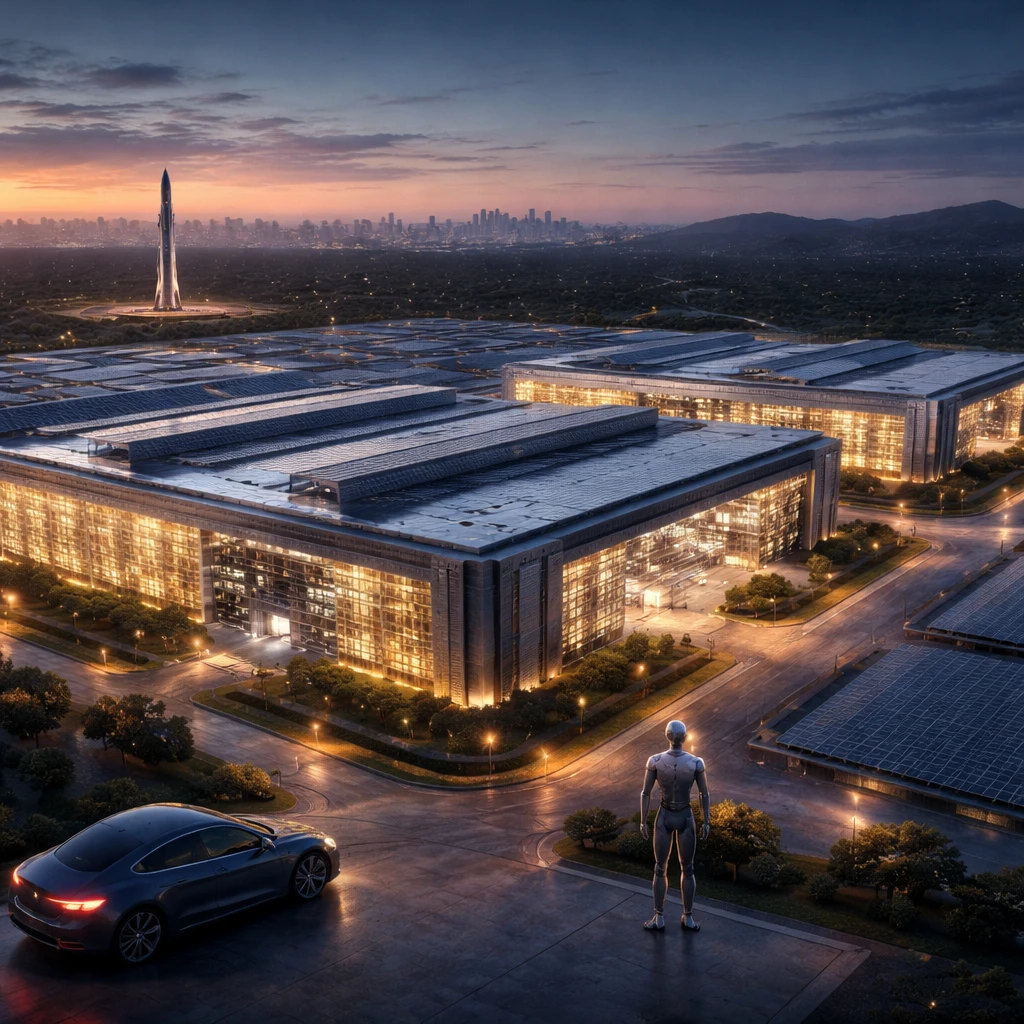
Elon Musk said on Sunday that SpaceX and Tesla plan to build two advanced semiconductor fabrication facilities at a large site in Austin, Texas. According to Musk, one plant would concentrate on chips for vehicles and humanoid robots, and the other would be dedicated to supplying AI compute for data centers in space.
The proposed cluster, described by Musk as "Terafab," is pitched as an effort to move into large-scale compute production. Musk says the complex would ultimately produce up to 1 terawatt of compute annually - a figure roughly 50 times the current global supply, which the discussion places at about 20 gigawatts.
Tesla and SpaceX plan an initial Austin facility engineered to handle logic, memory, packaging and mask production. Musk indicated that such capabilities would enable faster design iteration cycles. The company intends to prioritize edge inference chips for Tesla vehicles and humanoid robots while also developing higher-performance compute tuned for space applications.
Analysts wrestling with the announcement emphasize both the magnitude of the ambition and the uncertainty around execution. Stacy Rasgon, an analyst at Bernstein, noted that Musk plans to continue purchasing chips from existing suppliers but observed that scaling to 1 terawatt is far beyond what current suppliers appear willing to attempt. Rasgon framed that reluctance as a driver for Musk to pursue the Terafab program himself.
Barclays analyst Dan Levy described chips as central to Tesla's growth strategy over the coming decade, calling them "the pillar" underpinning the company’s AI aspirations. Yet Levy and Rasgon both flagged substantial hurdles that make the project a high-risk endeavor in the near and medium term.
Bernstein provided a technical scale estimate to clarify what the stated target would entail. Delivering 1 terawatt of compute annually, the firm estimated, would translate into approximately 7 million to 18 million 300mm wafer starts per month, largely driven by demand for high-bandwidth memory (HBM). Those wafer-start requirements, in turn, would equate to an estimated 140 to 360 new leading-edge fabrication facilities. Bernstein’s calculation implies capital expenditure in the range of $5 trillion to $13 trillion - amounts the analyst noted are comparable to or exceed the scale of the current global semiconductor manufacturing base.
Musk said that about 80% of the planned compute output would serve space applications, with the remaining 20% dedicated to terrestrial uses. He also outlined an annual production target of roughly 1 billion chips, supported by substantial infrastructure elements he envisions including solar power, launch capability and robotics.
Despite the grand scale, analysts expressed skepticism about the project's odds of achieving full stated scale. Rasgon called a true Terafab "a stretch," given current compute paradigms, and suggested two possible pathways: joint ventures with existing manufacturers if Musk finds it impractical to realize the project alone, or the possibility that Musk may pursue unconventional technical approaches to change the economics or feasibility of mass compute production.
Levy characterized the initiative as a "show-me story," expecting more modest, smaller-scale ambitions in the near to mid-term horizon. He cited several execution risks including limited manufacturing experience, technological complexity and lengthy equipment lead times. Levy compared the Terafab announcement to past grand production targets announced by Tesla in other technologies that have not yet been met, noting that the announcement does not by itself resolve questions about how concrete the plans are.
For the broader semiconductor industry, immediate practical impacts appear limited. Rasgon said the announcement is unlikely to do more than generate hype in the short term. Nonetheless, he and other observers noted that if the buildout were pursued, it would represent a major demand driver for semiconductor equipment suppliers - a dynamic that could materially boost the semicap segment.
Rasgon also acknowledged the potential competitive implications of Musk making his own chips. He suggested that while incumbents might initially worry about a new entrant, an environment with substantially greater compute demand would likely expand market opportunity broadly, creating more room for multiple players.
Context and takeaways
- The proposal centers on a dual-fab approach in Austin: one plant geared toward automotive and humanoid robotics chips, the other toward space-focused AI compute.
- Analyst estimates place the scale of the target well beyond current global production, with significant wafer, fab count and capital requirements implied.
- Analysts welcome the strategic emphasis on chips for Tesla's growth but highlight substantial execution, experience and supply-chain challenges that leave the plans unproven.