
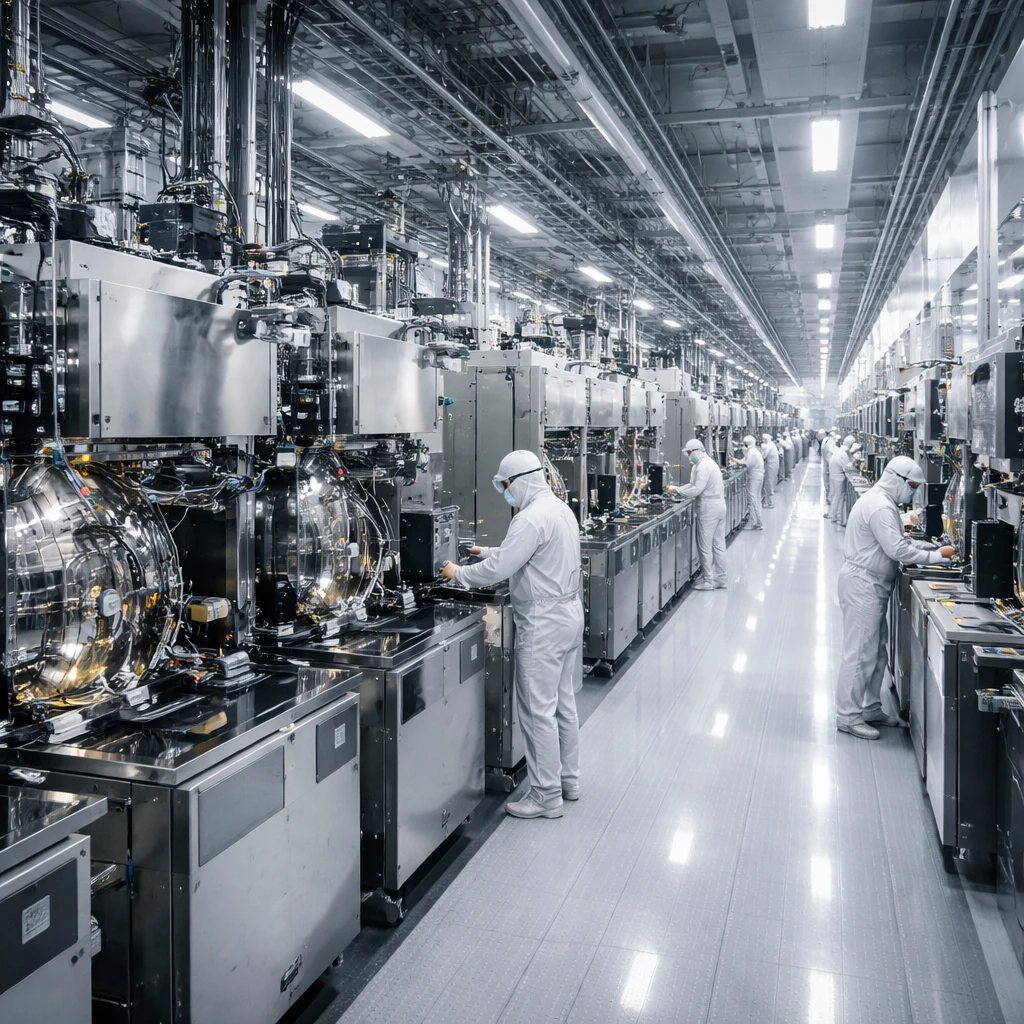
Mizuho semiconductor coverage warns that Elon Musk’s outline for a large-scale in-house semiconductor complex - dubbed "Terafab" - could be a meaningful narrative for companies that supply wafer-fab-equipment (WFE).
In a note, Mizuho TMT analyst Jordan Klein described the initiative as having "big semi fab spending plans" to support custom chips for Tesla, xAI and SpaceX. The note characterises the effort as sizable in both capital expenditure and the volume of new production tools that would be required.
Mizuho highlights two headline-scale technical metrics cited in the plan: estimated power requirements that could approach a terawatt, and demand for around 1 billion NVIDIA GPUs per year. The bank says the program is expected to be phased, with an early tranche of approximately $20 billion earmarked for new equipment in 2026.
The analysis stresses that a key driver for Musk pursuing in-house manufacturing is capacity constraints with current foundry partners. Klein notes that Taiwan Semiconductor Manufacturing Co. (TSM) is effectively sold out, while Samsung is already producing Tesla’s next-generation chip. According to the note, neither foundry would commit to large-scale capacity expansion "for data centers in space projects this early," which is part of the rationale offered for bringing production in-house.
Mizuho argues that the immediate market reaction may be more about investor perception than about near-term WFE revenue forecasts. Nevertheless, the firm lists specific equipment suppliers that could see demand if Terafab advances through funding and final planning.
Among those named, ASML is identified as a primary potential beneficiary due to the expected reliance on extreme ultraviolet (EUV) lithography for sub-2nm node capability. KLA is cited as being well positioned, and the note says Musk’s stated needs for extensive etch, deposition and advanced packaging could also support Applied Materials (AMAT), Lam Research (LRCX), Tokyo Electron (TEL) and Teradyne (TER).
Klein frames the project as "another potential call option for upside to WFE in [the] coming 3+ years," with the caveat that outcomes depend on financing and the final structure of the plans.
Contextual note - Mizuho’s commentary links the Terafab concept to potential supplier demand but does not provide definitive commitments or firm orders from Musk’s companies. The analysis emphasises a combination of technical scale and uncertainty around funding and implementation.