
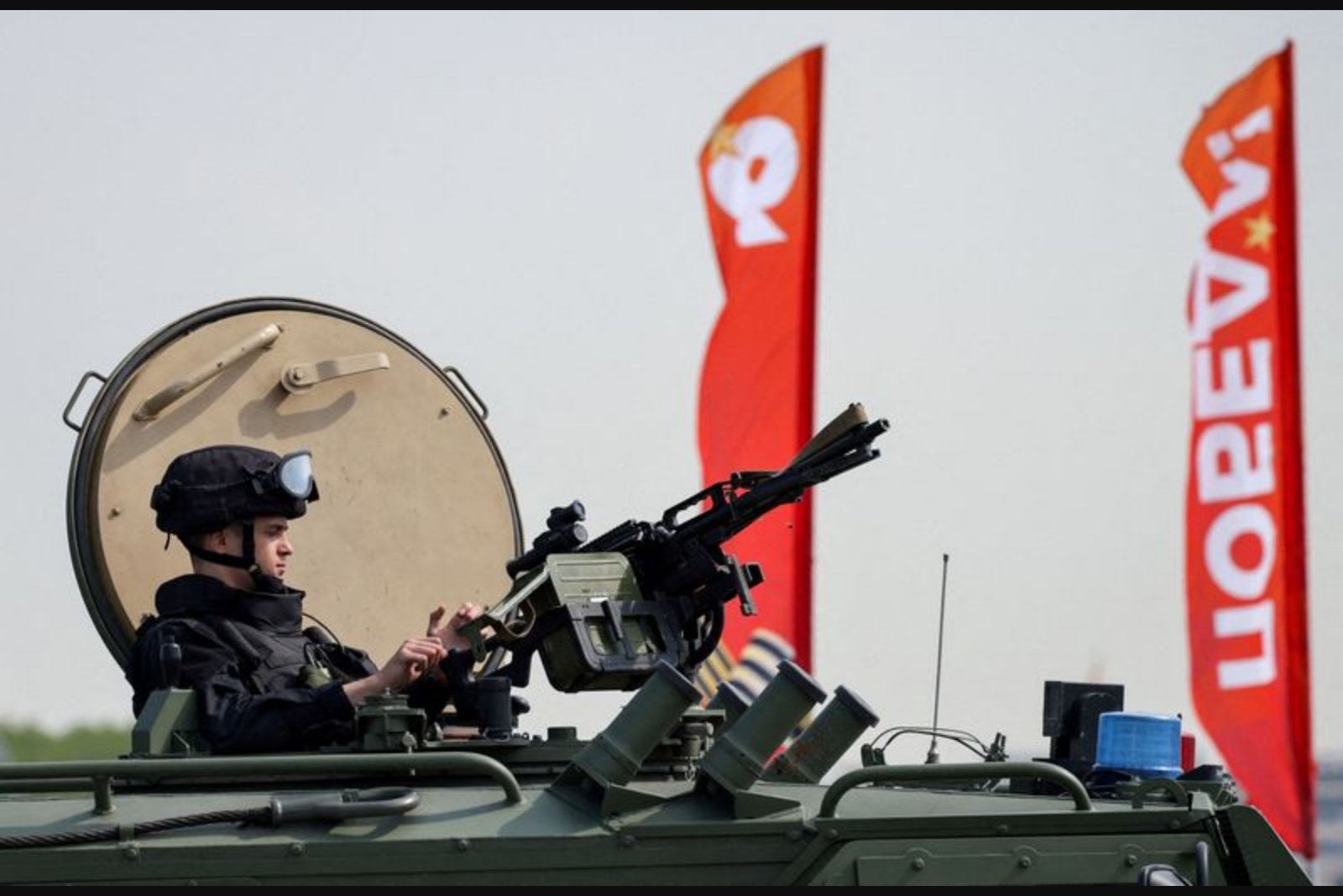
MOSCOW - Russia conducted a markedly scaled-back Victory Day parade on Red Square on May 9, removing the usual display of heavy military hardware amid worries of an attack tied to the war in Ukraine. The event, which commemorates the Soviet victory over Nazi Germany, proceeded without tanks or other equipment rolling across the cobbles, though soldiers still marched, fighter jets performed flyovers, and President Vladimir Putin gave a speech before laying flowers at the tomb of the Unknown Soldier.
The decision to limit visible military hardware reflected acute security concerns. "In general, everything is as usual, except for the demonstration of military equipment," Kremlin aide Yuri Ushakov told reporters, summarizing the main change to what is normally Russia’s most grandiose national ceremony.
Russian officials have publicly warned that any attempt by Kyiv to interfere with the event would prompt a substantial missile strike on the Ukrainian capital. Moscow also informed foreign diplomatic missions to prepare to evacuate their Kyiv staff should such an attack materialize. Ukraine’s President Volodymyr Zelenskiy said his country’s actions on May 9 would depend on developments the day before, accusing Moscow of violating its own ceasefire.
Security measures around the capital were robust. Moscow is protected by rings of air defenses and electronic barriers intended to confuse and bring down drones and missiles approaching the city. The capital and its surrounding region are home to roughly 22 million people, a concentration officials said underscoring the stakes for any aggressor contemplating an attack on the city.
Historical backdrop and commemoration
The parade marks Russia’s principal day of remembrance for the so-called Great Patriotic War of 1941-45, when the Soviet Union fought Nazi Germany. After the German invasion in 1941, Soviet forces eventually pushed into Berlin, where Adolf Hitler took his own life and the red Soviet Victory Banner was raised over the Reichstag in May 1945. Nazi Germany’s unconditional surrender took effect at 11:01 p.m. on May 8, 1945, a moment observed as Victory in Europe Day by Britain, the United States and France. In Moscow it was already May 9, which is why the date is commemorated there as Victory Day.
This year’s ceremony was held under the shadow of the ongoing war in Ukraine, a conflict that has proven persistent and costly. The fighting has killed hundreds of thousands of people, reduced large areas of Ukraine to ruins, and placed severe strain on Russia’s economy. Officials and commentators point to a depletion of national resources and a deterioration in relations with Europe to levels comparable to the darkest moments of the Cold War.
Domestic unease and official responses
The spectacle of Victory Day came amid heightened unease in Moscow about the war’s trajectory and its domestic consequences. Igor Girkin, a jailed pro-war Russian nationalist and former Federal Security Service officer who has criticized the Kremlin’s handling of the conflict, posted a message on Telegram warning that "the crisis is still deepening gradually, but any sharp movement can send the economy (and not only the economy) into a tailspin." He used a naval analogy to suggest that Russia’s leaders were more concerned about being "kicked out of their cabins than about a shipwreck."
Kremlin spokesman Dmitry Peskov pushed back against reporting in Western media, including CNN, that protective measures around President Putin had been increased because of fears of a coup or assassination. Russian officials have dismissed allegations of a coup plot as nonsense.
Attendance and diplomatic presence
In contrast to two decades ago, when President Vladimir Putin sat alongside then-U.S. President George W. Bush and other world leaders at a Moscow parade, foreign attendance this year was narrower. Delegations present included Belarusian President Alexander Lukashenko, Malaysia’s King Sultan Ibrahim and Laos’ Prime Minister Thongloun Sisoulith.
Implications for security and the economy
The curtailed display of heavy armaments on Red Square reflected the immediate security calculus facing Russian authorities. Officials emphasized air defenses and electronic countermeasures as primary protections for the capital. At the same time, critical commentary and concern over the economic and political fallout from the ongoing war were evident in public remarks and social media posts by prominent figures.
The parade proceeded without the rolling armored columns that have long been a feature of Victory Day, leaving the symbolic and human elements of commemoration in the foreground. Soldiers paraded past Lenin’s Mausoleum, aircraft crossed the skyline above the Kremlin, and the formal acts of remembrance and presidential participation were carried out under tighter-than-usual security for the city of 22 million people and its environs.
Reporting on the event noted the combination of military caution and public ceremony, the unresolved dynamics of the war in Ukraine, and the domestic unease that colors official narratives and critical commentary alike.