
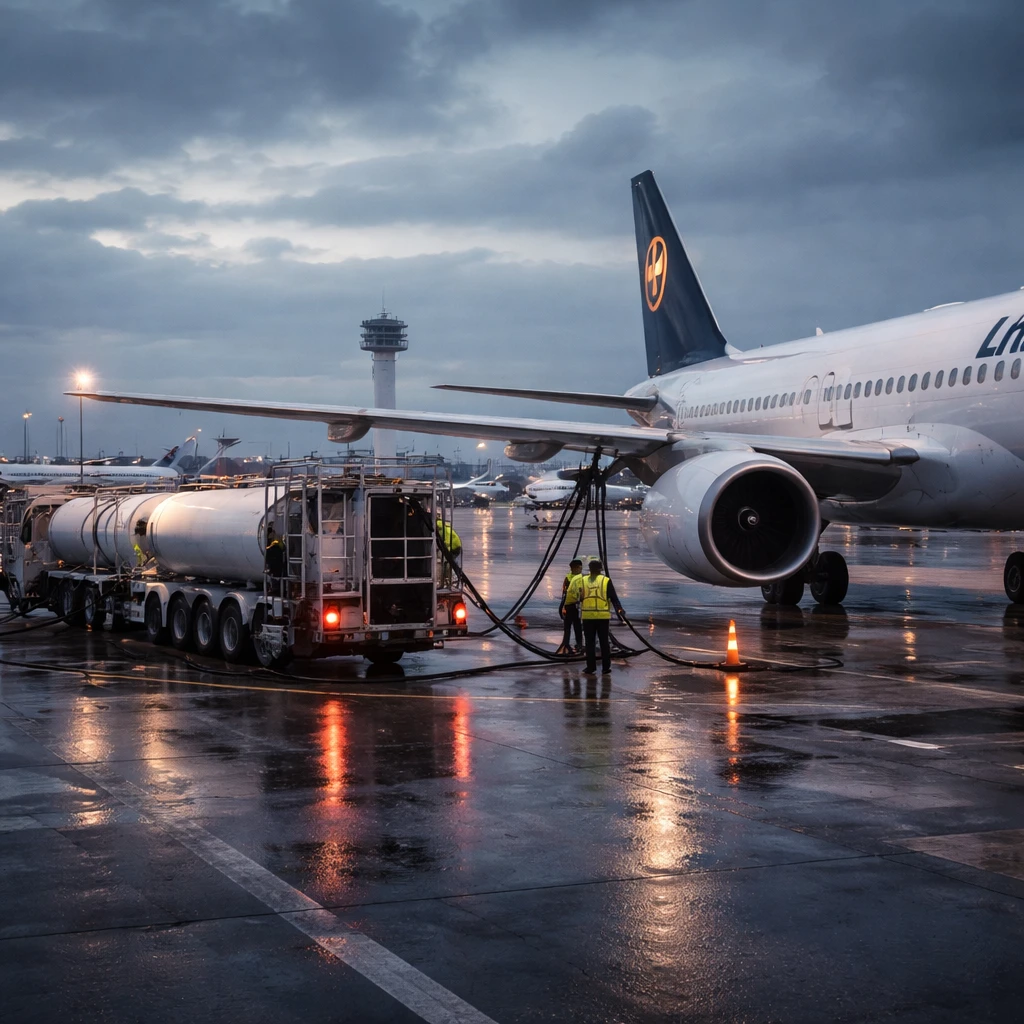
Morgan Stanley has moved Deutsche Lufthansa AG (ETR:LHAG) down one notch in its coverage, changing its recommendation from "overweight" to "equal-weight" and citing earnings that now look weaker relative to competitor airlines amid rising jet fuel costs.
Shares of the German carrier slipped 3.8% at 04:38 ET (08:38 GMT) following the note.
In its review, the brokerage flagged Lufthansa's comparatively less favorable fuel hedging position versus peers and said it now anticipates a larger hit to profitability. Morgan Stanley lowered its 2026 EBITDA forecast for Lufthansa by 17%, versus reductions of 6% for IAG and 10% for Air France-KLM.
The downgrade follows the bank's decision to lift its fuel-price assumptions, a move based on the jet fuel forward curve and ongoing supply constraints. Morgan Stanley described refined product markets as remaining tight, adding that jet fuel deficits are "structurally harder and slower to resolve," which postpones any return to normal pricing.
For Lufthansa specifically, the elevated fuel backdrop is projected to create a €1.6bn fuel-cost headwind, part of a total expected hit that translates into an €800m reduction in FY26 EBITDA versus prior forecasts - a change Morgan Stanley equates to roughly a 17% downgrade for the year.
Operational pressures also factor into the revised outlook. Morgan Stanley now expects load factors to weaken by about 2% year-on-year beginning in the third quarter of 2026. Capacity growth for Lufthansa is forecast to slow to 2.5%, down from prior guidance of 4%.
Pricing dynamics are expected to provide only partial relief. Passenger yields are projected to rise by +7%/+11%/+11% in 2Q/3Q/4Q26, respectively, but Morgan Stanley judged those increases insufficient to fully counteract the impact of higher jet fuel costs.
The downgrade reflects not only the absolute hit to Lufthansa's earnings but its relative position within the sector. While the report noted that flag carriers generally have more scope than low-cost operators to pass through higher costs to fares, Lufthansa was singled out as underperforming peers due to its weaker hedging and the steeper cuts to its earnings outlook.
Despite the downgrade, Morgan Stanley pointed out that Lufthansa shares have fallen about 9% year-to-date, compared with roughly 16% declines for IAG and Air France-KLM, and described that gap as "a disconnect we view as unjustified."
More broadly, the brokerage raised its expectations for a prolonged period of higher jet fuel prices and trimmed sector profitability estimates accordingly - cutting sector EBITDA estimates by about 11% for flag carriers and about 16% for low-cost carriers - while also forecasting softer demand and declining load factors from late 2026.