
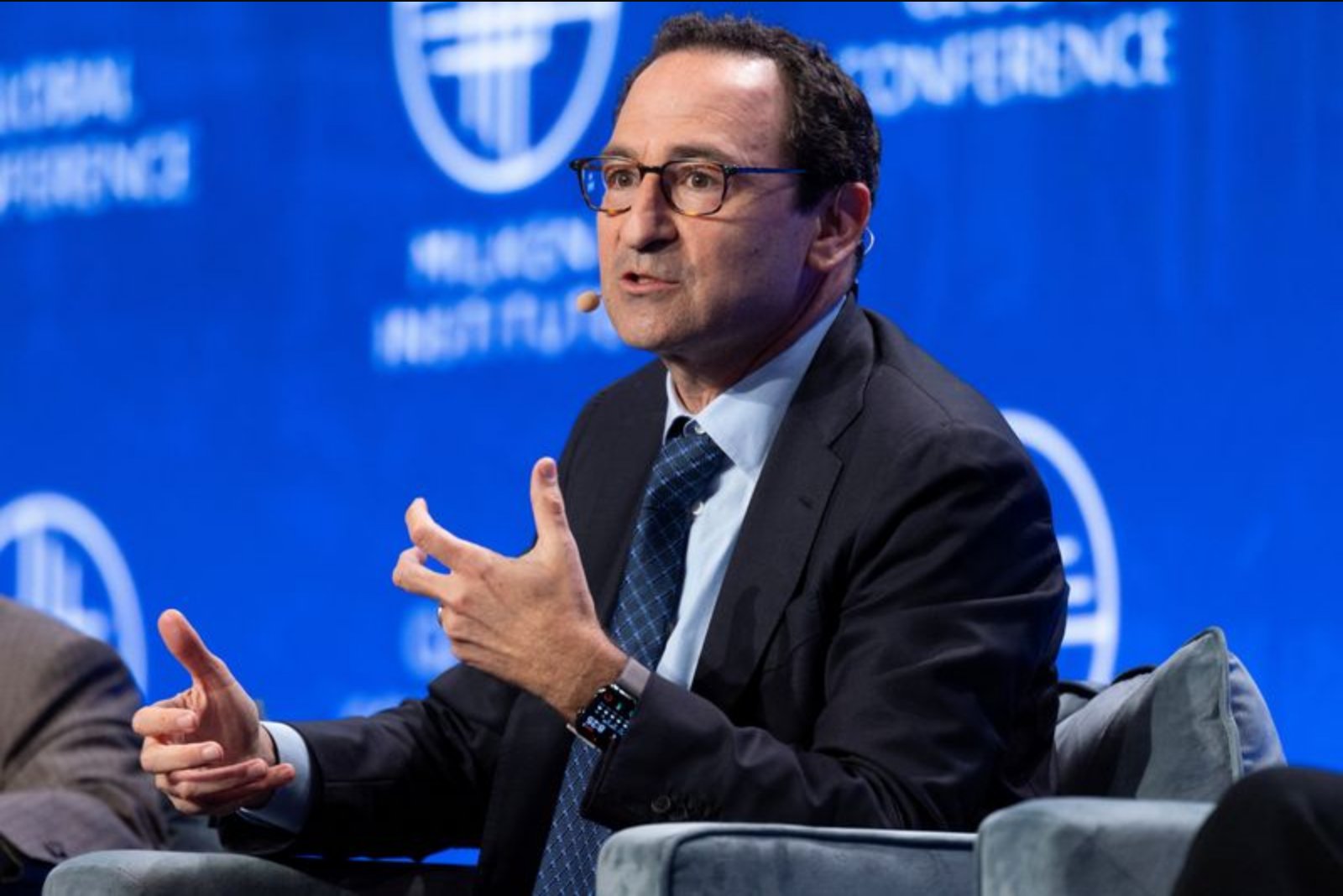
May 4 - Top global investors and corporate leaders gathered at the Milken Institute Global Conference in Beverly Hills on Monday to discuss a range of themes shaping markets: geopolitical tension, the evolving private credit landscape, the reorientation of capital flows and the economic implications of artificial intelligence. Participants addressed both the risks and the potential opportunities embedded in those trends.
Opening perspectives on resilience and geopolitics
Several speakers framed their remarks around recent geopolitical events and the market response. One participant emphasized the resilience of the U.S. and global economies despite repeated crises, and highlighted the role of careful navigation by certain Gulf states. In his comments, he said: "Now we have this war, which the UAE has done an extraordinary job navigating. Through each of those crises, the people in this room, all of us, would have said, 'Oh, I'm nervous. What's going to happen?' And yet the US economy and the global economy powered through, the markets powered through and my expectation is that will continue."
Private credit: scope, structure and market fit
Private credit drew sustained attention across sessions, with speakers urging attendees to look beyond narrow headlines. One executive cautioned against overstating issues tied to a small segment of business development companies, saying: "It's going to be a variety of private credit conversations. And so, for a few of us on the stage who have been asked about the private credit issues the last six to eight months, last eight weeks or whatever, it's such a small area of the BDCs (Business Development Companies)." He added that focusing narrowly on that subset misses "the big plot," namely the vast aggregate of private capital and a significant pipeline of companies that have chosen to stay private despite the traditional role of public markets in providing capital.
A sovereign investment executive described private credit as filling an important market need and predicted steady growth in the asset class, while noting that portfolio construction and emphasis on resiliency may require adjustment. His view was summarized in this remark: "Private credit is really interesting for the reason that it is filling a market need. Now, it may be that you have to design your portfolio a little bit differently. It may be that you want to look at resiliency, but it is inexorable that this asset class is going to grow and that it is doing okay as long as you're a good picker."
Another market leader argued that private credit acts as a distributor rather than a concentrator of risk, drawing a distinction with the conditions that precipitated the 2008 financial crisis. He said: "If you go back to 2008, why the system suffered was that it was banks that were at the center. Banks are concentrators of risk. All that risk was concentrated and a financial crisis turned into an economic crisis. Private credit is exactly the opposite, it is a distributor of risk."
Capital flow realignment and sovereign deployment
Speakers also highlighted large-scale capital moving from Gulf sovereign funds and state-linked investors to global markets. One chief executive described this as a major export of capital, noting: "The Iran war, and what that is triggering now, I believe will be a big realignment of capital flows. There's $3.2 trillion that the Gulf states and the various sovereign wealth funds have deployed now, and that has been an enormous export of capital to lots of people in this room, really, all over the world."
That observation underlined the conference backdrop: geopolitical shocks can prompt strategic redeployment by state-affiliated investors, with implications for funding availability across markets and regions.
AI: productivity potential versus labor disruption
Views on artificial intelligence split between optimism about productivity gains and concern over workforce disruption. One executive expressed optimism about AI-driven productivity and faster innovation, while rejecting scenarios of massive unemployment: "I think the real win (from AI) is when you see companies delivering better outcomes, innovating faster and actually being more productive. So I'm a buyer of the productivity story. I'm not a buyer of the, you know, we have massive unemployment. I just, I'm not an advocate of that scenario." He cautioned that some concerns are important but not necessarily systemic, and framed the current environment as a shift into a different phase of the credit cycle, which he viewed as healthy.
Another senior investor expressed caution about AI's impact on entry-level jobs and highlighted the lack of universal retraining infrastructure for workers in gig or independent contractor roles: "I think (AI is) wonderful, wonderful technology, but it will disrupt these entry-level positions. And then, are there really retraining programs for the gig economy? Probably not. They would have to do that on their own as independent contractors." That speaker also connected recent headlines about software exposure in debt markets to retail investor access and questioned whether certain instruments were structured for the liquidity demands they encountered.
Mergers, financing and opportunity
Looking ahead, a market strategist signaled an expectation of increased deal activity and suggested that current noise in private credit could create financing opportunities for investors positioned to fund prospective mergers and acquisitions. He said: "I would say we think the noise is overdone in private credit, but that will create an opportunity. There is an M&A wave coming. The financing of that M&A wave, especially given some of the noise, is going to enable some alpha to be generated by being the financier into that M&A market."
Participants at the conference repeatedly returned to a few connecting themes: private capital is reshaping how companies raise and access funding; large pools of sovereign capital are materially influencing global flows; and AI is simultaneously a source of productivity opportunity and a cause for labor market concern. The balance among those forces, speakers suggested, will affect portfolio construction, credit market structure and where financing opportunities arise.