
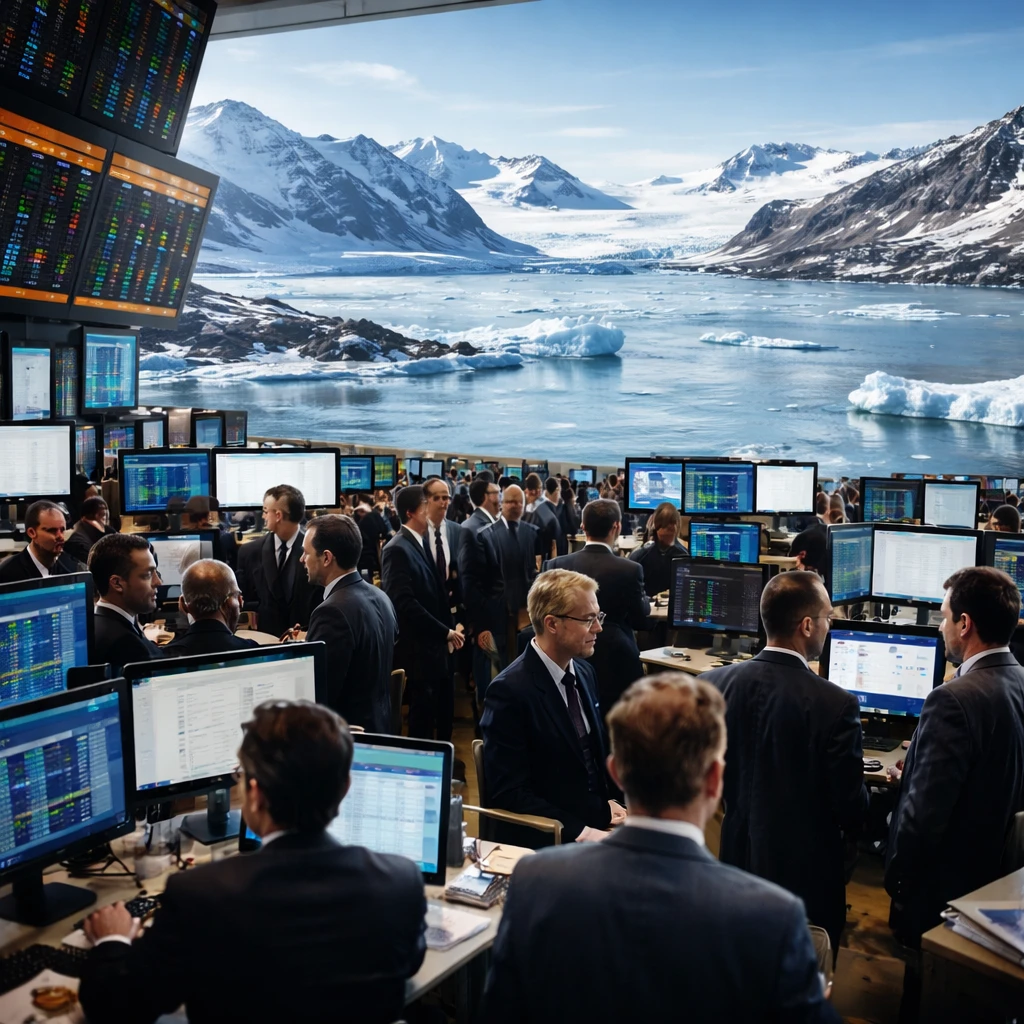
On Thursday, global financial markets displayed marked volatility after U.S. President Donald Trump publicly retracted earlier threats related to tariffs and the prospect of forcibly acquiring Greenland from Denmark, one of the United States' allies. Trump unequivocally stated, "I won’t do that. Okay? Now everyone’s saying ’oh, good’ that’s probably the biggest statement I made because people thought I would use force. I don’t have to use force, I don’t want to use force, I won’t use force."
This declaration came following dialogue with NATO Secretary General Mark Rutte, where Trump's prior stance appeared to soften. Trump emphasized a potential for renegotiated agreements involving Western Arctic allies that would fulfill his interests in establishing missile defenses and accessing critical minerals on Greenland, although specifics were not disclosed.
Financial markets responded to these developments with notable movements: the S&P 500 index surged by 1.16% overnight, marking its largest increase in two months. Concurrently, European stock futures climbed 1.3% during Asian market hours. In Asia-Pacific, stock indices also experienced upward trends, with Australia's and Japan's major benchmarks rising approximately 1%. Seoul's Kospi index notably surpassed 5,000 points for the first time.
Currency markets reacted as well. The U.S. dollar strengthened, pushing the euro below the $1.17 mark to $1.1676, and gold prices dropped sharply from a recent record high — falling roughly $100 per ounce, settling near $4,790. This correction reflects diminished investor demand for safe-haven assets amid the easing of heightened geopolitical fears. Damian Rooney, director of institutional sales at the Perth-based broker Argonaut, highlighted a recurring pattern labeled "TACO" — or "Trump Always Chickens Out" — indicating the president's tendency to retreat from aggressive postures.
Despite the positive shift, market participants remain cautious. While Trump's earlier remarks stoked concerns of conflict within NATO partnerships, the consensus built around avoiding such confrontations has tempered risk premiums. However, prudence prevails as demonstrated by lingering gold holdings; investors understand that Trump's unpredictable nature could still fuel market disruptions.
In fixed income markets, the VIX index, a barometer of market fear, reverted to near baseline levels, and U.S. Treasury securities, having experienced earlier sell-offs, regained appeal. Ten-year Treasury yields declined by one basis point to 4.24% during Tokyo trading, after a four basis point gap down in New York. Japanese government bonds stabilized in early trading following significant volatility triggered by electoral spending announcements.
Turning to central banks, the Bank of Japan initiated a two-day policy meeting with expectations of maintaining current rates; nevertheless, analysts anticipate an assertive tone hinting at potential rate increases in the future. Currency movements showed the yen steady against the dollar at 158.24, though it faced pressure when paired with other currencies. The Australian dollar hit an 18-month high of 107.04 yen and a 15-month peak against the U.S. dollar at $0.6786, bolstered by employment data indicating stronger-than-forecast hiring and a substantial decrease in the unemployment rate.
Market attention remains focused on upcoming U.S. core Personal Consumption Expenditures (PCE) data, a key inflation indicator, with prevailing market sentiment factoring in expectations for two additional U.S. interest rate reductions this year. Earnings reports slated for later include those from major corporations such as Intel, General Electric, Freeport McMoRan, and Procter & Gamble, which could influence market direction.