
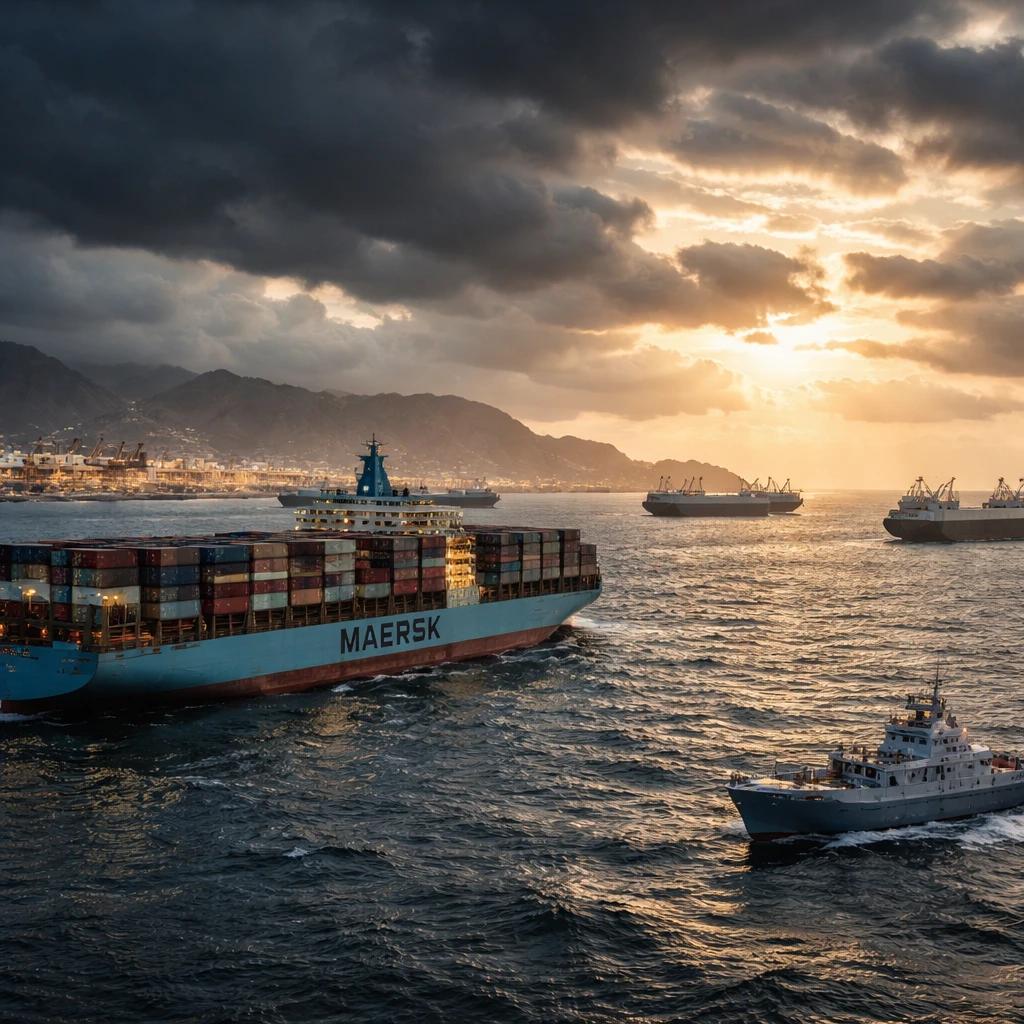
Shares of A.P. Møller - Maersk and Hapag-Lloyd rose by over 4% on Monday after Iran-linked incidents affecting the Strait of Hormuz led top container carriers to suspend vessel transits through the waterway.
The interruption reverberated through energy markets. At 05:25 ET (10:25 GMT), Brent and U.S. crude futures were each higher by more than 7%, while natural gas prices had climbed in excess of 4%.
Maersk confirmed it is pausing all vessel crossings at the Strait of Hormuz until further notice, joining Hapag-Lloyd and CMA CGM in diverting services away from the area amid elevated safety concerns.
Market reaction and analyst context
Despite the initial market moves, Morgan Stanley urged caution against treating the price action as a permanent re-rating of container shipping equities. The brokerage kept its "underweight" rating on Maersk, its sole pure-play container shipping coverage among European names, and said the Hormuz disruption is "meaningful but not 'Suez scale'" for container flows.
"Disruptions at Suez have implications for the global container shipping network, while disruptions to transits at the Strait of Hormuz have implications more on a regional basis," the analysts wrote.
The analyst note draws a clear distinction between the two chokepoints. Before the Red Sea crisis, the Suez Canal accounted for around 22% of global container traffic, giving it a unique systemic role in the Asia-Europe container corridor.
Transits through Suez remain roughly 90% below the pre-disruption levels seen in the fourth quarter of 2023, even though Maersk and Hapag-Lloyd have recently restarted rerouting some services back through the canal.
The note also emphasized that large Gulf ports, while substantial in absolute throughput—Dubai's Jebel Ali handled 15.5 million TEU in 2024, equivalent to about 8% of global container liftings—do not replace the Asia-Europe corridor serviced by Suez and therefore do not create the same systemic outcome.
Oil flows and beneficiaries
The oil market faces a different calculus. In 2024, some 20% of global petroleum liquids consumption transited the Strait of Hormuz, so any closure has clearer and more immediate implications for tanker operators and oil prices than for container flows.
Structural outlook for container shipping
For container carriers, Morgan Stanley's base case remains that fleet oversupply will continue to pressure freight rates regardless of how the current regional crisis unfolds. Under the brokerage's scenario where Suez transits normalise by mid-2026, effective container supply growth would reach 6.2% while demand growth would be just 3.3%.
Even in a persistently constrained Suez environment, Alphaliner's February 2026 estimates project fleet capacity growth of 3.8%, which the analysts note would still outpace demand. "Either way, the risk is to the downside on freight rates, notwithstanding short-term dislocations," Morgan Stanley said.
Maersk's share price has moved independently of freight rate momentum in recent months. Morgan Stanley added it sees "no strong fundamental reason for this to persist," and values the stock at 3x FY26 EV/EBITDA and 0.5x price-to-book, figures the firm says sit at the lower end of Maersk's historical valuation range.
Wider sector activity
Copenhagen-listed DSV, the Danish freight forwarder that Morgan Stanley rates "overweight" with a price target of DKr 1,635.50, was also active as logistics stocks tracked the broader transport sector's moves. Other carrier names, including those diverting vessels such as CMA CGM, were cited for adopting routing changes as a result of the disruption.
Investors and market participants will be watching both the duration of the Strait stoppage and any follow-on shifts in container routing, but analysts stress the longer-term structural dynamics of supply and demand in container shipping will remain a key determinant of freight rates and company valuations.