
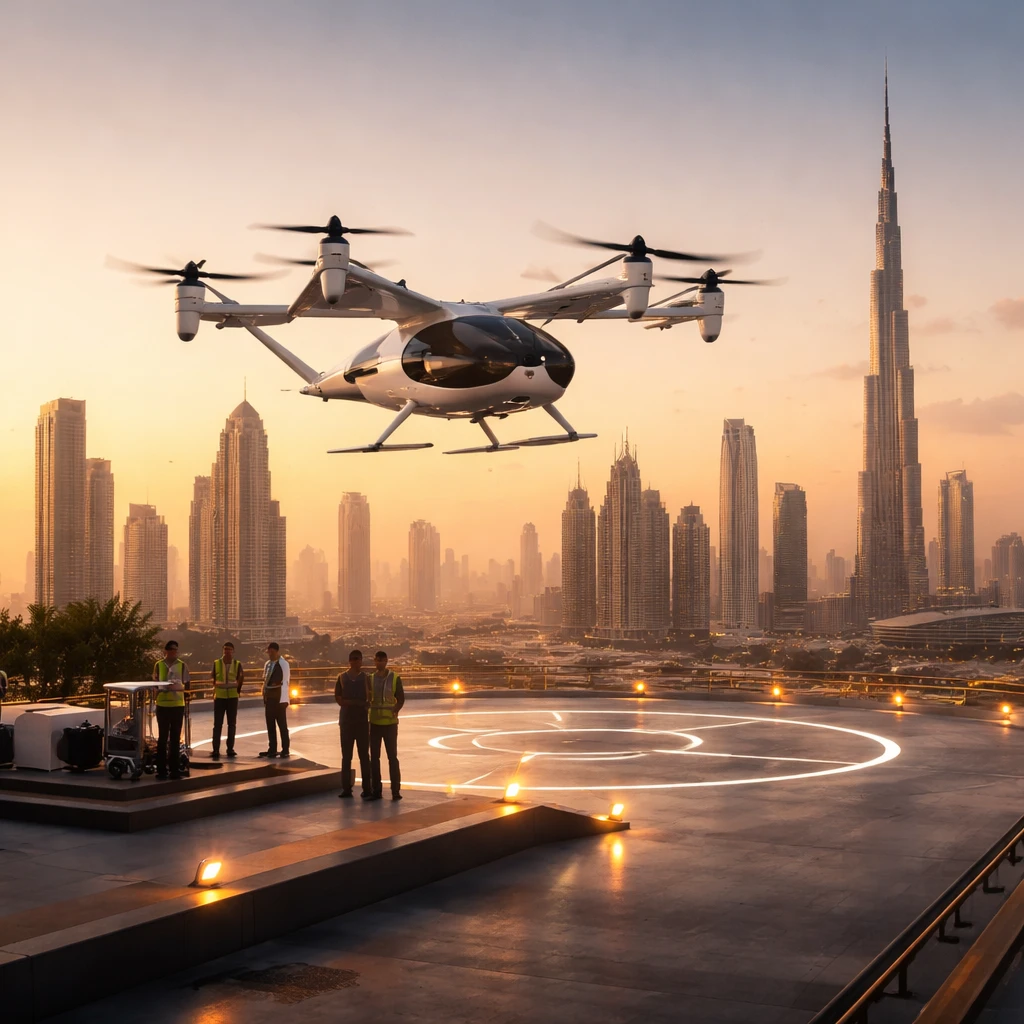
Joby Aviation shares climbed 7.5% on Wednesday after the company and Uber introduced a booking option in Dubai that lets riders reserve flights on Joby’s electric air taxi through the Uber app.
The service, marketed as Uber Air powered by Joby, integrates Joby’s aircraft into Uber’s ride-hailing experience. Riders who enter a destination in the Uber app will see Uber Air powered by Joby as a selectable option when their trip qualifies. The app will coordinate and book all segments of the journey - including Uber Black pickup and drop-off - to connect ground transportation with the aerial leg.
Joby projects it will carry its first passengers in Dubai later this year. The company’s aircraft is an all-electric vehicle configured to accommodate up to four passengers and will be operated by a certified commercial pilot. The design relies on six tilting propellers that allow vertical takeoff before transitioning to forward flight, and Joby states the aircraft can reach speeds up to 200 mph with a range of as much as 100 miles on a single charge.
Before Joby can commence commercial operations in the United States, the Federal Aviation Administration requires extensive testing and certification. Joby reports having completed more than 50,000 miles of flight testing across its fleet and has entered the final stage of the certification process.
The collaboration between Joby and Uber dates back to 2019 and has evolved through several strategic moves. In 2021 Joby acquired Uber’s Elevate division. More recently, the companies said they planned to incorporate Blade’s commercial helicopter service into the Uber app in 2026, following Joby’s acquisition of Blade’s passenger business. The partnership is intended to broaden Joby’s electric air taxi footprint to additional markets including New York, Los Angeles, the United Kingdom, and Japan.
This announcement represents an operational milestone for Joby and Uber in urban air mobility, linking aircraft capability, app-based booking, and ground transportation. The Dubai rollout sets a timeline for passenger service this year while regulatory and certification processes remain central to further expansion, particularly in the United States.