
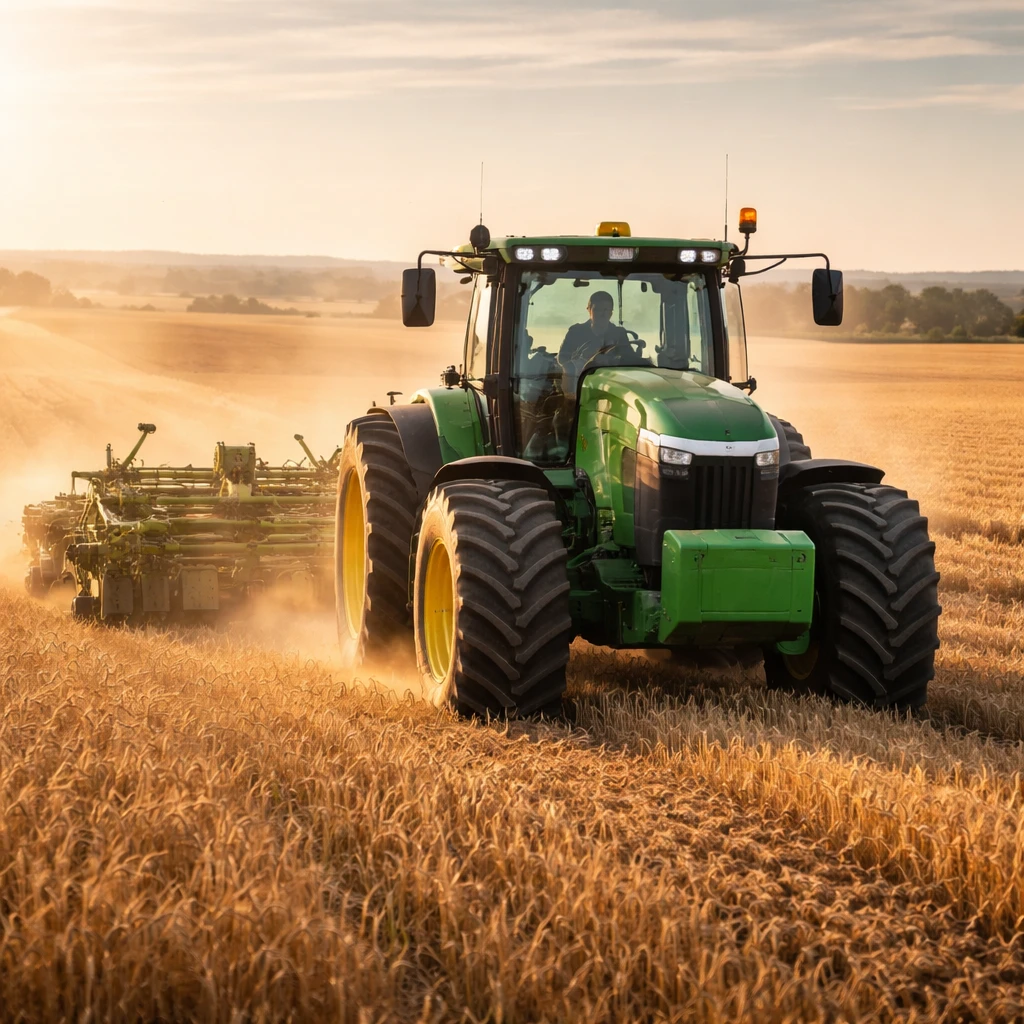
Jefferies has moved Deere & Company to a Hold rating from Underperform, arguing that the equity's roughly 15% retreat from mid-February peaks has brought its risk-reward into better balance relative to the firm's unchanged valuation outlook.
Analyst Stephen Volkmann, in a Tuesday note, said, "The shares are nearing our unchanged $550 PT, and we believe additional downside risk is limited following the recent pullback." Jefferies maintained the $550 price target and the upgrade reflects a view that the stock's near-term downside has moderated after the drop.
Valuation framework and earnings outlook
Jefferies described Deere as one of the highest-quality franchises in its coverage, pointing to sustained product innovation, deep market penetration, and a substantial proprietary agricultural data asset. The firm cited Deere's John Deere Operations Center as hosting 500 million engaged acres, which it views as a strategic competitive advantage.
On earnings, Jefferies expects Deere to reach record profits at the next cycle peak. The firm's scenario projects a 75% revenue expansion from the trough in 2026, driven by a 65% increase in volumes and an additional 10% from pricing, with incremental margins of 35%. Applying a 15-times peak earnings multiple and discounting back to 2026 produces the $550 price target that the firm retained.
Macro outlook and industry dynamics
Despite raising the rating, Jefferies left its macro assumptions intact. The bank expects a prolonged trough through 2026 for high-horsepower equipment demand in North America. February represented the 30th consecutive month of negative high-horsepower equipment sales in the region, and volumes are down more than 40% since the 2023 peak, according to the note.
Production and Precision Agriculture volumes are forecast to decline another 10-15% in fiscal 2026. For historical perspective within the firm's note, the prior downcycle - from 2014 to 2017 - lasted 43 months with volumes falling roughly 55% during that period.
Farmer economics and commodity risks
Farmer economics remain a prominent headwind in Jefferies' assessment. The USDA is cited as projecting farm income to fall about 15% in 2026. Volkmann noted that higher input costs, trade volatility and elevated debt-to-asset ratios constrain substantial equipment purchases and point to a more measured recovery in demand.
The note also flagged geopolitical and commodity channels that could affect the outlook. Volkmann observed that a sustained conflict in Iran could raise fertilizer prices and increase fuel costs, which over the longer term might boost biofuel demand and support commodity crop prices. However, the analyst cautioned that any such benefits to farmer income are unlikely to materialize in the near term.
Investor takeaways
Jefferies' upgrade to Hold reflects a balance between Deere's structural strengths and a challenging cyclical environment. The retained $550 price target rests on explicit assumptions about a recovery in volumes and pricing and the application of a 15-times peak earnings multiple. At the same time, the firm warns of an extended trough in equipment demand through 2026 and weaker farmer balance sheets that could delay a return to peak profitability.
For those assessing exposure to agriculture equipment and related supply chains, Jefferies' note underscores both the franchise-level durability of Deere's business and the macro and commodity risks that could weigh on near-term earnings and volumes.
Model and research tools referenced
The note quantified the peak-cycle revenue and margin assumptions that underpin the retained price target. Separately, the article referenced ProPicks AI, which evaluates DE alongside thousands of companies using more than 100 financial metrics to identify risk-reward opportunities. The promotional and model details for ProPicks AI were included verbatim in the original material.