
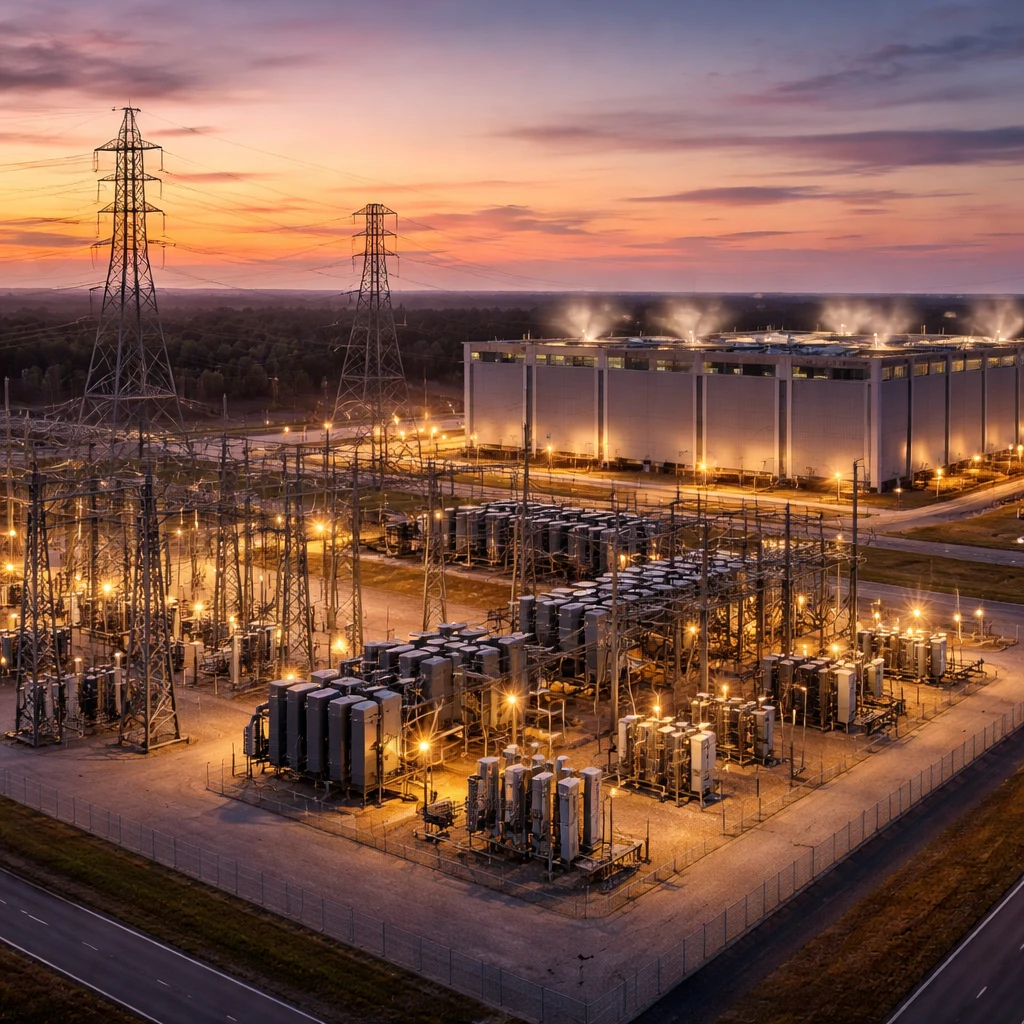
Jefferies has singled out several utility companies it sees as particularly well positioned to capture growth from the continued expansion of hyperscaler data centers. The investment firm points to utilities that have established regulatory structures and struck significant commitments with major technology firms - including Amazon, Meta, and Google - creating what Jefferies views as replicable models for accommodating very large loads while delivering tangible customer protections.
Summary of Jefferies recommendations
The research note identifies four utilities in particular - NiSource (NI), Entergy (ETR), Xcel Energy (XEL), and American Electric Power (AEP) - and outlines how each has locked in terms or built regulatory constructs that support premium returns from large-load customers while mitigating potential costs to existing residential users.
NiSource (NI)
Jefferies ranks NiSource as its top pick. The firm highlights NiSource's deployment of an Indiana "GenCo" unregulated structure, which stakeholders and political actors increasingly regard as a benchmark for how to handle large-load developments. That structure - currently awaiting regulatory approval and supported by a non-unanimous settlement with Amazon - is cited as delivering significant premium returns for the utility. At the same time, Jefferies notes the arrangement provides concrete savings to existing residential customers, amounting to roughly $7 per month.
Management at NiSource expects to secure additional agreements with hyperscalers, and Jefferies projects that such deals should underpin an effective earnings per share trajectory of better than 10% annually. In NiSource's fourth-quarter 2025 results, the company reported adjusted earnings per share of $0.51, which exceeded analyst forecasts, while revenue of $1.2 billion came in below expectations. NiSource also declared a quarterly dividend of $0.30 per share.
Entergy (ETR)
Entergy is described by Jefferies as achieving sector-leading earnings per share growth, with the firm estimating growth of over 11% and guidance from the company of 8% or more. Jefferies attributes this performance to major infrastructure developments tied to hyperscaler projects from Meta in Louisiana, Google in Arkansas, and Amazon in Mississippi. The firm notes Entergy's regulatory construct has attracted clustering of hyperscaler operations, and that Entergy's Gulf Coast states have largely avoided the localized push-back against data center development seen in other jurisdictions - a point of differentiation identified for 2026.
In its fourth-quarter 2025 report, Entergy posted earnings per share of $0.51 and revenue of $2.92 billion; both figures were below analyst expectations.
Xcel Energy (XEL)
Jefferies highlights Xcel Energy's relatively low-cost, diversified Midwest footprint and its decarbonization attributes that hyperscalers increasingly seek. The firm points to top-decile rate base and earnings per share growth metrics for Xcel, noting that the stock trades at a discount to other electric peers.
Jefferies cautions investors that shares should factor in an element of prospective wildfire liabilities, but the research note states the magnitude of those liabilities already embedded in the stock appears excessive. Recent company developments noted by Jefferies include an analyst upgrade from Argus, which lifted its price target and maintained a Buy rating, and Xcel's appointment of Rob Cain as senior vice president and chief technology officer.
American Electric Power (AEP)
AEP is identified as having a substantial and growing pipeline of potential data center load, quantified at roughly 56 gigawatts through 2030. Jefferies notes that approximately 90% of this incremental load is backed by electric service agreements. The utility has secured approved large-load tariff structures featuring extensive customer protections - including commitment terms ranging from 12 to 20 years, minimum demand charges of 80% to 90%, and strict termination fees.
After a period of regulatory and execution challenges, Jefferies sees evidence that AEP's new management team has improved the balance sheet and rebuilt confidence. In addition, AEP's Ohio subsidiary announced plans for a $4.2 billion transmission infrastructure project designed to support a new 10-gigawatt data center campus.
Implications and context
Across these cases, Jefferies emphasizes a recurring theme: utilities that marry favorable regulatory constructs with enforceable commercial agreements can both capture outsized earnings growth from hyperscaler load and protect existing residential customers from bearing undue infrastructure costs. The arrangements with Amazon, Meta, and Google are presented as practical examples of how large-load development can be structured to achieve that balance.
Jefferies' selections reflect a broader focus on how rate design, tariff protections, and contract terms - including multi-year commitments, high minimum demand charges, and termination penalties - shape the economics of serving hyperscalers while managing regulatory and community risk.
What the note does not claim
Jefferies' research presents these utilities as leading candidates to benefit from hyperscaler expansion based on current agreements and regulatory frameworks. The note provides specific company results for fourth-quarter 2025 and details on tariff structures and project pipelines, but it does not make forward-looking guarantees beyond the earnings-per-share trajectories and guidance cited.