
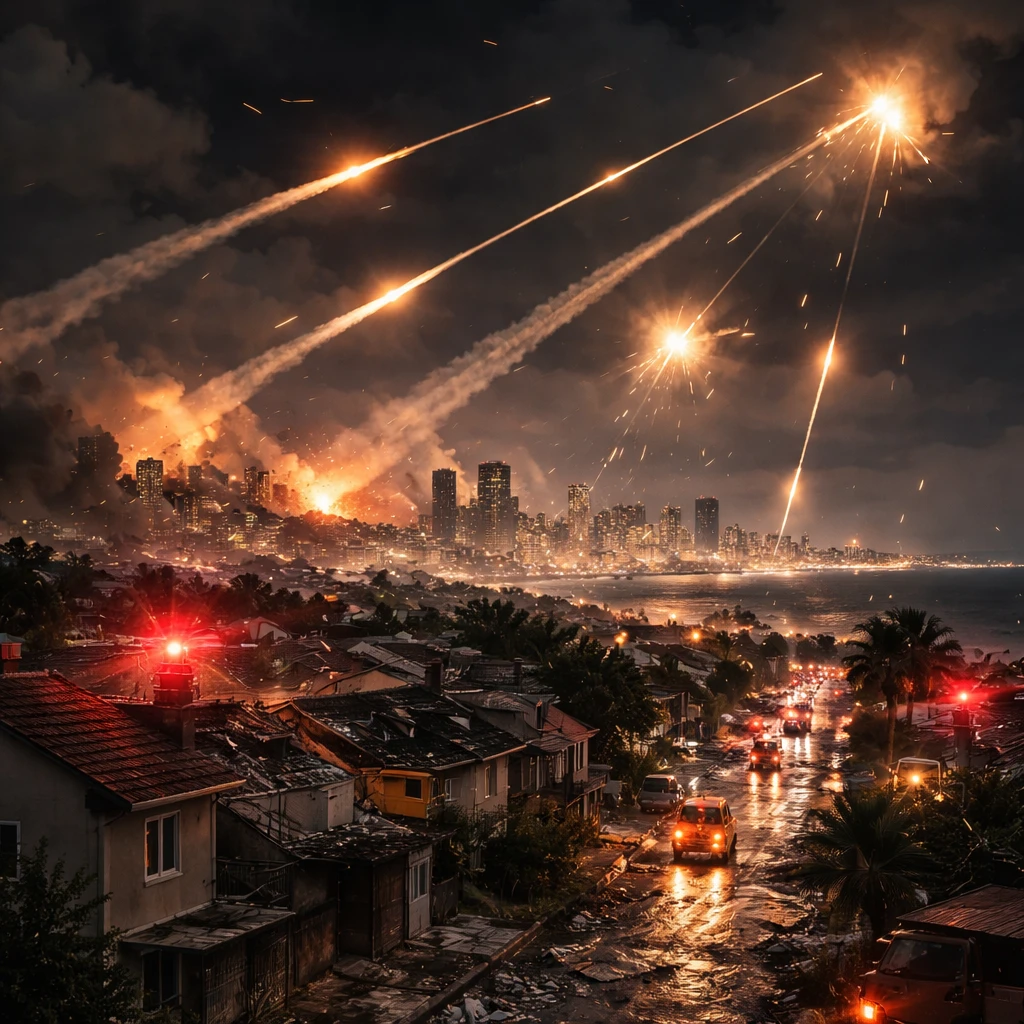
WASHINGTON/JERUSALEM/TEL AVIV, March 24 - Iran fired multiple waves of missiles at Israel, the Israeli military reported, following a public statement from U.S. President Donald Trump that he had postponed a threat to hit Iran's power grid after what he called productive discussions with Iranian officials.
The missile salvos prompted air raid sirens in several areas of Israel, including Tel Aviv, where residents heard explosions from interceptions. Intercepted projectiles produced debris that fell in northern Israel, damaging homes, though authorities reported no fatalities.
On Monday, President Trump wrote on his Truth Social platform that the United States and Iran had engaged in "very good and productive" conversations aimed at a "complete and total resolution of hostilities in the Middle East." He said he was postponing for five days a plan to strike Iran's energy grid, an announcement that initially lifted equities and pushed oil prices sharply lower to below $100 a barrel - reversing an earlier market selloff triggered by weekend threats and Iran's vows to retaliate.
That market uplift was put at risk when Iran's parliament speaker Mohammad Baqer Qalibaf - identified by an Israeli official and two other sources as the Iranian interlocutor in the reported talks - publicly denied that negotiations had occurred. Qalibaf wrote on the social platform X that "No negotiations have been held with the U.S., and fakenews is used to manipulate the financial and oil markets and escape the quagmire in which the US and Israel are trapped."
The Islamic Revolutionary Guard Corps (IRGC) also weighed in, saying it was launching fresh attacks on U.S. targets and dismissing Trump's remarks as psychological operations that were "worn out" and had no effect on Tehran's campaign.
Markets initially rallied in relief overnight on Monday after Trump said he was adding five days to a prior ultimatum for Iran to reopen the Strait of Hormuz within 48 hours. The Strait is a critical shipping route that handles roughly 20% of the world’s oil and liquefied natural gas. By Tuesday, however, the gains were under threat as investors and traders tried to reconcile divergent messages from Tehran and Washington.
U.S. Treasury yields rose and the dollar recovered some losses as concerns over an energy shock persisted. Brent crude futures rose 4.2% to $104.21 a barrel, erasing part of a 10% decline seen on Monday, while U.S. crude climbed 4.3% to $91.93 a barrel. These moves highlighted how sensitive energy markets remain to developments in the Gulf and to statements that can alter perceptions of the conflict’s trajectory.
"The underlying situation is still incredibly fragile or flammable," said IG market analyst Tony Sycamore, reflecting widespread market unease as diplomatic signals shifted.
President Trump told reporters his special envoy Steve Witkoff and Jared Kushner - who previously engaged with Iran before the war - had met with a senior Iranian official late on Sunday and planned to resume discussions on Monday. He said: "We have had very, very strong talks. We'll see where they lead. We have major points of agreement, I would say, almost all points of agreement."
European officials, however, described the communications differently. One European official said there had been no direct negotiations between the United States and Iran, but that third countries - including Egypt, Pakistan and Gulf states - had been passing messages between the parties. A Pakistani official and a second source told Reuters that direct talks about ending the war could take place in Islamabad as soon as this week.
In Jerusalem, Prime Minister Benjamin Netanyahu said in a video statement that he had spoken with Trump and that Israel would continue operations in Lebanon and Iran. Netanyahu added that Trump saw the possibility of "leveraging the mighty achievements obtained by the IDF and the U.S. military, in order to realize the goals of the war in a deal - a deal that will preserve our vital interests."
Iran's foreign ministry described steps aimed at reducing tensions. It said Foreign Minister Abbas Araqchi had discussed developments around the Strait of Hormuz with his Omani counterpart and agreed to continue consultations between the two countries.
Separately, Pakistani sources indicated U.S. Vice President JD Vance, in addition to Witkoff and Kushner, were expected to meet Iranian officials in Islamabad this week after a call between President Trump and Pakistan's army chief Asim Munir. The White House confirmed Trump's call with Munir. Officials in Pakistan's prime minister's office and foreign ministry did not immediately respond to requests for comment. Iranian state media reported that Iranian President Masoud Pezeshkian and Pakistani Prime Minister Shehbaz Sharif had discussed the war's implications for regional and global security.
The conflict has had a direct effect on shipping and energy routes. Iran has effectively closed the Strait of Hormuz since the United States and Israel launched their military campaign against the country on February 28. The war has caused substantial human tolls - more than 2,000 people have been killed, according to the figures reported.
Iran had warned it would retaliate against threats to its energy infrastructure. After President Trump threatened strikes against Iranian power plants, Tehran said it would target the infrastructure of U.S. allies in the Middle East, raising the prospect that significant disruptions to global energy supplies could persist for longer than previously expected.
Summary - Key Market and Security Developments
The central facts are that Iran launched multiple missile waves into Israel, triggering air raid alerts and causing some local damage but no reported deaths. President Trump announced a temporary postponement of a plan to strike Iran's power grid, citing productive talks, a claim later denied by Iran's parliamentary speaker. The IRGC said it was mounting further attacks on U.S. targets and markets reacted swiftly to the mixed signals, with oil reclaiming prices above $100 a barrel and safe-haven assets regaining ground.
- Key points:
- Military - Iran launched successive missile waves at Israel; interceptions were reported with debris damaging homes in the north.
- Diplomacy - The United States signaled progress in talks that it said warranted delaying an attack, while Iranian officials publicly denied any negotiations.
- Markets - Oil and financial markets swung in response to the competing claims, with Brent crude and U.S. crude prices rising after an initial dip, and U.S. Treasury yields and the dollar moving higher.
- Risks and uncertainties:
- Communication risk - Conflicting public statements from Tehran and Washington create uncertainty that can destabilize energy and financial markets.
- Energy supply risk - Iran's actions around the Strait of Hormuz and threats to energy infrastructure raise the possibility of extended disruptions to global oil and LNG flows.
- Escalation risk - Military exchanges and claims of further attacks on U.S. targets increase the risk that the conflict could broaden, with consequences for security and market stability.
The situation remains fluid as officials and intermediaries continue to communicate. Markets and policymakers are closely watching subsequent statements and any movement in diplomatic channels that might clarify whether de-escalation or further confrontation will follow.