
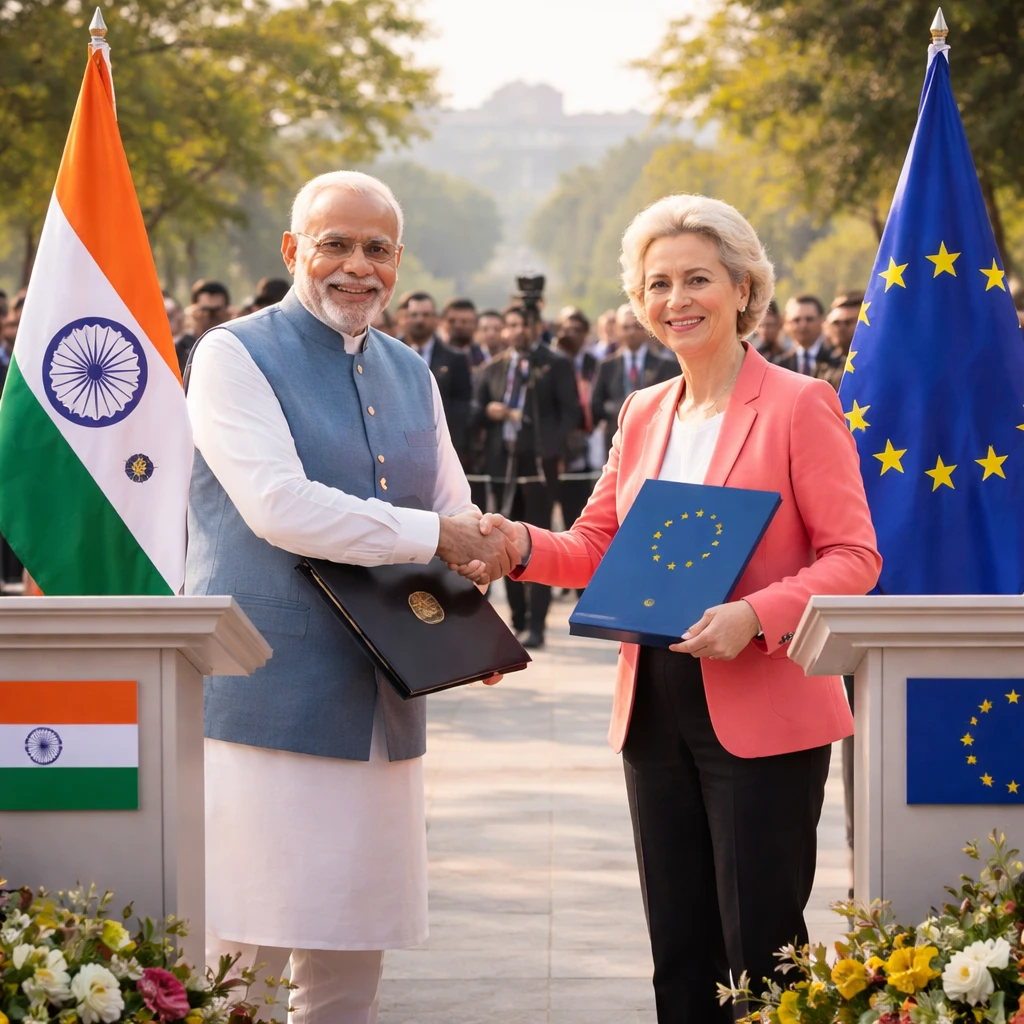
India and the European Union have concluded negotiations on a far-reaching trade agreement, Indian Prime Minister Narendra Modi said on Tuesday, calling it a landmark pact that will affect a sizable share of the global economy. Modi characterised the arrangement as a major opportunity for both regions and noted its scale in terms of global output and trade.
Modi announced that "yesterday, a big agreement was signed between the European Union and India," and added that people globally are referring to it as "the mother of all deals." He said the agreement will create significant prospects for India's 1.4 billion people as well as the millions who live in Europe. According to Modi's statement, the pact covers 25% of global GDP and accounts for one-third of global trade.
Officials said that Modi and European Commission President Ursula von der Leyen are expected to make a joint announcement later in the day at an India-EU summit in New Delhi, where further details of the deal will be disclosed. While the leaders will present the agreement publicly, the formal completion of the deal remains subject to legal vetting.
An Indian government official familiar with the matter said the legal review is likely to take five to six months. Provided that vetting goes as expected, the official said the expectation is for the agreement to be implemented within a year. That timeline indicates a staged approach: public announcement at the summit followed by a period of formal legal checks prior to final signing and rollout.
Trade ties between India and the EU are already substantial. Commerce between the two reached $136.5 billion in the fiscal year through March 2025. The new pact will see India's large and historically guarded market open further to trade with the 27-member EU, its largest trading partner.
The India-EU agreement follows a recent string of trade deals involving the European bloc and other major partners. The EU finalised a pact with Mercosur days earlier, and last year concluded agreements with Indonesia, Mexico and Switzerland. During the same interval, India completed trade arrangements with Britain, New Zealand and Oman.
Observers point to a broader pattern of diversification in trade relationships. The recent flurry of agreements has been framed as part of efforts to hedge against unpredictable ties with the United States. The article cited recent tensions involving the U.S., including references to President Donald Trump’s past threats and actions - such as a proposal involving Greenland and the imposition of tariffs - as factors that have strained relations among Western nations. The U.S. had imposed a 50% tariff on goods from India, and an India-U.S. trade deal collapsed last year after a breakdown in communication between the two governments.
The timing and scope of the India-EU agreement, coupled with an explicit expectation that it will be implemented within a year after legal vetting, indicate a significant reorientation of trade ties for both sides. Market participants and sectors engaged in cross-border goods and services may monitor the detailed terms once they are released at the summit and through the subsequent legal review period.