
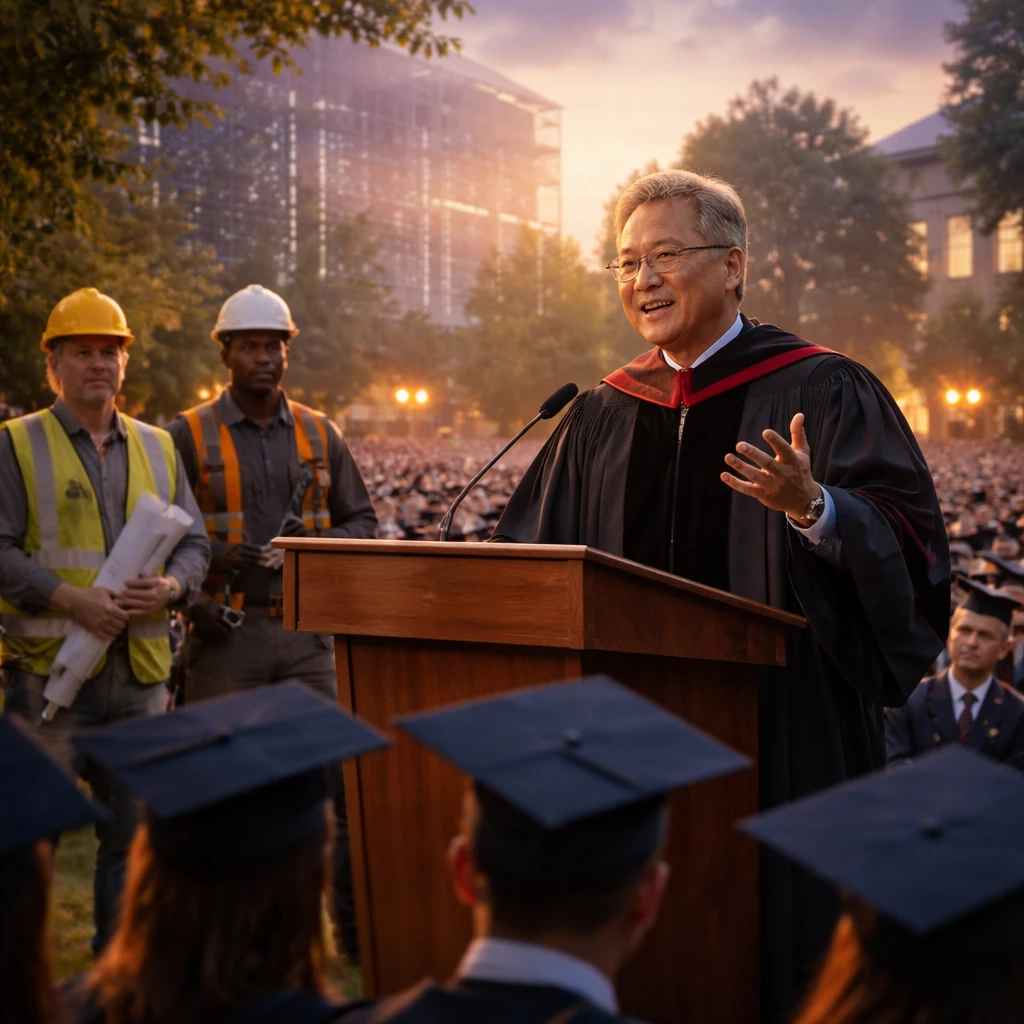
NVIDIA chief executive Jensen Huang used a commencement address at Carnegie Mellon University to lay out a vision in which artificial intelligence becomes a broadly available commodity, accessible to people ranging from carpenters to shopkeepers. Huang said the technology will reach "billions of people who have never had access to computing power before," and that the moment calls for a wide labor base to build the necessary infrastructure.
Huang received an honorary doctorate at the ceremony, and in his remarks framed the AI expansion as a form of American reindustrialization. He said constructing the chip factories and data centers that underpin modern AI will require not only engineers but also plumbers and ironworkers, reflecting the scale and variety of skills needed for the buildout.
"We have the opportunity to close the technology divide-and bring the power of computing and intelligence to billions of people for the very first time," Huang told graduates.
The comments come as NVIDIA remains the dominant supplier of the semiconductors that power the current AI industry. Huang noted that the company’s chips are the foundation of data centers built by major cloud providers, naming Amazon, Microsoft, Google and Meta as users of the technology.
Addressing common concerns about job displacement, Huang distinguished between routine tasks and the deeper purpose of professions. He argued that AI can automate repetitive duties while enabling professionals to focus more on human-centered aspects of their work. Using medical imaging as an example, he said a radiologist does not simply read scans but cares for patients; AI, he said, automates the former and elevates the latter.
Huang placed the current unease about AI in a historical pattern. "Every major technological revolution in history created fear alongside opportunity," he said. He urged that when society engages new technology "openly, responsibly, and optimistically," the expansion of human potential will outweigh the losses.
He also urged that the development of AI capabilities be matched by advances in safety. Huang called on scientists, engineers and policymakers to move forward on both fronts together, warning that protective measures must keep up with the rapid pace of technological change.
In reflecting on Carnegie Mellon’s role in the field, Huang highlighted the university’s early contributions to artificial intelligence research. He cited the Logic Theorist program of the 1950s and the founding of the Robotics Institute in 1979 as foundational elements of American technological leadership that the new generation should build upon.
Huang concluded his address by urging graduates to treat AI as an inclusive tool rather than an exclusive privilege and to see the current moment as a mandate to construct the systems and safeguards necessary to extend computing and intelligence more widely.