
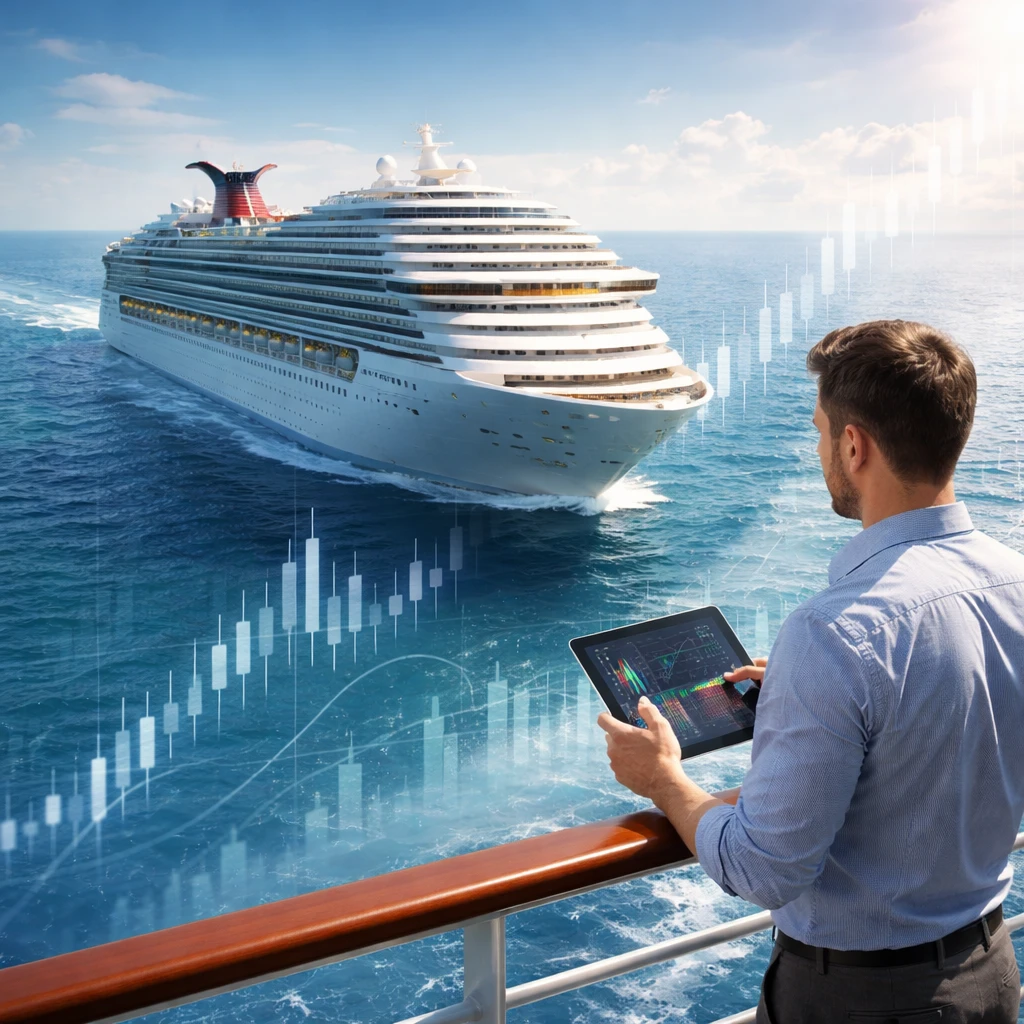
HSBC has moved Carnival Corporation's rating to Buy from Hold and assigned a $30.10 per share price target in the wake of the cruise line's most recent quarterly report. Analyst Meredith Prichard Jensen cited results that the bank says show sustained consumer demand, tighter operating discipline and the early benefits of deleveraging.
HSBC pointed to revenue outcomes that beat expectations, underpinned by a healthy net yield increase of +2.7% year-on-year and stronger onboard spending, which rose +8.3% year-on-year. Those top-line gains, together with ongoing cost management, supported margin expansion: adjusted EBITDA climbed 5.1% compared with the year-ago quarter.
Liquidity metrics also improved, according to the note. Customer deposits increased 9% to $7.5 billion, a development the bank views as reinforcing Carnival's cash position as it reduces leverage.
At the same time, HSBC trimmed its earnings forecasts for 2026 and 2027 by roughly 9% each, a revision the bank attributes chiefly to higher fuel-cost assumptions. Specifically, HSBC now models average fuel expenses for 2026-27 that are about 20% above its prior assumption. The firm expects modest capacity growth of around 1% and net yield expansion of 3.6% over that period.
On leverage, HSBC projects meaningful progress: net leverage is forecast to decline to 2.6 times by 2027, down from 7.0 times in 2023. The bank's valuation approach uses a 9.0x EV/EBITDA multiple to derive its $30.10 target, which it says implies roughly 19% upside from current levels.
Jensen's note also highlights Carnival's market performance and sensitivity to fuel. The analyst observed that the stock has fallen about 25% since the onset of OEF2, a decline largely linked to Carnival's unhedged exposure to rising fuel prices. Despite that drop, shares are trading at a 2026 price-to-earnings ratio of 9.9, below the two-year average of 12.4, indicating a valuation discount in HSBC's view.
HSBC pointed to several corporate actions and cash-generation metrics that support a more constructive stance. The bank reiterated Carnival's $2.5 billion buyback program and cited an estimated 2026 free-cash-flow yield near 10% as signs of improving financial discipline. Demand indicators remain robust as well, with approximately 85% of 2026 bookings already secured at healthy pricing, the note said.
Context on HSBC's assumptions and the stock's outlook
While the bank reduced earnings estimates primarily because of fuel-cost pressure, it maintained that Carnival's operating fundamentals are intact. HSBC now assumes higher fuel costs for 2026-27, offsets that with modest capacity and yield growth assumptions, and projects a steady path toward lower leverage by 2027.
Analyst tools mentioned
The research note also referenced ProPicks AI, describing it as a tool that evaluates companies using more than 100 financial metrics. The description notes that the AI looks at fundamentals, momentum and valuation to generate stock ideas, and cites past winners identified by the tool, including Super Micro Computer (+185%) and AppLovin (+157%).