
Stock Markets April 1, 2026

Grab and WeRide Begin Robotaxi Service in Singapore Residential Estate

Autonomous ride-hailing launches in Punggol with safety operators onboard and free rides until commercial rollout in 2026

By Derek Hwang GRAB
Grab and WeRide Begin Robotaxi Service in Singapore Residential Estate
GRAB

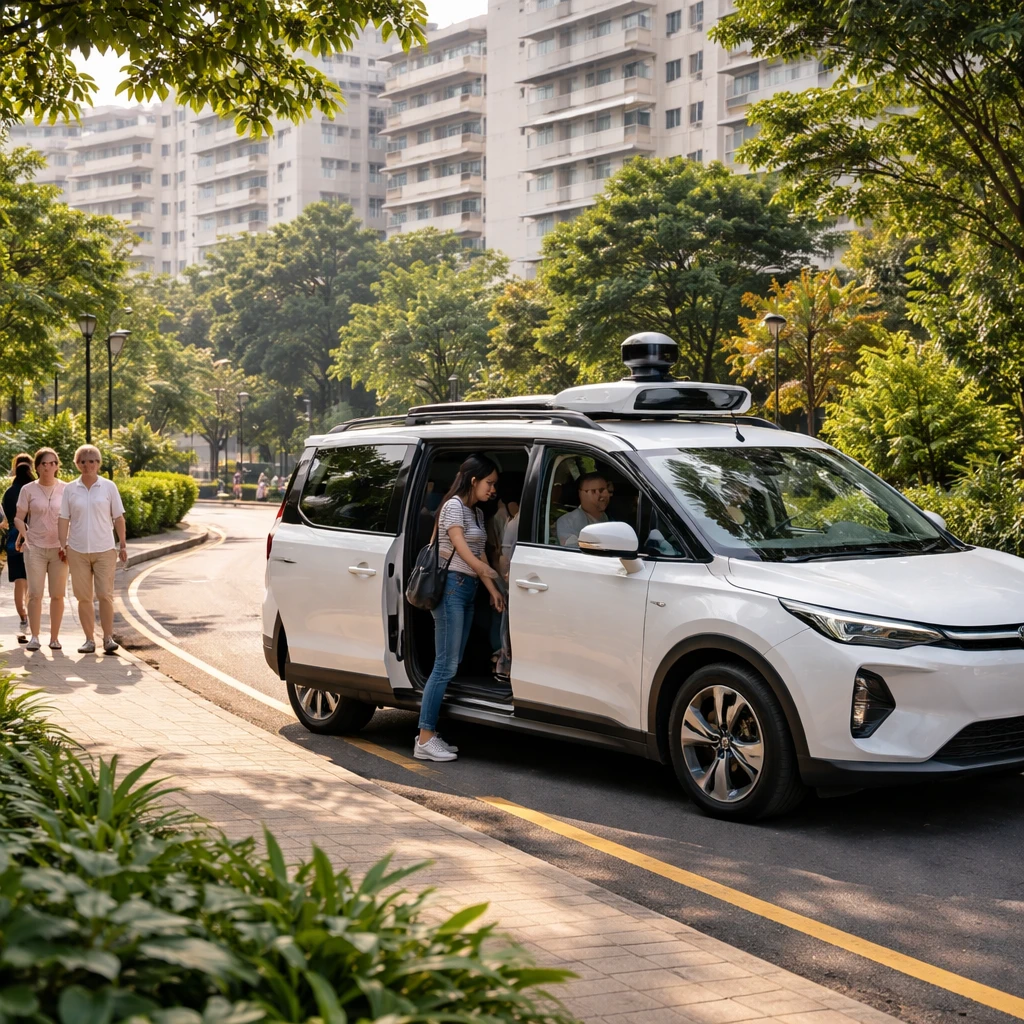
Grab and WeRide have started Singapore's first publicly accessible autonomous ride-hailing service operating in a residential neighborhood. The pilot began in Punggol, offers rides on fixed routes to the public, and will provide free trips while the partners collect feedback ahead of a planned commercial launch in 2026. WeRide shares in Hong Kong rose after the announcement.

Key Points

  • Grab and WeRide launched Singapore's first public autonomous ride-hailing service in the Punggol residential area, operating on fixed routes and available to the public.
  • WeRide reported trials spanning over 1,000 users and more than 30,000 km of autonomous driving prior to the rollout; the initial public phase retains onboard safety operators while Grab retrains drivers for roles such as remote monitoring.
  • Rides will be complimentary until commercial operations are planned to start later in 2026; WeRide's Hong Kong-listed shares rose 6% after the launch.

Grab Holdings and WeRide have initiated Singapore's first autonomous public ride-hailing service within a residential district, marking a new step in the city-state's move toward driverless mobility. The service commenced operations in Punggol on Tuesday and is open to members of the public, who can book trips on autonomous vehicles that run on predetermined routes.

The rollout comes after a period of trialing the system. According to a statement from WeRide, the company conducted trials involving more than 1,000 users and accumulated in excess of 30,000 kilometers of autonomous driving during the testing phase. These trials served as the operational base for the launch in the Punggol neighborhood.

In the initial phase of public operations, human safety operators will remain aboard the vehicles. Grab said it is retraining drivers so they can assume new responsibilities tied to autonomous services - including remote vehicle monitoring - as part of the transition to driverless operations. The presence of onboard safety operators reflects the staged approach the partners are taking as they move from testing toward broader deployment.

Both companies stated that rides will be free for users until commercial operations are scheduled to begin later in 2026. During this period, the partners will gather user feedback and make refinements to the service ahead of paid operations. The temporary complimentary service is intended to inform adjustments to routes, user experience, and operational procedures before the service becomes revenue-generating.

The announcement had an immediate market effect for WeRide in Hong Kong. Shares of the Hong Kong-listed autonomous vehicle firm rose 6% on Wednesday following news of the launch.

This deployment represents a controlled expansion of autonomous mobility within an urban residential context, combining extended pre-launch testing, on-vehicle safety oversight, and a trial period of free rides to collect real-world user data. The partners have positioned the initiative as a phased approach, with the current iteration focused on refining the service and preparing staff for new roles linked to autonomous fleet operations ahead of the commercial debut planned for 2026.

Risks

  • Safety and operational readiness - the continued presence of onboard safety operators indicates ongoing safety monitoring and potential operational constraints during the transition to fully driverless service, which could affect deployment timelines. This impacts the transport and autonomous vehicle sectors.
  • Commercial viability and user acceptance - offering free rides until the commercial launch in 2026 suggests revenue generation depends on user feedback and service refinement, creating uncertainty for the ride-hailing and mobility services markets.
  • Market reaction and share volatility - WeRide's stock moved sharply after the announcement, highlighting potential volatility in market valuation tied to pilot outcomes and future milestones, affecting investors in mobility and technology equities.

More from Stock Markets

Laplace Renewable Energy Surges After Tesla Order Reports; Company Says No Contract Yet Apr 1, 2026 Elliott Says Mitsui O.S.K. Lines’ Plan Falls Short on Shareholder Returns Apr 1, 2026 Australian Shares Climb as Materials and Mining Stocks Lead Gains Apr 1, 2026 Zhipu AI Stock Jumps After Revenue More Than Doubles on Domestic Demand Apr 1, 2026 TSMC to Manufacture 3-nm Chips in Japan Starting 2028, Filing Shows Apr 1, 2026