
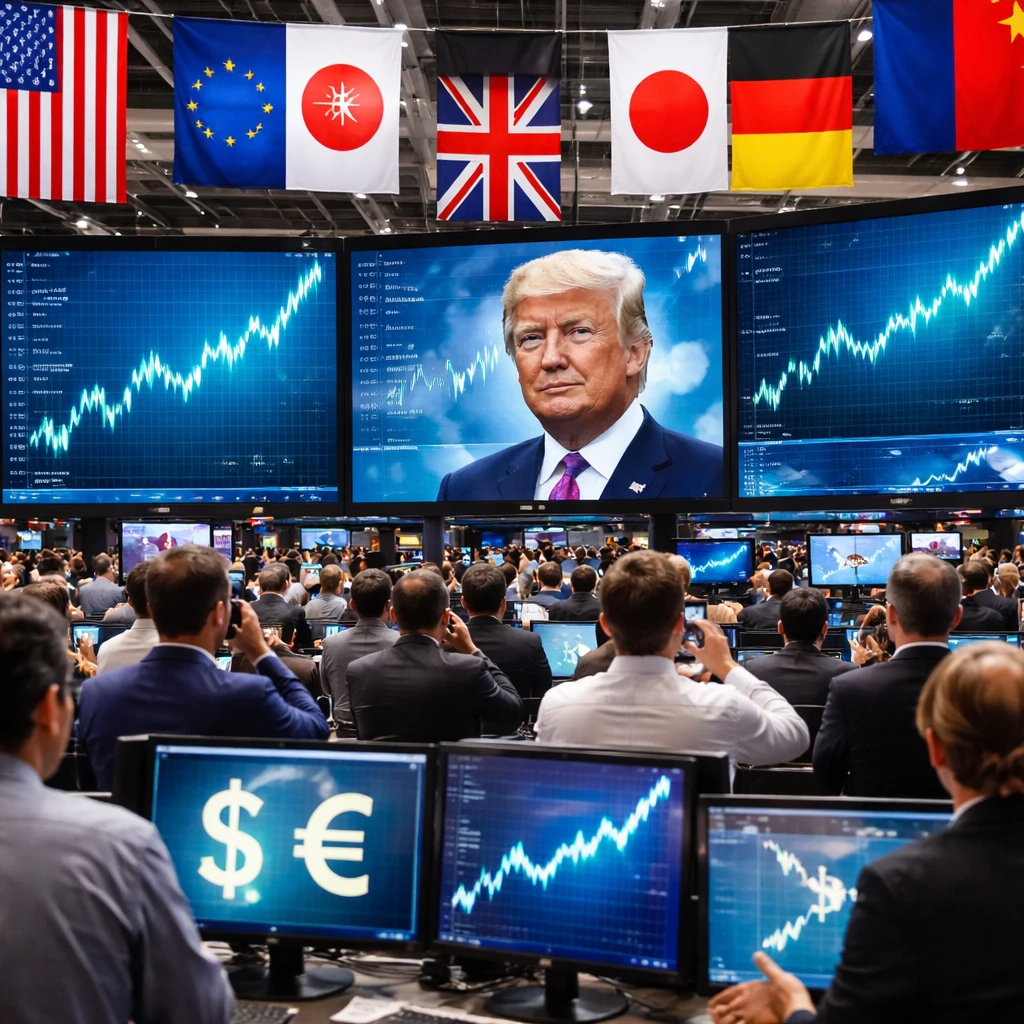
Global equity markets showed signs of strengthening on Thursday as investors responded positively to a notable reduction in political uncertainties involving the United States and Europe. The MSCI World Index, which tracks stock performance across developed and emerging markets, anticipated a second consecutive day of gains, reflecting growing relief among market participants following recent geopolitical tensions.
U.S. President Donald Trump, speaking from the World Economic Forum in Davos during an interview with Fox Business Network, clarified his administration's position regarding Greenland, a Danish territory. He announced that previous threats to seize Greenland by force had been withdrawn and that negotiations toward a U.S. agreement concerning the territory were ongoing. The proposed deal would grant the United States comprehensive access to Greenland, especially for military purposes, at no financial cost.
Simultaneously, revised data from the U.S. Commerce Department’s Bureau of Economic Analysis painted a more robust picture of the American economy in the third quarter of 2023. The GDP growth rate was adjusted upward to an annualized 4.4%, marking the fastest expansion since the same period the year before. Consumer expenditure showed solid increases in both October and November, indicating persistent demand strength. Additionally, corporate earnings figures were also revised higher, suggesting improving profitability across sectors.
New weekly applications for unemployment benefits in the United States edged slightly higher last week, implying that the employment landscape remained broadly stable heading into January. Despite the earlier market turbulence caused by worries about Greenland and associated tariff threats, these U.S. economic indicators were received with equanimity by investors, who appeared more focused on the President's recent policy recalibrations.
Rick Meckler, a partner at Cherry Lane Investments based in New Vernon, New Jersey, emphasized that the overriding influence on market sentiment was Trump's reversal of military and tariff threats. Meckler characterized Thursday's market activity as largely a relief rally, rather than a comprehensive reevaluation of the global economic framework or U.S. trade relations. He noted, "The market tends to react to emergencies and it seems the emergency aspect of this is over for now." Nonetheless, Meckler cautioned that the situation’s long-term implications remained uncertain.
On Wall Street, key indices advanced notably by early afternoon. The Dow Jones Industrial Average rose 518.63 points, or 1.05%, to stand at 49,594.73. The S&P 500 increased 56.17 points, or 0.81%, reaching 6,931.62, while the Nasdaq Composite climbed 257.29 points, or 1.11%, to 23,481.77.
International stock markets experienced similar momentum. MSCI’s global equity benchmark grew by 9.41 points, or 0.91%, closing at 1,038.03. Europe’s STOXX 600 index was up 1.03%, bolstered by easing concerns over trade disruptions and geopolitical conflict.
Currency markets reflected the shift in risk perception following Trump’s remarks. The U.S. dollar, traditionally a haven during times of uncertainty, weakened amid the calming political climate. The dollar index, measured against major currencies including the euro and Japanese yen, declined by 0.51% to 98.38. The euro appreciated by 0.5% to $1.174, while sterling rose 0.45% to $1.3486. The dollar’s slight strengthening versus the yen, up 0.04% to 158.31, suggested mixed investor positioning.
In the bond market, U.S. Treasury yields experienced modest moves as investors balanced expectations of future volatility with the desire for safety. The benchmark 10-year Treasury note yield inched up 0.6 basis points to 4.259%. Conversely, the 30-year bond yield declined by 1.1 basis points to 4.859%. The 2-year note, closely tied to Federal Reserve interest rate forecasting, rose 1.7 basis points to 3.614% from the previous session.
Meanwhile, Japanese government bonds saw volatility in response to the Bank of Japan's two-day policy meeting, where a possibly hawkish tone on rates was anticipated, reflecting global monetary policy shifts.
Energy markets reacted to the reduced geopolitical tensions and reassessments of supply-demand conditions by retreating from earlier gains. U.S. crude oil settled at $59.32 per barrel, down 2.14%, and Brent crude closed at $63.93, falling 2.01% for the day. The easing of threats against Greenland and Iran contributed to these declines.
Precious metals followed suit with increased investor confidence enabling earlier declines in safe-haven assets to reverse. Spot gold prices climbed 1.12% to $4,890.39 an ounce, while U.S. gold futures rose 0.74% to $4,867.40 an ounce, indicating strengthened risk appetite.
The cryptocurrency sector marked losses, with bitcoin decreasing 1.16% to $89,154.62 and ethereum dropping 2.93% to $2,942.11, reflecting the broader risk-on environment favoring more traditional assets.