
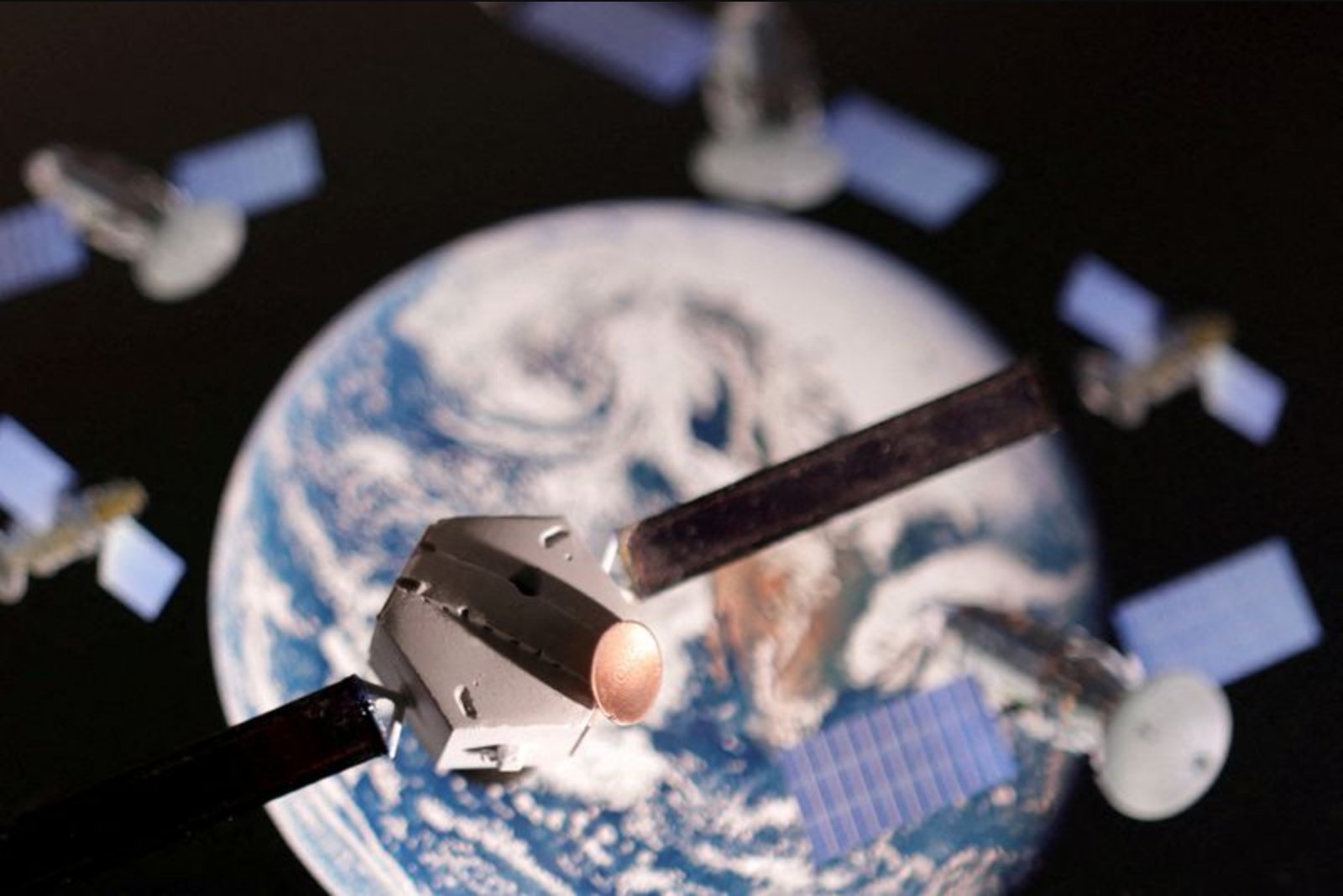
Germany's proposal to fund and build a dedicated military satellite network worth 10 billion euros is drawing scrutiny within the European Union, where some lawmakers fear the move could duplicate and fragment a larger bloc-wide initiative.
The German project, announced as a national effort alongside industrial partners Rheinmetall, OHB and Airbus, would deploy roughly 100 low-Earth-orbit (LEO) satellites exclusively for military communications. It is intended to be separate from the EU's IRIS² programme - a 10.6 billion euro civilian-and-security hybrid constellation that aims to field about 290 satellites by 2029 as a central element of the bloc's drive toward strategic defence autonomy.
Several European Parliament members and other EU officials have expressed unease that a national, stand-alone German architecture could undermine collective European defence aspirations. Marie-Agnes Strack-Zimmermann, who chairs the European Parliament's security and defence committee, warned there is a risk of weakening European structures if Berlin builds a national system that is not integrated into IRIS². "If Germany now builds a purely national architecture that is not integrated into IRIS², there is a risk of weakening European structures," she said.
Proponents of the German plan say the constellation responds to specific military requirements. A German government spokesperson told reporters that Berlin is closely monitoring IRIS² and that the EU project "has the potential, where appropriate, to complement national initiatives in fulfilling sovereign tasks." The spokesperson added that Germany's proposed network is designed to meet its armed forces' unique capability demands and has performance parameters that are "entirely different" from those of IRIS².
Analysts cited in discussions compare the planned German system to technology used in commercial and military hybrid platforms, noting similarities to SpaceX's Starshield offering - a tool that has played a role in Ukraine's battlefield communications. Both the German military plan and the EU's IRIS² would be comparable in scale to SpaceX's Starshield network. Still, IRIS² is expected to carry commercial traffic as well and would be far smaller than SpaceX's Starlink constellation, which numbers roughly 10,000 satellites.
The potential divergence between Germany's national priorities and the EU's collective vision highlights the tension at the heart of the debate: reconciling national sovereignty and tailored military capability with the efficiency and strategic coherence that pooled European projects are meant to deliver. Strack-Zimmermann pointed to the risk of "duplicate structures, fragmented standards, and ultimately less strategic impact for more money," noting that the war in Ukraine has intensified security concerns across the continent. "The decisive point is compatibility, connectivity and European integration," she said, urging that national projects remain aligned with EU frameworks.
Other member states are also exploring national approaches. Italy, for example, is reported to be studying its own LEO satellite network designed for mixed military and civilian use, although that initiative remains at the feasibility stage and is less advanced than Germany's proposal.
At the EU executive level, a European Commission spokesperson, Thomas Regnier, declined to comment on individual member state investments, noting that those are national responsibilities. He said, however, that participating in IRIS² allows member states to join a common European effort that pools resources and expertise, helping to develop advanced satellite communications technologies "more efficiently and at a larger scale."
Questions about cost-effectiveness and who ultimately bears the bill have also surfaced. Jeanne Dillschneider, a Green Party rapporteur on the Bundestag's defence committee, pointed out the fiscal consequence: "The (German) taxpayer will ultimately pay the bill," she said.
Others warned about inefficiencies from fragmented procurement. Christophe Grudler, a Renew Europe lawmaker focused on defence and space policy, cautioned that fragmentation is rarely the most efficient use of public resources, arguing that a smaller, isolated constellation would face limitations in coverage and scalability.
By contrast, the Alternative for Germany (AfD) party signalled its support for Berlin's initiative on the grounds of resilience. AfD defence policy spokesperson Ruediger Lucassen said redundancy is necessary given the capabilities of potential adversaries to disrupt or destroy satellites. "Redundancy - in military terms, reserves - is not a waste of money but a requirement of responsible national security policy," he argued.
Industry voices have weighed in as well. OHB's chief executive Marco Fuchs criticised IRIS² as lacking the specificity needed for a strictly military network, saying the public-private partnership model of IRIS² "lacked the specificity required for a military-focused network." He added that for a genuine military requirement, it is not sufficient to simply plan to "rent it from private companies and wait to see how the conditions turn out," comments he made after OHB reported its 2025 earnings.
Airbus indicated it looks forward to receiving a formal request for proposals from Berlin, but the company declined to comment on the broader concerns about duplication. A spokesperson said Airbus is prepared to participate in the procurement process.
Timing is another contested issue. Supporters of IRIS² argue that the EU programme will reduce dependency on non-European providers and promote interoperability across member states' military systems, but IRIS²'s full deployment is not expected until the 2030s. Christophe Grudler urged acceleration, saying, "Europe must accelerate," while also noting that national systems may not address capability shortfalls more quickly than the EU project.
The debate raises open questions about the balance between national sovereignty and collective European capability-building, the efficient use of public funds in defence procurement, and the speed at which robust space-based communications can be delivered to meet escalating security needs. Currency conversion used in reporting: $1 = 0.8675 euros.