
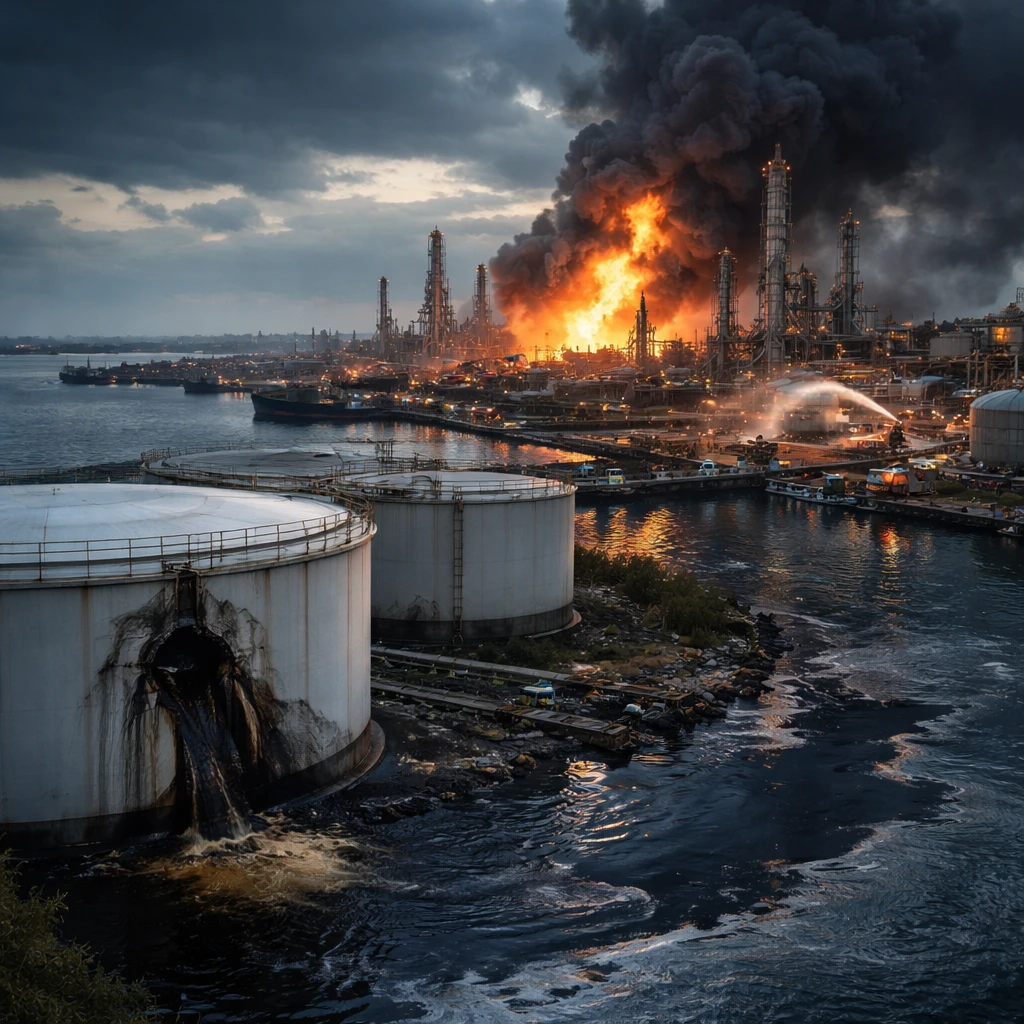
Russian officials said on Sunday that a fuel reservoir at the Baltic Sea port of Primorsk leaked and that the NORSI oil refinery was ablaze after drone strikes targeted both locations.
Alexander Drozdenko, governor of the north-western Leningrad region, initially reported that a pipeline at Primorsk had been damaged. He later clarified on the Telegram messaging service that the pipeline itself was not hit; instead, shrapnel struck a fuel reservoir in the port area, causing the leak.
Primorsk is one of Russia's principal oil export hubs and has capacity to handle 1 million barrels per day. U.S. commercial satellite images viewed by Reuters last Thursday showed that at least 40% of Primorsk's storage facilities were lost in Ukrainian drone attacks last month.
Officials also noted that at one point last month roughly 40% of Russia's oil exporting capabilities were shut down. That broader disruption reflected a combination of recent attacks, the closure of the Druzhba pipeline in Ukraine and the seizure of Russia-linked tankers.
Separately on Sunday, Gleb Nikitin, governor of the Nizhny Novgorod region, reported on Telegram that the NORSI oil refinery - described by authorities as the country's fourth-largest - was on fire after being struck by a drone. Nikitin said two facilities at the plant were hit and that a power station and several houses sustained damage. He added that preliminary information indicated there were no injuries.
NORSI is reported to be Russia's second-largest producer of gasoline and has a processing capacity of 16 million metric tons of oil per year, which equates to about 320,000 barrels per day.
In the Black Sea port city of Novorossiysk, Mayor Andrey Kravchenko said an air alert was in effect because of an incoming drone threat. Authorities typically suspend oil loadings during such alerts, including at the terminal that handles Kazakhstan's oil exports via the Caspian Pipeline Consortium.
Context and immediate effects
The incidents at Primorsk and NORSI occurred amid a recent uptick in attacks on energy-related infrastructure, which officials say are aimed at damaging a key source of state revenue and military support. The confirmed damage to storage and processing capacity follows moves earlier in the month that temporarily removed a significant share of Russia's ability to export oil.
Authorities reported no confirmed injuries at the NORSI refinery based on initial information. The precise extent of environmental or operational impacts from the fuel leak at Primorsk has not been detailed beyond the governor's statement that a reservoir was pierced by shrapnel.
What remains uncertain
Officials have provided preliminary details, but the full scale of damage, the time required to restore affected facilities and the longer-term effects on export operations remain to be seen. Local alerts and typical suspensions of loading operations during air alerts already affect throughput at terminals serving regional and international oil shipments.