
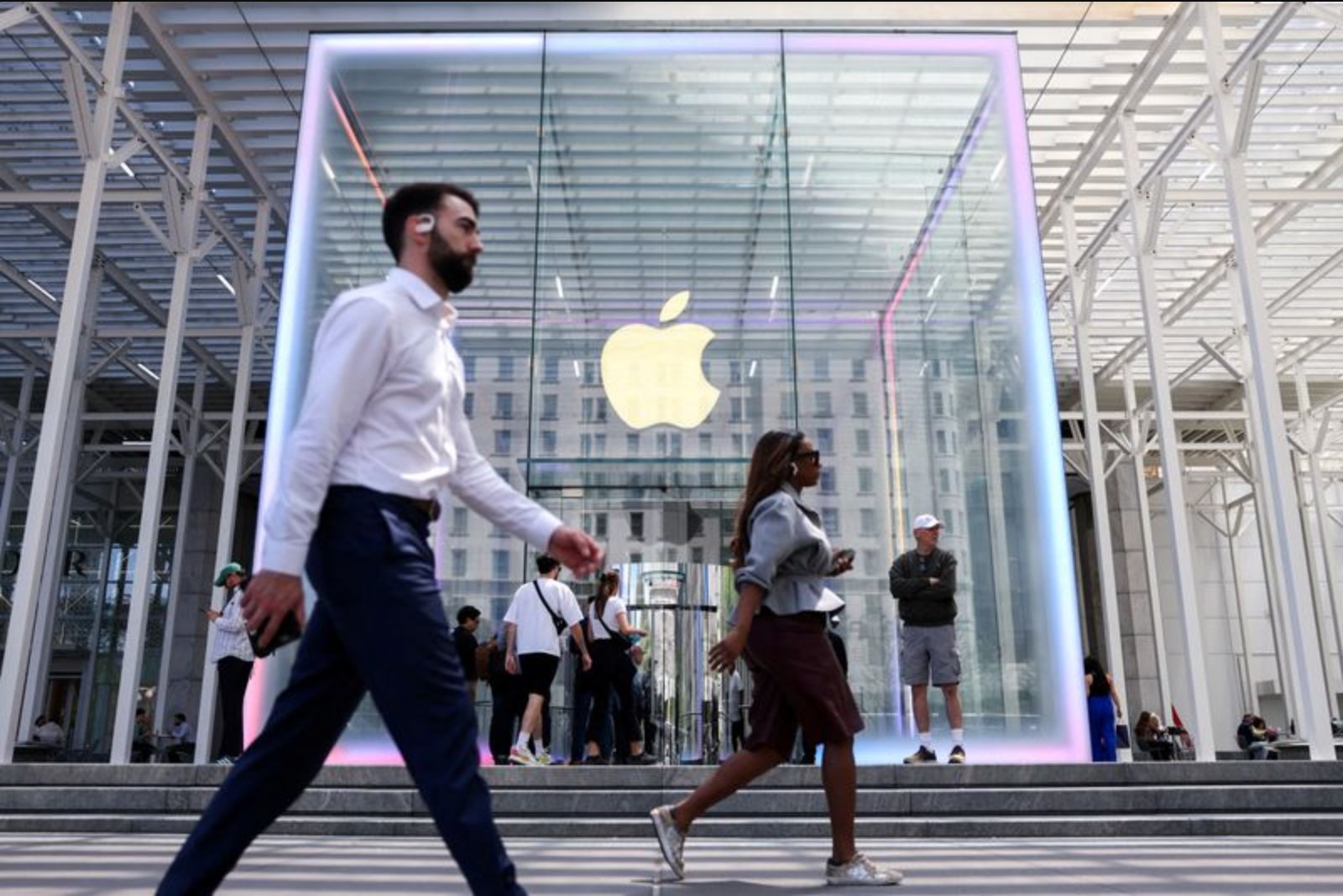
In early 1976 in California, a circuit board designed by Steve Wozniak for fellow electronics hobbyists became the seed of a commercial enterprise when Steve Jobs suggested producing and selling it. That project evolved into Apple, which marks 50 years of operation - a trajectory that has reshaped the consumer electronics landscape and popular culture.
Apple popularized desktop computing and later led the mainstreaming of smartphones. Its product footprint expanded from early machines such as the Apple I into devices that include music players, smartphones, laptops, wearables and a mixed-reality headset. The company also developed a software and services ecosystem that has deepened customer engagement and produced recurring revenues.
Despite this history, Apple now faces pressure to prove it can maintain technology leadership in an era dominated by artificial intelligence. Large software rivals are investing heavily in AI - the article notes Alphabet and Microsoft spending tens of billions of dollars - and new entrants and partners in the AI space are targeting user experiences that could challenge the centrality of smartphones.
Market performance has reflected investor doubts about Apple’s AI positioning. Since OpenAI introduced ChatGPT in November 2022, the company’s stock has been the second-worst performer among the so-called "Magnificent Seven." Observers point to delays in delivering anticipated AI-driven features, such as an overhauled Siri, as evidence that Apple may have been underprepared for how consumers will use advanced AI capabilities despite embedding machine learning features into its chips since 2017.
Yet Apple’s consumer products continue to generate meaningful demand. The December-quarter earnings were driven by strong sales of the iPhone 17 series. The company also launched a $599 MacBook Neo, described as its cheapest laptop to date, which had a strong market reception. These product-level dynamics contributed to the company’s expected fiscal-year sales of $465 billion for the year ending in September, underscoring its position among the world’s largest revenue generators.
Apple’s in-house M-series processors are also highlighted as a growth factor, having helped stimulate Mac sales after Apple transitioned away from third-party chips. That vertical integration between silicon, hardware and software has been central to Apple’s value proposition and to the surge in its stock price after the turn of the century, when the iPhone became a bestseller and the device lineup expanded.
The company’s services division has become an increasingly important growth engine. Housing the App Store, Apple Music and a streaming offering, the services business benefits from an expanding installed base of devices that create recurring income through subscriptions and commissions on app sales. The prominence of services has also led to high-profile disputes, such as the conflict with Epic Games over control of in-app payment mechanisms.
Geographic revenue composition is shifting as well. With smartphone penetration plateauing in the United States, China and emerging markets - including India - now account for a larger share of Apple’s revenue growth. These markets are significant to sustaining unit volumes and revenue momentum as more mature markets slow.
Observers continue to debate the company’s prospects in a future defined by AI. Independent tech analyst Ben Thompson noted that Apple has reached fifty years without a true competitor to its integrated business model, but suggested that the company’s next half-century might hinge on how compelling AI features become and whether rivals, including firms associated with OpenAI, can challenge Apple’s dominance in key device categories.
Five business themes reflected in Apple’s evolution
- Stock appreciation: Public since 1980, Apple’s shares accelerated sharply after the iPhone era and subsequent expansions in its device line-up.
- Scale of revenue: Apple is approaching half a trillion dollars in annual sales, with projected revenue of $465 billion for the fiscal year ending in September.
- Services as growth driver: Recurring revenue from the App Store, music and streaming services has become central to growth and margin stability.
- Regional mix shift: As U.S. smartphone growth slows, China and other emerging markets including India are increasing their contribution to Apple’s top line.
- Product breadth: From the Apple I to devices such as the iPod, iPhone, smartwatches, wireless earbuds and the Vision Pro headset, Apple’s product slate underpins its ecosystem.
Apple’s position at 50 is thus a mix of enduring commercial strengths and strategic challenges. Its integrated approach to silicon, devices and software continues to differentiate it in the market, but the timing and execution of AI-enabled features and the intensity of competition from large software-focused firms will be central factors to watch as the company seeks to sustain growth.