
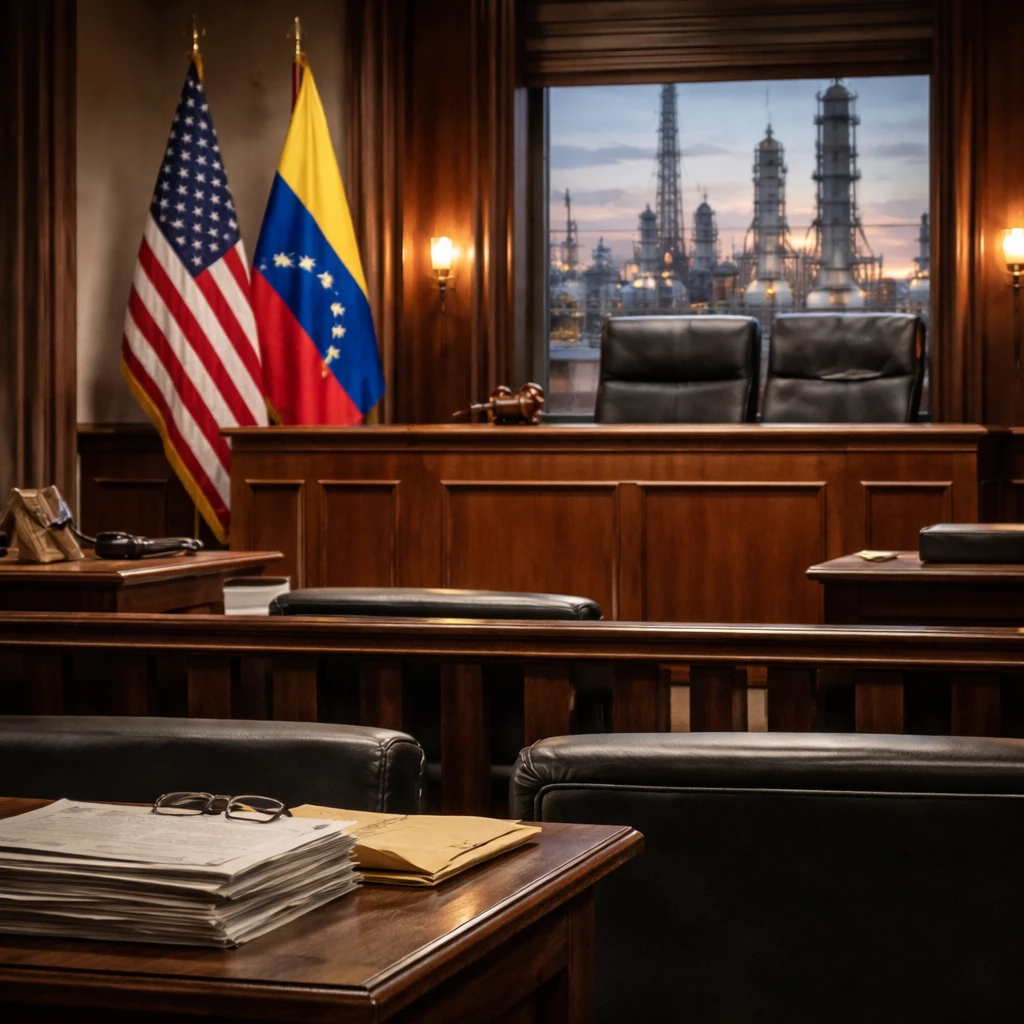
A former U.S. lawmaker will stand trial beginning Monday on federal charges alleging he covertly lobbied U.S. officials on behalf of Venezuela without registering under the Foreign Agents Registration Act (FARA).
Federal prosecutors in Miami allege that David Rivera was paid $20 million in 2017 by Venezuelan state-owned companies to press U.S. officials to limit or rescind further sanctions against the government of ousted Venezuelan President Nicolas Maduro. Prosecutors say Rivera did not register as a foreign agent as FARA requires.
The case promises to illuminate the private diplomatic efforts that took place during the early months of President Donald Trump’s first term in the White House and to examine reported interactions involving Delcy Rodriguez, who prosecutors say was central to the lobbying effort. Rodriguez, who prosecutors describe as having a role in directing compensation, is now identified as Venezuela’s interim president in court documents cited by authorities.
Rivera, a 60-year-old Republican who represented southern Florida in the U.S. House of Representatives from 2011 to 2013, has pleaded not guilty to 10 criminal counts, including failure to register as a foreign agent and conspiracy to commit money laundering. He was arrested in 2022 and has been released on a $200,000 bond pending trial.
Prosecutors have indicated they may call U.S. Secretary of State Marco Rubio, a former U.S. senator and onetime political ally of Rivera’s, to testify. The trial is expected to last several weeks.
Rivera’s defense has pushed back on the allegations. In a telephone interview, his lawyer Ed Shohat said Rivera did not have to register under FARA because the payment came from a U.S. affiliate of the Venezuelan state oil company Petroleos de Venezuela (PDVSA). In filings made public in January, attorneys for Rivera and his co-defendant, political consultant Esther Nuhfer, argued that prosecutors have mischaracterized their clients’ activities. "The prosecutors in this case have it completely wrong and backwards," the lawyers wrote in that court filing. Nuhfer has also pleaded not guilty.
The indictment, as described by prosecutors, traces events to early 2017. It alleges that a Venezuelan businessman in February 2017 sought Rivera’s assistance to arrange lobbying with U.S. officials on behalf of the Venezuelan government. At that time, Venezuela was in the throes of an economic crisis, and Maduro’s government faced domestic unrest and accusations that it had marginalized the opposition-controlled legislature. U.S. lawmakers were pressing for stronger measures against Maduro.
According to the indictment, Rivera arranged in April 2017 for a meeting between Rodriguez, then Venezuela’s foreign minister, and a U.S. congressman from Texas. In June 2017, prosecutors say, Rivera arranged a meeting between the same businessman and a U.S. senator from Florida. The indictment did not name the businessman, congressman or senator. In separate court filings, Rivera’s lawyers identified the businessman as Raul Gorrin and the senator as Rubio.
Raul Gorrin, identified in court papers as the owner of Venezuelan television station Globovision, has a lawyer who did not respond to a request for comment. The State Department similarly did not respond to a request for comment. Venezuela’s information ministry, which handles media inquiries for the government, also did not respond to requests for comment, according to court filings.
Prosecutors allege that Rodriguez directed compensation to Rivera by instructing U.S. oil refiner Citgo - a PDVSA subsidiary - to sign a consulting contract with Rivera’s company. The indictment ties that consulting arrangement to the overall effort to improve U.S.-Venezuelan ties, according to the allegations made public by prosecutors.
Despite the alleged lobbying activities, the Trump administration moved forward with increased sanctions on Venezuela, the indictment notes. The legal proceedings now underway will examine whether the payments and consulting arrangements were properly disclosed under U.S. law and whether those actions constituted undisclosed foreign lobbying.
The courtroom process will also weigh the competing legal interpretations presented by prosecutors and the defense about FARA compliance and the nature of Rivera’s work, while potentially bringing testimony from multiple figures referenced in the indictment. Rivera and his co-defendant maintain their not guilty pleas as the case proceeds.
Contextual note: The information above reflects allegations and claims made in the charging documents and statements from counsel and has not been adjudicated. The trial will determine the accuracy of the allegations.