
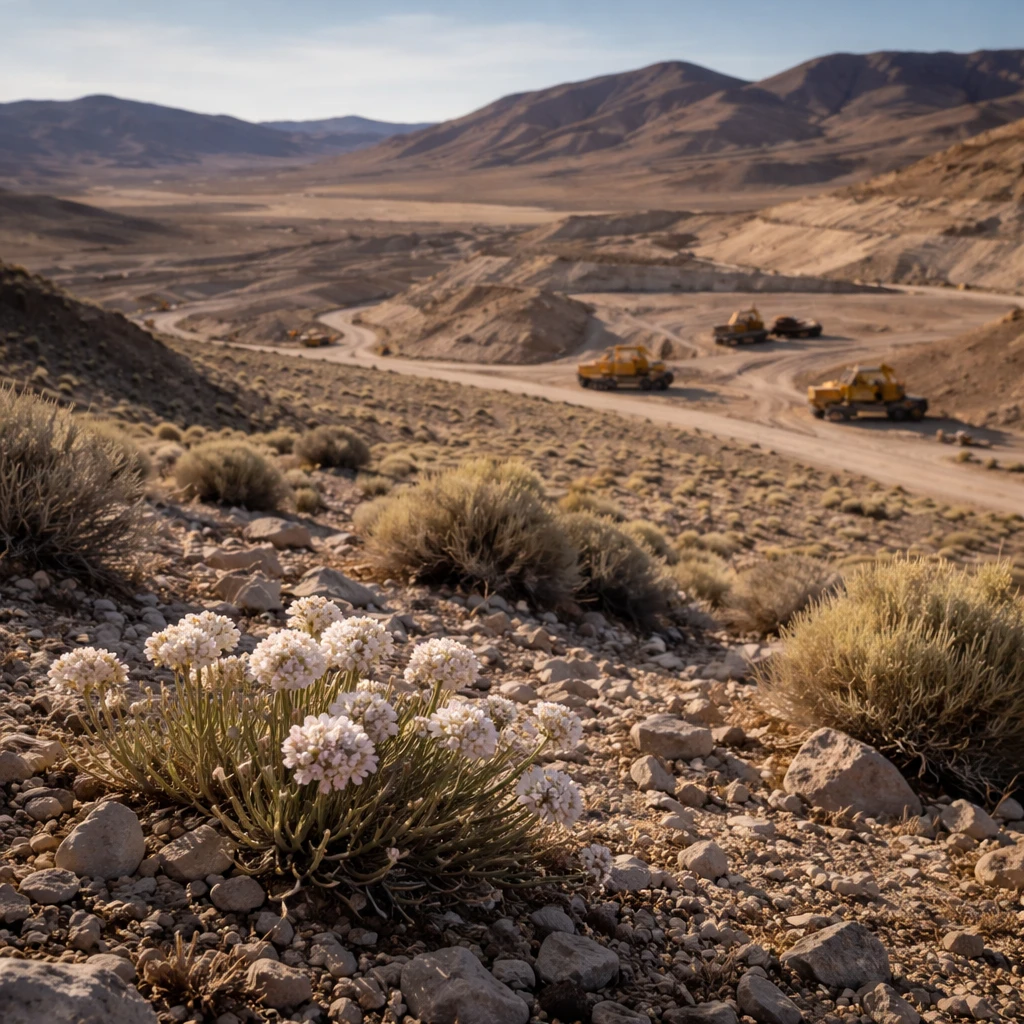
A federal judge in Las Vegas has upheld the U.S. government's approval of the Rhyolite Ridge lithium and boron mine in Nevada, rejecting claims by environmental advocates that regulators failed to properly evaluate the project's environmental impacts. The decision, issued on Monday, affirms steps taken by the Interior Department during the prior administration to permit the Australia-based developer's planned operation.
U.S. District Judge Cristina Silva - who was appointed by President Joe Biden - concluded in a 14-page opinion that the U.S. Bureau of Land Management and other Interior Department officials had imposed mitigation measures for Tiehm's buckwheat that are "sufficiently detailed and reasonable," and had properly analyzed effects on groundwater and related ecological factors. The ruling was handed down in a lawsuit brought by the Center for Biological Diversity, which sought to block the project.
The environmental group had argued that the mine, if developed, could push the rare Tiehm's buckwheat toward extinction and cause harm to groundwater, air quality, cultural resources and wildlife habitat. In its complaint the group contended the federal approval violated the National Environmental Policy Act, the Federal Lands Policy and Management Act and the Endangered Species Act.
Judge Silva found that federal regulators had sufficiently reviewed the potential environmental consequences and had attached mitigation requirements aimed at protecting the wildflower and other resources. The ruling states officials completed an appropriate analysis of the mine's likely impacts and set conditions intended to limit damage.
The company reacted positively to the decision. An ioneer spokesperson described the ruling as a meaningful milestone for the U.S. critical minerals agenda. "Rhyolite Ridge will create hundreds of new American jobs, reduce reliance on foreign materials and processing and provide a domestic source of two critical minerals," said spokesperson Chad Yeftich.
Market reaction was swift for ioneer stock. Shares climbed roughly 24 percent in afternoon trading on the New York Stock Exchange following the court's decision. The company still faces a financing task for the project after a prior partner withdrew, and executives are working to secure a replacement backer.
Sibanye Stillwater, which had been set to co-develop the mine, exited the partnership last year amid its own financial challenges. That withdrawal left ioneer searching for new investors to help fund the project's reported $1.67 billion capital cost. Company officials said this month they are in active discussions with multiple parties to secure the required funding.
The Rhyolite Ridge site, located roughly 225 miles north of Las Vegas, is expected to become one of North America’s largest sources of lithium, a metal central to battery manufacturing and already identified as a supplier to automakers including Ford. The project also would produce boron, another mineral considered critical for certain industrial uses.
Despite the court ruling in favor of the government and the developer, the Center for Biological Diversity said it was deeply disappointed and criticized the government's plan to protect the wildflower as fragile. "We’re exploring our next steps but we’re more determined than ever to continue fighting to save Tiehm’s buckwheat," said Patrick Donnelly, a regional director for the group.
The Interior Department declined to comment on the ruling. When it approved the mine, the department said it had implemented numerous measures to protect the ecosystem surrounding the site, which lies in a high desert environment in Nevada.
Funding and permitting milestones remain critical next steps for ioneer. Days before leaving office last year, President Biden finalized a $996 million loan for the Rhyolite Ridge project from the U.S. Department of Energy and issued the project's final permit in 2024. Those federal actions were aimed at supporting domestic critical minerals production but did not prevent subsequent shifts in project partners.
With the legal challenge resolved for now, ioneer must still secure the capital needed to move forward. The company faces the practical task of converting the federal approvals and loan commitment into a financed, permitted and constructible mine, a process that will rely on finding a financing partner willing to participate following Sibanye Stillwater's withdrawal.
The court decision reduces regulatory uncertainty tied to judicial review but does not eliminate opposition from conservation groups, which have signaled continued resistance. The project's trajectory will therefore continue to be shaped by both funding dynamics and ongoing environmental scrutiny.