
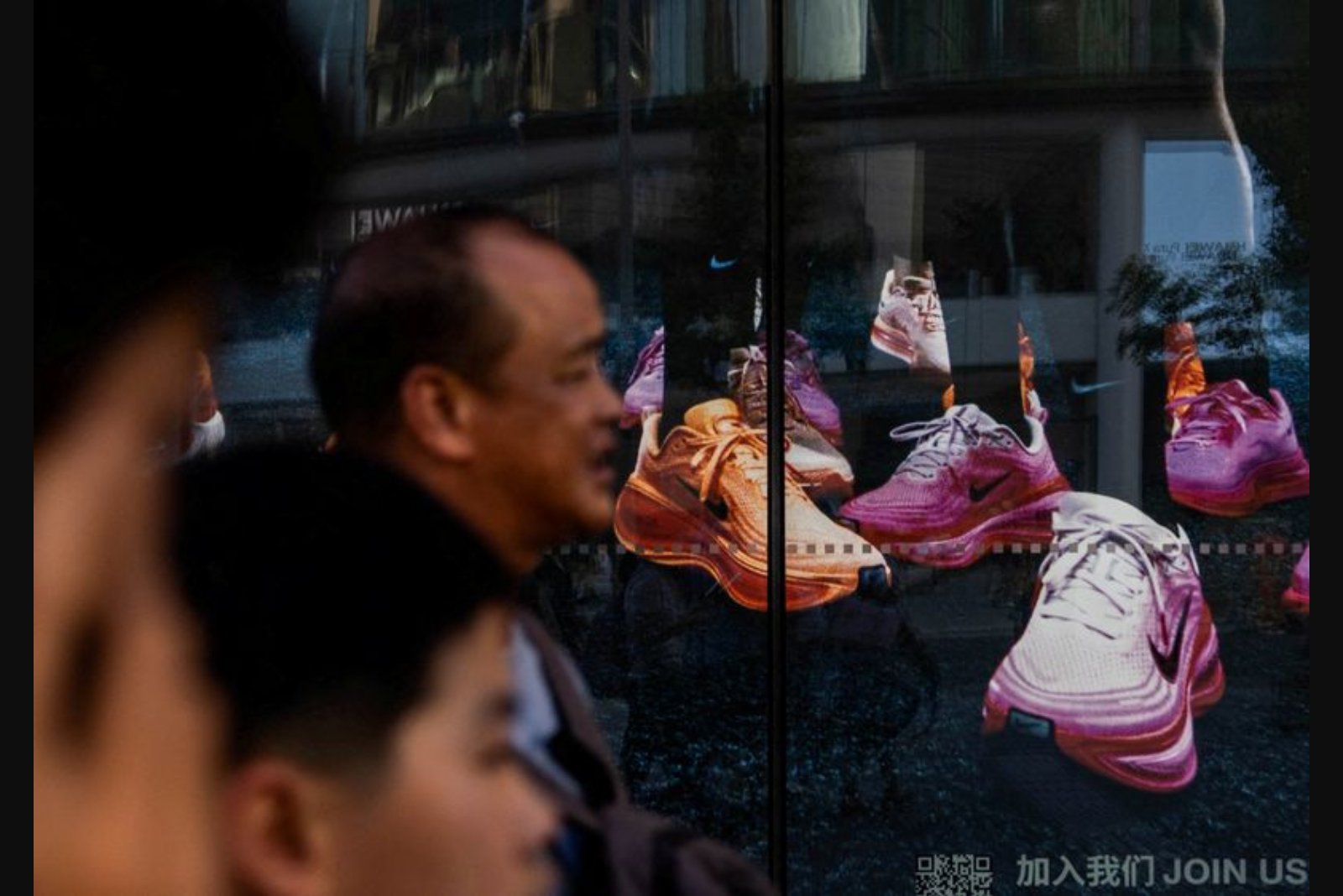
Nike’s recent performance in Greater China has revealed executional shortcomings that extend beyond a backlash against foreign brands, as the U.S. sportswear giant grapples with a slowing Chinese consumer, a prolonged property crisis and increasingly capable local competitors.
Greater China represents about 15% of Nike’s global revenue and stands as the company’s largest market outside North America, making the region’s downturn an urgent problem for the company. The combination of weaker consumer demand and intensified local rivalry has magnified the consequences of operational missteps, turning strategic errors into a material business risk.
The scale of the challenge is clear in Nike’s recent results. The company has now posted six straight quarters of declines in China, including a 17% drop in the latest quarter reported in December. Chief Executive Elliott Hill described the market as the "longest road" in the company’s global turnaround and acknowledged a need to "reset" the approach in Greater China.
Early this year Nike tapped a long-serving internal executive to lead the effort. The company appointed 25-year company veteran Cathy Sparks as Vice President and General Manager of Greater China, replacing long-time executive Angela Dong. Sparks has been tasked with repairing ties to retailers, tackling stale inventory and accelerating Nike’s digital push in the region.
But industry observers and insiders say the causes of the slump run deeper than brand perceptions alone. Yaling Jiang, founder of research and strategy consultancy ApertureChina, argued that the brands facing difficulty in China - including Nike, Starbucks and Häagen-Dazs - are not declining simply because consumers avoid foreign names. Instead, she said, these brands are attempting to sell at premium price points without offering a convincing rationale for the premium.
Those shortcomings have played into the hands of domestic rivals. Anta and Li Ning have exploited agile supply chains and expansive store networks to bring competitively priced products into more of China’s inland markets, narrowing Nike’s advantage on distribution and price. Meanwhile, international competitors such as On and Hoka have achieved strong double-digit growth by riding increased sports participation, particularly running.
Adidas provides a case study of a foreign peer that managed to recalibrate. After five consecutive quarters of decline in China during 2023, Adidas returned to growth and, by 2025, had recorded ten straight quarters of expansion in the market. Executives there emphasized localising product design and accelerating product cycles: locally designed items now account for a vastly larger share of Adidas’ China assortment than before the shift.
Retail partners and former Nike staff members say Nike’s response has been less structural. A concept store owner and wholesale partner said Adidas went beyond superficial tweaks to apparel fit and sneaker models, while Nike has often confined changes to patterns, palettes or graphics. The wholesale partner, who asked not to be named, said Nike’s adjustments were not deep enough to meet evolving local tastes.
Three employees with direct knowledge of Nike China - two former and one current - described operational frictions that undermined responsiveness to local demand. They pointed to a top-down decision-making culture that slowed reactions to market signals, repeated pushes to place poorly received products with retail partners and inventory practices that left the company exposed as consumer spending softened.
Those inventory challenges have had commercial consequences. Frequent discounting to clear excess stock eroded Nike’s premium image and strained relationships with wholesale partners, according to the employees who spoke on condition of anonymity. Analysts now expect Nike’s gross profit margin to contract for a sixth consecutive quarter, and revenue is forecast to slip about 0.3%, based on data compiled by LSEG.
Beyond domestic operational shortcomings, broader risks are adding uncertainty. The ongoing property sector crisis and a wider economic slowdown in China are dampening household spending power, while geopolitical developments in the Middle East have pushed oil prices higher, raising the prospect of increased material and input costs for global manufacturers.
Still, some observers say a recovery is possible if Nike can execute a more localised approach. Morningstar analyst David Swartz said the trajectory seen at Adidas shows a rebound is not impossible, noting: "It doesn’t have to be a death spiral." Wei Kan, founder of consultancy Conduit Asia and a former brand director at Nike Greater China, pointed to recent marketing efforts that leaned into local humour for a Chinese New Year campaign as signs Nike is beginning to adapt. He observed that when sentiment is buoyant, the "Just Do It" message resonates, but in the current climate it has been less aligned with how people in China are feeling.
Nike declined to comment as it enters the company quiet period ahead of its third-quarter earnings report, expected Tuesday. The company’s leadership changes and stated priorities - improving retail relations, clearing aged inventory and accelerating digital engagement - indicate a clear plan of attack. But industry voices, ex-staff and analysts underscore that reversing the decline will require deeper operational adjustments to pricing, product localisation and supply-chain responsiveness if Nike is to reclaim momentum in a market that is becoming less tolerant of premium brands that cannot justify their price tags.
Context note: This article focuses on the operational and competitive factors shaping Nike’s performance in Greater China as described by industry sources, company announcements and analyst expectations. It does not introduce any data or claims beyond those cited above.