
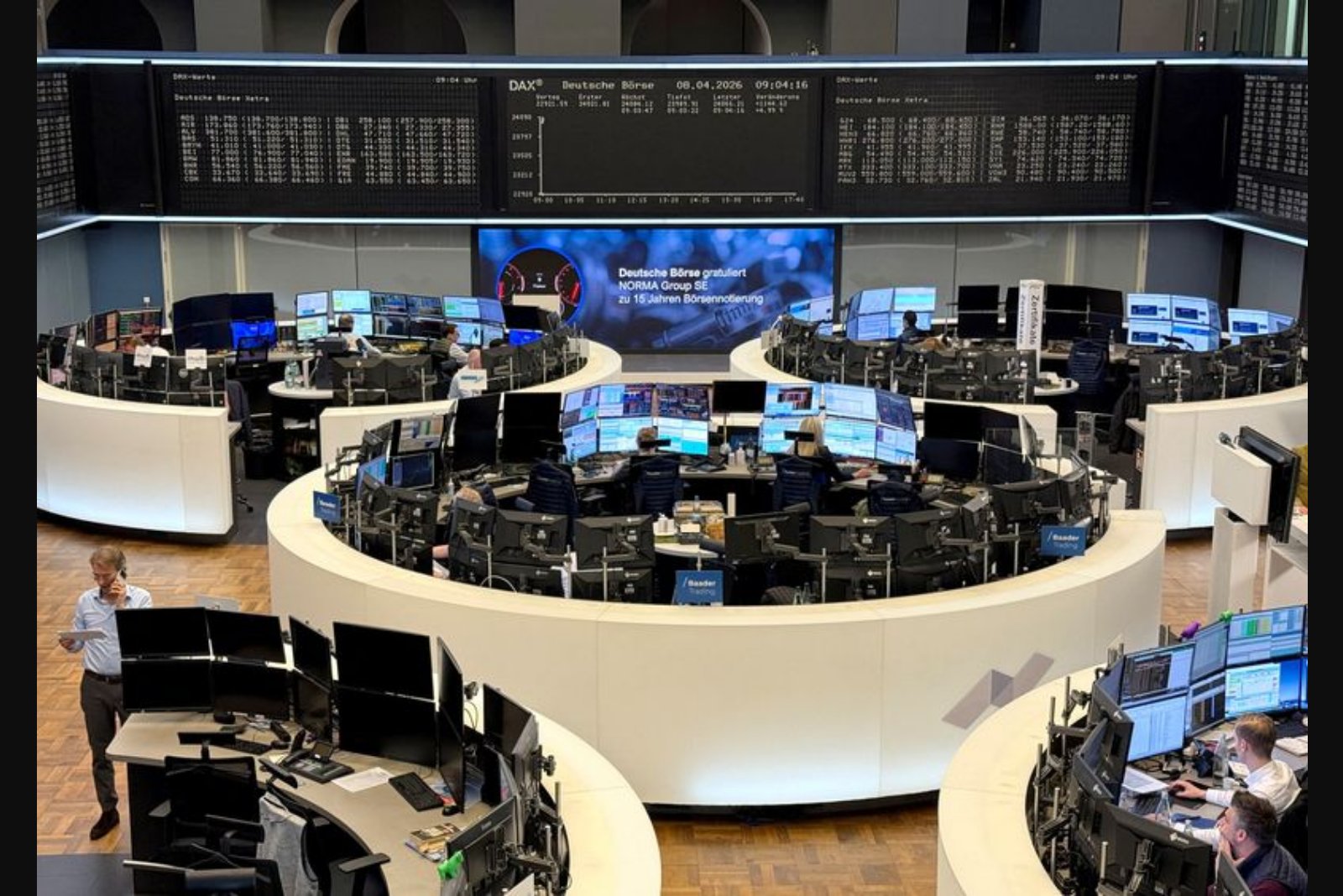
European markets staged a strong rebound on Wednesday after news that U.S. President Donald Trump and Iran agreed to a two-week ceasefire, rekindling hopes that trade through the Strait of Hormuz could resume. The pan-European STOXX 600 climbed 3.7% to 612.32, marking its biggest one-day gain in more than four years.
Regional benchmarks posted substantial gains alongside the STOXX 600. Germany's DAX rose 4.7% while France's CAC 40 added 4.5%. The ceasefire agreement arrived less than two hours before a U.S. deadline for Iran to reopen the Strait of Hormuz, a development that helped trigger a sharp drop in oil prices beneath $100 a barrel.
Despite the broadly positive market reaction, concerns persisted in parts of the region as Israel continued strikes in Lebanon. Kiran Ganesh, multi-asset strategist at UBS Global Wealth Management, cautioned that investors should be prepared for the possibility of renewed rhetoric or intermittent disruptions to energy flows through the strait. "Investors should not be surprised if we do see some period of re-escalation in rhetoric, or if some of the energy flows through the Strait of Hormuz perhaps disappoint what people might hope for. But overall, the announcement is a positive development," he said.
Sentiment indicators reflected the easing of near-term geopolitical risk. The STOXX volatility index dropped below 25 points for the first time in over three weeks, underscoring reduced market fear compared with recent sessions.
The rally was broad-based, with cyclical sectors typically sensitive to energy costs and interest rates among the best performers. Travel, industrials and the banking sector moved higher by between 5.7% and 7.1% - categories investors often view as beneficiaries of lower energy expenses and falling bond yields.
Barclays analysts said they see only limited earnings impact for European banks from the recent developments and maintained a positive view on the industry, while noting that a fuller recovery in the sector depends on a sustained ceasefire. "Investors are not turning bearish, but appetite to 'buy the dip' remains limited absent a clear de-escalation," the analysts wrote.
Steelmakers, which had been pressured by high production costs tied to energy, also surged. ArcelorMittal climbed 12.8% to become the top gainer on the STOXX 600, while Germany's Salzgitter and Thyssenkrupp added 15.2% and 9%, respectively.
Technology stocks advanced 5.6%, led by strong performances among chip-related names. Shares of Infineon, Soitec, ASML and SUSS Microtec rose in a band between 8.9% and 11.8%.
Energy shares were the exception to the rally, falling 2.3% as a sector. Shell dropped 4.7% after the company cut its first-quarter gas production outlook, even as it signalled a surge in oil trading profit and acknowledged a hit to short-term liquidity.
Market participants continued to price in shifts to monetary policy in the region. Traders are currently assigning odds that reflect two quarter-point interest rate hikes from the European Central Bank by year-end, according to LSEG data.
Separately, promotional analysis tools referenced in market commentary highlighted ongoing interest in whether Shell (SHEL) is included in algorithmic strategies, noting that such systems evaluate companies across many metrics. The promotional copy mentioned that the AI had previously identified substantial winners in other sectors, a point presented as part of broader market commentary.
Context and takeaway
- The two-week ceasefire agreement between the U.S. and Iran acted as the immediate catalyst for a risk-on move across European equities.
- Cyclical sectors tied to energy costs and interest-rate sensitivity - including travel, industrials, banks and steel - led gains, while energy names underperformed after company-specific updates.
- Volatility eased materially, though market participants and strategists noted the possibility of intermittent re-escalation or disrupted energy flows.