
The recent episode involving U.S. President Donald Trump’s interest in Greenland has energized European Union leaders to adopt a firmer posture in their delicate dealings with Washington. At the World Economic Forum in Davos, President Trump publicly dismissed the notion of acquiring Greenland by force and subsequently retracted the threat of imposing tariffs on eight European countries. This shift came after apprehensions that the U.S. was overstepping, particularly regarding Greenland’s status as an autonomous region of Denmark—a position European officials regard as sacrosanct and non-negotiable.
European policymakers consider Trump’s retreat a result of their unwavering stance, marking a departure from last year’s more conciliatory tone during tariff negotiations. An EU official, granted anonymity to candidly address the situation, emphasized the significance of resisting unilateral U.S. actions that disregard European sovereignty. The official warned that such challenges are likely to recur, necessitating continued vigilance and assertiveness.
Dr. Rosa Balfour, director at Carnegie Europe, signaled the difficulty of this evolving approach but suggested confidence in Europe’s latent influence. She noted that the bloc possesses considerably more leverage than it has historically exercised in engaging with its transatlantic partner.
Despite tensions, European nations are keen not to sever ties with the United States. An urgent summit convened by European leaders aimed to rejuvenate the stalled EU-U.S. trade agreement, previously paused in reaction to the Greenland dispute. German Chancellor Friedrich Merz, speaking ahead of the meeting, acknowledged recent frustrations but urged caution against prematurely discarding the partnership.
Recognizing the volatility posed by the U.S. administration’s approach—including critiques of European defense spending and demands for open market access—the EU is actively pursuing measures to "de-risk" its relationships. Coordination among 27 diverse member countries presents complexities, highlighted by comments from U.S. Treasury Secretary Scott Bessent regarding the EU's divergent political landscapes.
One consequence of the Greenland incident has been accelerated discussions within the EU about adopting more flexible, coalition-based strategies, similar to the voluntary security guarantees seen in the Ukraine context. This model allows for groups of willing countries to act collectively without the need for unanimous consent, thereby circumventing potential vetoes. Strategies under consideration include collective efforts in strategic domains such as artificial intelligence development.
Groups like the "E3"—composed of France, Germany, and the United Kingdom—offer frameworks for security collaboration that extend beyond the EU, drawing in key partners facing similar challenges from U.S. policy directions. Canadian Prime Minister Mark Carney underscored this, calling on middle powers to assert themselves to avoid being sidelined.
Moreover, the EU has leveraged existing legal provisions, exemplified by a December measure enabling the indefinite immobilization of substantial Russian assets. This prevented a single member state from unilaterally undermining collective actions tied to sanctions.
Economic policy is also poised for transformation. The European Commission is preparing legislation centered on "Made in Europe" requirements in critical sectors to enhance strategic autonomy. Additionally, stricter conditionality for foreign direct investment into the EU will serve to diversify and secure supply chains away from excessive reliance on volatile markets.
European Commissioner for Prosperity and Industrial Strategy, Stephane Sejourne, highlighted that while initial efforts were aimed at reducing dependency on China, the policies will also address vulnerabilities related to other markets. He asserted these changes would fundamentally shift the European approach to managing strategic sectors.
European efforts to diversify its global economic partnerships continue, though no strategic pivot toward China akin to Canada’s has been announced. The EU has finalized the EU-Mercosur trade agreement, its largest ever, and is edging closer to a deal with India, aiming to broaden its trade horizons.
Though U.S. tariffs have not definitively reduced Europe’s trade surplus with the U.S.—which initially increased as companies rushed to export ahead of tariff changes—investment behavior presents a more cautious picture. German firms, for example, nearly halved their investments in the U.S. in the prior year.
Security remains a particularly challenging area. While European governments have publicly committed to increased defense expenditures, analysts caution that the capacity to meet current demands—such as fortifying Arctic security—is years away. Discussions are now focused on whether recent tensions can catalyze meaningful reductions in Europe's dependence on the U.S.
Swedish Deputy Prime Minister Ebba Busch commented on the unfolding dynamics at Davos, observing that the EU needs a stronger stance in the face of the U.S. administration's posture. Her remarks reinforce the broader European sentiment advocating for resilience and greater self-reliance in the transatlantic relationship.
As Europe navigates this complex period, the balance between reinforcing partnerships and asserting autonomy remains central to its strategic calculus.
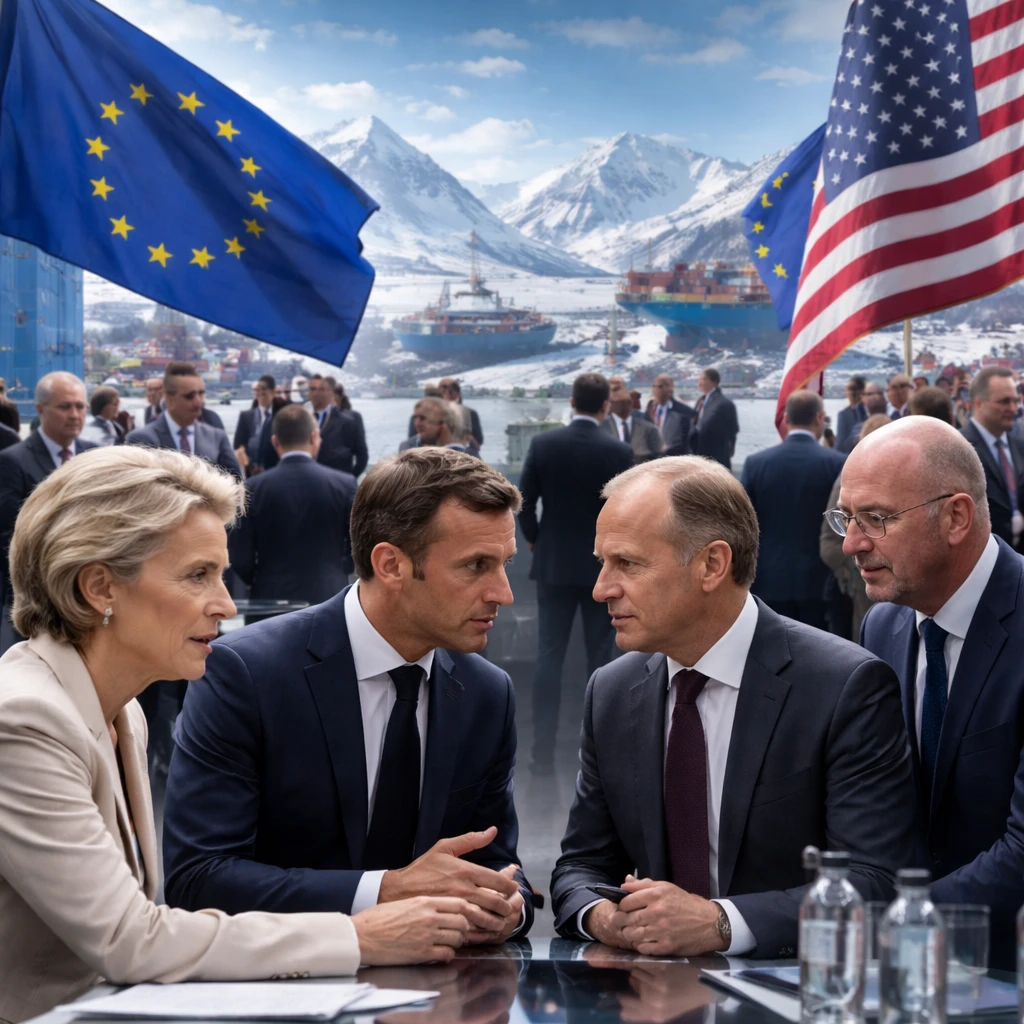
European Union leaders are galvanizing efforts to confront what they view as the escalating assertiveness of the United States under President Donald Trump, following a diplomatic standoff over Greenland. The incident has underscored the urgency of stabilizing the transatlantic partnership and reducing Europe’s economic and security vulnerabilities, especially within the context of the $2 trillion U.S.-EU trade relationship, NATO cooperation, and support for Ukraine.
Key Points
- Europe responded firmly to U.S. President Trump's provocative interest in Greenland, reinforcing Greenland's autonomous status and European sovereignty.
- The EU is accelerating initiatives to diversify economic and security partnerships, including flexible coalition models and legislation enhancing strategic autonomy in critical sectors.
- Despite recent tensions, European leaders emphasize the importance of maintaining and stabilizing the transatlantic partnership with the U.S., while also addressing exposure risks amid shifting U.S. policies.
Risks
- Recurring unilateral U.S. policy actions pose ongoing challenges to European sovereignty and economic interests, potentially disrupting trade and security arrangements.
- Diverse political and economic interests among EU member states complicate rapid consensus-building, risking delays in strategic responses to U.S. pressures.
- Europe's current defense capabilities remain insufficient to independently manage emerging security demands, including Arctic security, extending reliance on U.S. support.