
At the recent World Economic Forum meeting in Davos, Elon Musk, the CEO of Tesla, presented a broad overview of forthcoming technological advancements spanning AI, robotics, autonomous vehicle technology, and space exploration. He revealed that Tesla is preparing to offer humanoid robots for consumer purchase by the end of next year. This launch is contingent upon the company’s confidence in the robots’ reliability and safety. Currently, Tesla’s Optimus robots are performing basic tasks in factory settings, with enhancements aimed at more complex operations expected by the end of the current year.
On the subject of autonomous driving, Musk described self-driving cars as a "largely solved problem," highlighting Tesla's Full Self-Driving software, which undergoes updates approximately every week. He mentioned that some insurance providers are incentivizing adoption by offering discounted premiums, sometimes cutting insurance costs by half for users of Tesla's Full Self-Driving features, citing improved safety metrics. Tesla has initiated robotaxi services in multiple cities and anticipates a wider rollout across the United States by year-end. In Europe, supervised full self-driving approval could be granted as soon as next month.
Musk also addressed ambitions for space technology through SpaceX, where the goal is to attain complete rocket reusability with the Starship program within the year. He described the Starship as "the largest flying machine ever made," stressing that this breakthrough would slash the costs of space access by a factor of 100, lowering the cost below $100 per pound.
Additionally, Musk discussed plans to deploy solar-powered AI satellites in the near future. He underscored the advantage of space-based solar panels due to constant exposure to sunlight and the absence of atmospheric disruption, which increases their efficiency fivefold compared to ground-based panels. Projecting a timeline of two to three years, he proposed that space could become the most cost-effective location for hosting AI systems.
Regarding terrestrial energy production, Musk noted that an area of solar panels measuring 100 miles by 100 miles could fulfill the entire electricity requirements of the United States. He further indicated that Tesla and SpaceX are independently advancing efforts to establish manufacturing capacity aimed at producing 100 gigawatts of solar power annually within the U.S. over the coming three years.
Looking forward, Musk forecasted that AI might surpass human intelligence "by the end of this year" or "no later than next year." He articulated his broader vision as striving to maximize the likelihood that civilization enjoys a prosperous future and to extend consciousness beyond Earth.
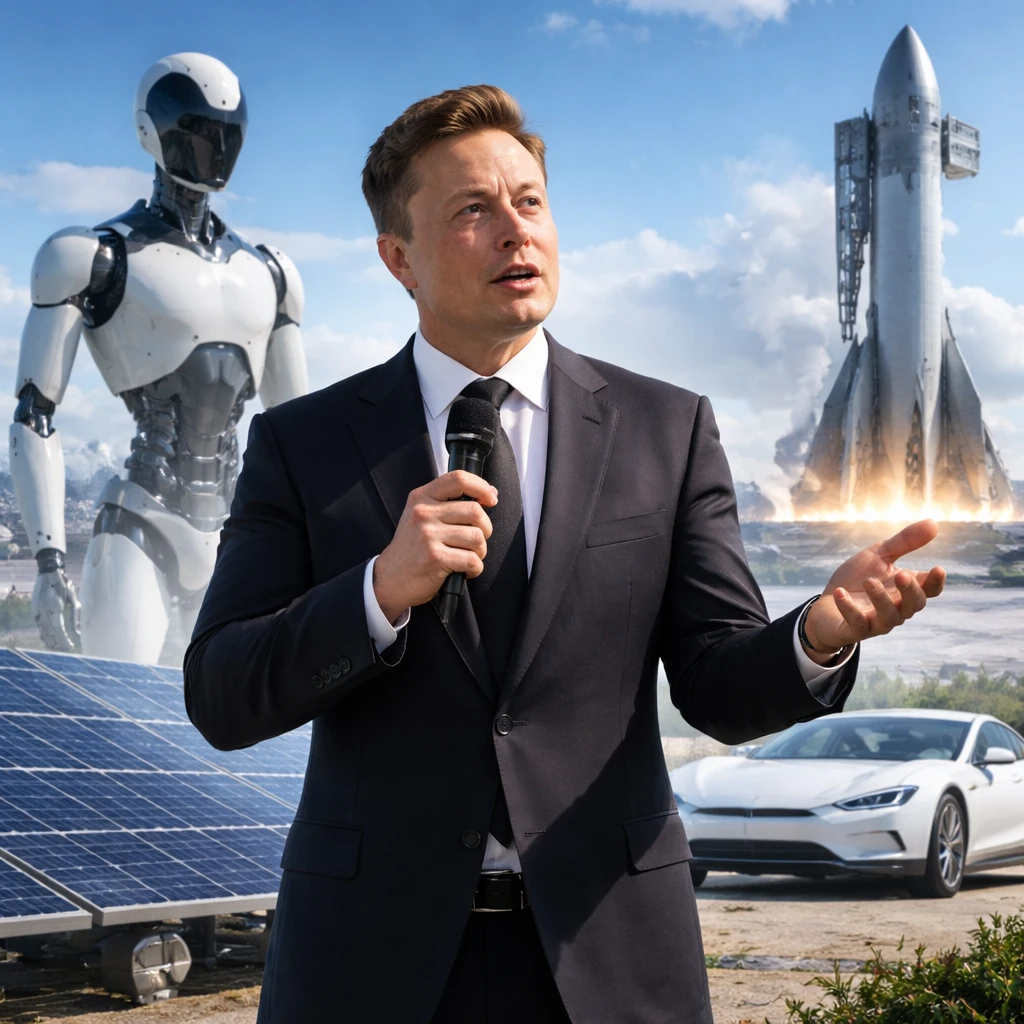
During a discussion at the World Economic Forum in Davos, Tesla CEO Elon Musk shared insights about the rapid advancement in artificial intelligence (AI), robotics, autonomous vehicles, and space exploration. He projected that AI could outperform human intelligence by the end of this year or at the latest by next year. Tesla plans to introduce humanoid robots to the consumer market by late next year after demonstrating reliability, while autonomous self-driving technology progresses toward broader implementation. SpaceX aims to achieve full rocket reusability with Starship, potentially drastically reducing space access costs, alongside plans for solar-powered AI satellites that harness the efficiency of orbiting solar panels. Tesla and SpaceX are also focusing on expanding solar energy production capacity in the U.S.
Key Points
- Tesla plans to release humanoid robots to consumers by late next year, pending validation of safety and reliability, with current applications in factory-based simple tasks.
- Tesla considers autonomous driving technology effectively resolved, with frequent software updates and insurance discounts reflecting improved safety; widespread robotaxi services are anticipated in the U.S. by year-end.
- SpaceX targets full reusability of the Starship rocket within the year, aiming to significantly reduce space access costs, and plans to deploy solar-powered AI satellites leveraging superior space-based solar panel efficiency.
- Tesla and SpaceX intend to expand solar power manufacturing capacity to 100 gigawatts annually in the United States within approximately three years, supporting substantial renewable energy growth.
Risks
- Reliance on achieving safety and reliability milestones before humanoid robots can be marketed, presenting potential delays or setbacks in commercial rollout, impacting robotics sector expectations.
- Pending regulatory approvals in Europe for full supervised self-driving could restrict Tesla's autonomous vehicle expansion if not granted, posing a risk to the automotive and autonomous technology sectors.
- The ambitious aim for full rocket reusability with Starship could face technical or developmental challenges, which may affect project timelines and cost reduction goals, influencing the aerospace and space exploration markets.