
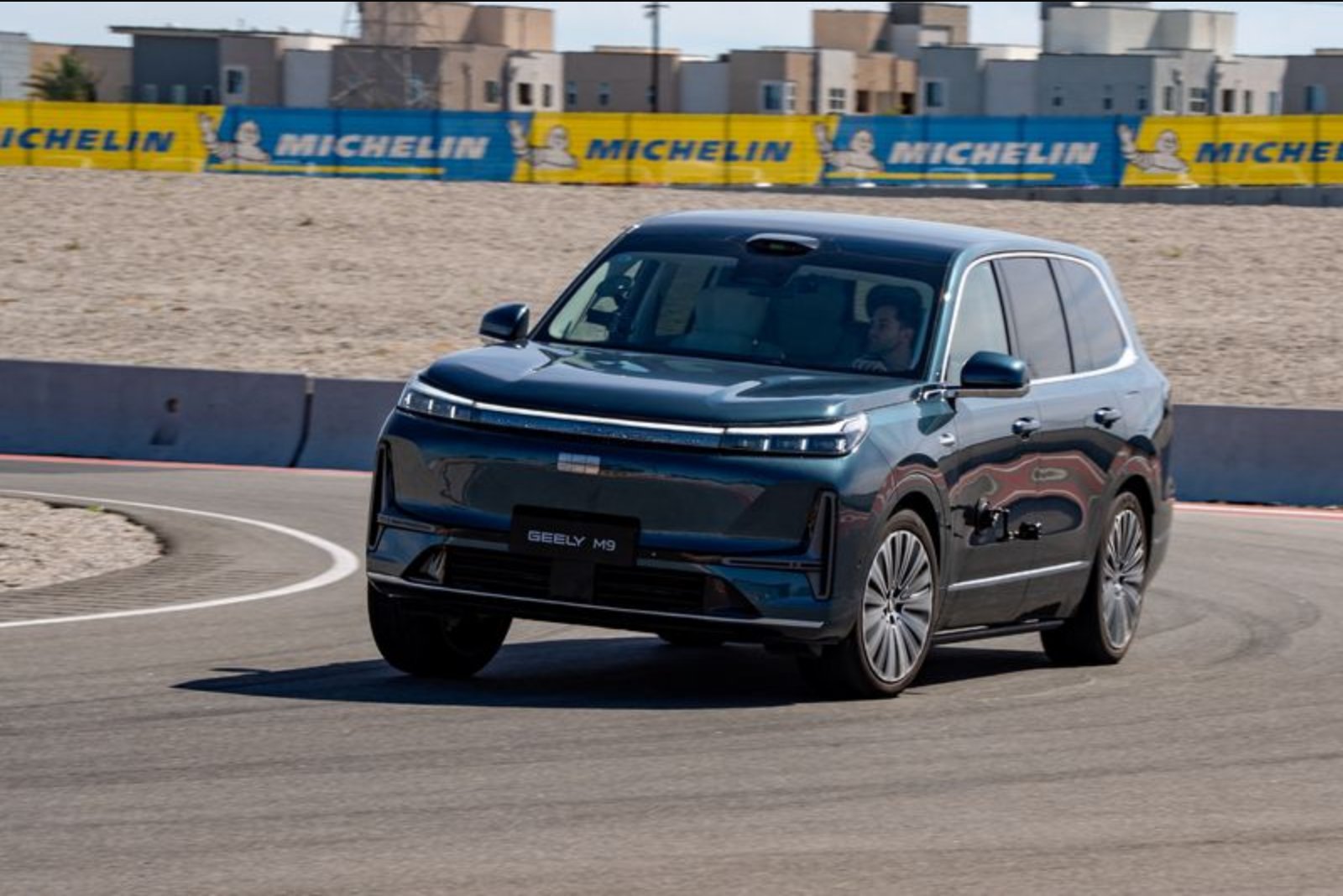
Edmunds conducted a full evaluation of a Geely Galaxy M9, marking the first time the car-shopping site has put a Chinese-brand vehicle through its complete testing regimen. The model assessed was an extended-range hybrid three-row SUV that starts at about $25,000 in China. After driving the vehicle on Edmunds’ Los Angeles-based test track and using it in routine scenarios, Editor-in-Chief Alistair Weaver said the experience left a clear impression: U.S. automakers have reason to take notice.
"The technology is terrific," Weaver said after driving the Galaxy M9 around the test course. Edmunds’ engineers and reviewers drove the vehicle for about three weeks in everyday situations - grocery trips and other routine uses - and also conducted a 227-point evaluation measuring acceleration, braking, driving range, performance and functionality.
Testing and technical findings
The site evaluated how the plug-in extended-range hybrid performs across metrics the outlet routinely measures. Edmunds’ testing indicated the Galaxy M9 can travel roughly 100 miles on electric power alone before the small gasoline engine, functioning primarily as a generator, is needed. The outlet also reported an estimated total driving range of about 808 miles for the model, a figure that Edmunds said exceeds projections from similar products expected from U.S. automakers.
Beyond range figures, the Galaxy M9 includes a 30-inch infotainment screen that Edmunds determined to be as responsive as those in Tesla vehicles. Reviewers also noted features commonly found on Chinese-brand models: a built-in fridge, exterior speakers and a flip-down entertainment screen for the second row. Edmunds concluded that the Galaxy M9’s feature set and refinement rival those of much pricier competitors.
Value comparison and market access
Edmunds contrasted the Galaxy M9 with three-row SUVs sold in the U.S. that commonly sell for substantially more. The outlet compared the Geely to fully loaded versions of the Hyundai Palisade, Kia Telluride and Toyota Grand Highlander - vehicles it said the M9 matches in equipment and comfort despite a much lower starting price in China. Edmunds noted that, even if the M9 were priced higher for sale in the U.S., it would still be competitive at double its current Chinese starting price.
Chinese-brand cars are effectively excluded from the U.S. market by a combination of regulations, opposition from lawmakers and tariffs reportedly near 100%. Nonetheless, Edmunds said it was able to legally borrow the Galaxy M9 from Geely after meeting company executives at the CES trade show earlier this year and drive the model on U.S. roads.
Company statements and broader consumer interest
Geely confirmed it provided the vehicle to Edmunds to demonstrate its global technological capabilities and emphasized that the company’s commercial focus for the Galaxy M9 remains on China. "Geely continuously evaluates global markets, but our current commercial focus for the Galaxy M9 remains on China," a spokesperson said.
A recent survey from Cox Automotive, the outlet noted, shows consumers in the United States are increasingly open to Chinese-brand vehicles. Some potential buyers have explored ways to import Chinese models from Mexico, where such cars are more common, or from Canada, where their presence is likely to grow after trade barriers were eased.
Industry context and manufacturer strategies
Extended-range hybrids - large battery packs that power the vehicle in electric mode, combined with small gasoline engines that act mainly as generators - have been offered by Chinese automakers for years. Major global manufacturers, including Ford and Stellantis, have plans to introduce extended-range hybrid models in the U.S. as alternatives to vehicles powered solely by batteries, reflecting a broader industry interest in hybrid solutions.
Tu Le, founder of consultancy Sino Auto Insights, attributed the abundance of feature-rich, low-priced models in China to intense competition in that market. He warned that if those options are kept out of the U.S. entirely, especially as domestic prices rise, consumer dissatisfaction could grow. "We’re seeing some of the most innovative products at the lowest prices, and consumers around the world are benefiting," Le said. "To keep them out 100%, full stop, that’s what’s going to upset people."
Takeaway
Edmunds’ hands-on testing of the Geely Galaxy M9 highlights a Chinese-built, extended-range hybrid SUV with a combination of long estimated driving range, advanced infotainment responsiveness and convenience features that reviewers judged to be competitive with much more expensive U.S.-market rivals. The assessment adds to ongoing debate about market access, consumer interest and how U.S. automakers might respond to technology and value propositions coming from Chinese manufacturers.