
Stock Markets May 12, 2026 09:59 AM

Dimon Warns Markets May Be Getting Ahead of Themselves Amid Global Frictions

JPMorgan CEO cautions that investor optimism could be underestimating inflation and geopolitical risks

By Leila Farooq JPM

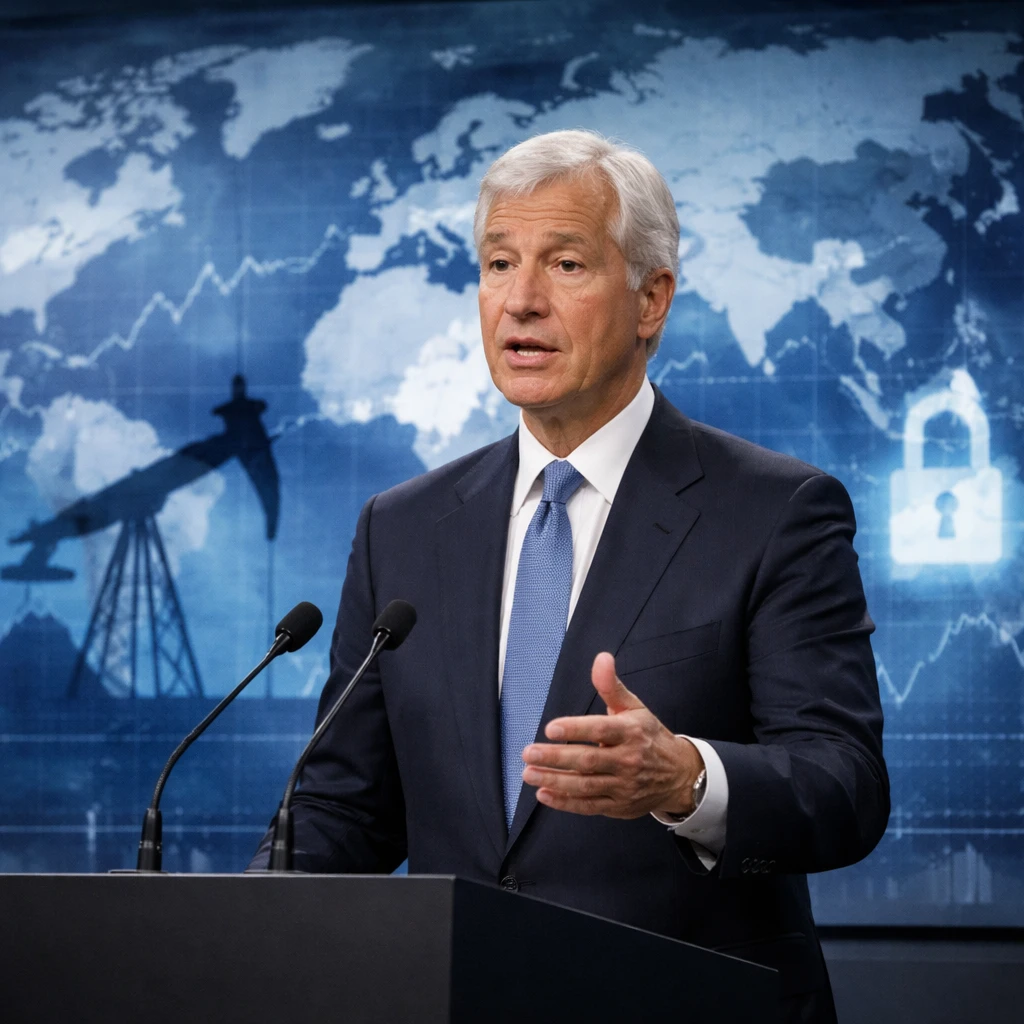
JPMorgan Chase CEO Jamie Dimon said markets show signs of 'a little too much exuberance' and cautioned that inflation pressures and multiple geopolitical flashpoints remain unresolved. Speaking on Bloomberg TV, Dimon flagged robust corporate profits and consumer strength in higher-income cohorts, while warning of mounting Middle East tensions and heightened cyber risk from artificial intelligence.

Dimon Warns Markets May Be Getting Ahead of Themselves Amid Global Frictions
JPM

Key Points

  • JPMorgan CEO Jamie Dimon said markets show "a little too much exuberance," warning investors may be underestimating inflation risk.
  • Dimon cited strong corporate profits this year, supported by increased spending including a $300 billion contribution from the "One Big Beautiful Bill" and $100 million in gas price increases.
  • Geopolitical tensions - including in the Middle East, Ukraine, and frictions between the U.S. and China - remain unresolved and could affect markets; energy flows have shifted with China cutting demand by 5 million barrels per day and the U.S. boosting exports by 3 million barrels daily.
  • Dimon described U.S. consumer conditions as uneven: the top 50% have financial resilience while the bottom 30% are "struggling a little bit" but still employed without excessive debt, and he called cyber risk heightened by AI vulnerabilities.

JPMorgan Chase CEO Jamie Dimon said Tuesday that market sentiment appears overly buoyant and that investors may be minimizing inflation risks while concentrating on hopes for a resolution in the Middle East. Speaking on Bloomberg TV, Dimon described the current market tone as upbeat but urged caution given a range of unresolved geopolitical and economic issues.

Dimon pointed to several international tensions - involving Ukraine, Russia, and relations between the United States and China - as complicating factors that could influence markets. He emphasized that inflation remains a troublesome factor despite the prevailing optimism among investors.

On corporate performance, Dimon said profits have been strong this year and attributed part of that strength to higher spending that carries inflationary potential. He cited the so-called "One Big Beautiful Bill" as contributing roughly $300 billion in spending, and he also noted gas price increases amounting to $100 million as additional pressure.

Describing market conditions, Dimon said equities are trading in a range that places valuations roughly in the top 10% to 50% historically, and he noted that interest rates remain low. Nevertheless, he said the resolution of ongoing geopolitical tensions is uncertain and that outcomes could influence the market trajectory.

Addressing the conflict in the Middle East, Dimon said the situation "gets a little more serious every day," though he observed that the timeline for a potential disaster has been extended compared with earlier expectations. He also pointed to shifts in global oil dynamics, noting that China has cut oil demand by about 5 million barrels per day while the United States has increased exports by roughly 3 million barrels daily, which he said may have helped blunt the immediate severity of the situation.

On the U.S. consumer picture, Dimon drew a distinction across income groups. He said the top 50% of households have money, jobs, and rising home prices. By contrast, he said the bottom 30% are "struggling a little bit," though they remain employed and are not carrying excessive debt, according to his remarks.

Dimon also highlighted technological risks, calling cyber risk the bank's largest concern and saying that artificial intelligence amplifies those vulnerabilities. He warned that AI will "change almost everything" and urged the financial industry to collaborate on cybersecurity measures to address growing threats.


Contextual note: Dimon's comments combined caution on macroeconomic and geopolitical fronts with acknowledgement of current corporate earnings strength and heterogeneous consumer conditions across income tiers.

Risks

  • Inflation risk driven by increased spending and higher gas prices could affect equities and fixed-income markets - relevant to banking, consumer, and broader market sectors.
  • Escalating geopolitical tensions, particularly in the Middle East and between major powers, present uncertainty for energy markets and overall market stability - impacting energy and financial sectors.
  • Rising cyber risk amplified by AI vulnerabilities threatens financial institutions and requires cross-industry cybersecurity coordination - pertinent to banking and technology sectors.

More from Stock Markets

TrueBlue Shares Rise After HireQuest Offers $105M for PeopleReady On-Demand Unit May 12, 2026 U.S. Equities Finish Mixed as Healthcare, Telecoms and Energy Outperform; Tech and Industrials Slip May 12, 2026 Bovespa Ends Lower as Utilities, Industrials Drag Stocks to One-Month Low May 12, 2026 Canadian equities tick higher as energy, staples and materials lead gains May 12, 2026 Intuitive Machines Selected for Space Force Andromeda IDIQ to Develop GEO Surveillance Systems May 12, 2026