
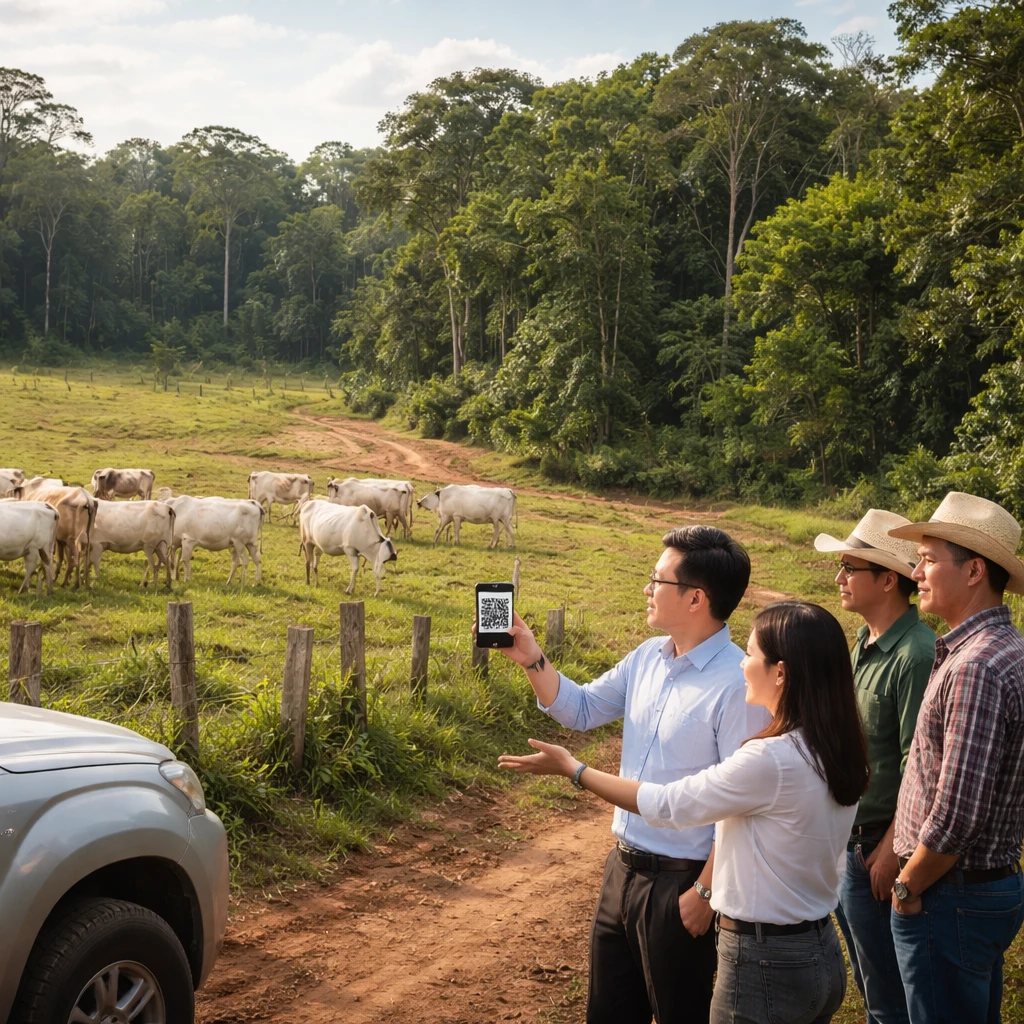
When Xing Yanling shared images and impressions from her April trip to the Brazilian Amazon on WeChat, she wrote of the unforgettable feeling of being "enveloped by tens of thousands of shades of green." Her account stands out not simply because of its lyrical description, but because Xing leads the Tianjin Meat Industry Association, representing importers who purchase roughly 40% of Chinese beef imports from Brazil.
Under her leadership, Tianjin's membership has pledged to buy 50,000 metric tons of Brazilian beef certified as free from deforestation by the end of the year. That quantity equals about 4.5% of the volume Brazilian beef exporters are expected to sell to China this year. The commitment by Tianjin importers may signal a willingness among some powerful Chinese buyers to pay a premium for greener, traceable supply chains rather than rely solely on price.
The pledge challenges a longstanding belief among many Brazilian farmers that China - the world's largest importer of both beef and soy - prioritizes price above other attributes. It arrives against a backdrop of recent moves by Chinese authorities and state-linked traders to address the environmental footprint of trade while still shielding domestic producers. China revised its forest law in 2019 to bar trade in illegal timber, and in 2023 it signed a joint commitment with Brazil aimed at ending illegal deforestation driven by trade. Starting last year, state-owned trader COFCO said it would remove deforestation from its supply chain.
Experts who track agricultural supply chains see the beef sector as particularly amenable to concrete action on deforestation. "The beef supply chain is ripe for concrete action because it is not as essential to the Chinese diet as other commodities, such as soy," said Andre Vasconcelos, head of global engagement for Trase, a platform that maps environmental impacts across commodities. "At the same time, there is awareness, supported by available information, that beef, especially Brazilian beef, is the commodity most associated with deforestation among all agricultural commodities imported by China," he added.
The Amazon rainforest, the world's largest and most biodiverse tropical forest, continues to lose hundreds of thousands of acres of tree cover each year. According to MapBiomas, a Brazilian land-use monitoring nonprofit cited by proponents of the certification, around 90% of newly cleared land in the region becomes pasture for cattle almost immediately.
Xing and others involved in the Tianjin initiative say that some Chinese consumers, as they grow wealthier, are becoming more selective and are attentive to environmental impacts. "It's not just 'cheap is good,'" she said. "This means deforestation-free, green, safe and traceable beef will have a stronger market in the future."
For many Chinese households, however, choosing products based primarily on environmental attributes instead of price remains impractical amid rising grocery bills. Supporters of the project point to traceability as a bridge between consumer concerns about the environment and longstanding worries about food safety. The beef Tianjin plans to buy will carry a Beef on Track label developed by the Brazilian nonprofit Imaflora. That label sets out four levels of compliance, tied to how far back in the supply chain beef can be traced and whether ranchers can demonstrate that land used to raise cattle was cleared legally.
Tianjin importers say they are prepared to pay a 10% premium to meatpackers that can verify their supplying farms have no links to legal or illegal deforestation, or to slave labor. If other buyers adopt similar requirements, the proponents argue, the cumulative effect could be meaningful: China purchases over 10% of Brazil's beef exports, according to government statistics and Brazil's beef export association ABIEC.
Yet several obstacles remain that could blunt that potential. Brazil's cattle traceability system is fundamentally based on cattle transport documentation, which prosecutors and other critics say can be manipulated. Illicit practices known as "cattle laundering" allow bad actors to conceal links to illegal land clearing and other unlawful practices within complex supply chains. Strengthening traceability could require years of reform and enforcement to be effective.
The Tianjin delegation visited the Carioca farm in Castanhal, in the Amazon's north, where rancher Altair Burlamaqui showed them his cattle and a protected portion of forest on his property. The meeting took an unexpected turn when the delegation asked whether Burlamaqui would welcome having his beef marketed in China as a product helping to protect the Amazon. He called the idea exhilarating and daunting. "What I gathered from the conversation with them is that they want a product with more added value for a section of their population who is willing to pay for it," he said. "But that section of their population may be bigger than the entire Brazilian population."
Despite the attention Tianjin's sustainability project has attracted, reception across Brazil's broader beef industry has been mixed. Two people who recently spoke with ABIEC's leadership told others that the export group is uncomfortable with Xing's initiative. One concern is that adding certification requirements may impose new hurdles on a market already facing constraints.
This year Beijing imposed quotas on beef imports designed to protect its domestic industry. Brazil is expected to reach a limit of 1.1 million tons by the end of next month, a cap that coincides with Tianjin's plan to ship its first container of certified sustainable beef. Once the quota is reached, any additional beef imports face a 55% Chinese tax, potentially slowing Tianjin's planned shipments.
In a statement, ABIEC said it supports certification efforts in principle but warned that any new labels should be harmonized with existing systems to avoid redundancy and requirements that depend on public infrastructure that may not exist, which could create obstacles to production. ABIEC did not respond to detailed questions about the Tianjin project.
Beef markets are also operating in a year when global production is slated to fall as ranchers in the United States and Brazil rebuild herds, a dynamic that has pushed prices higher in many countries, including China. In that context, import quotas and elevated prices can constrain the pace at which new, higher-cost products penetrate markets.
Traceability is familiar to many Chinese consumers in other product categories. During their visit, members of the Tianjin delegation demonstrated how they affix QR codes to egg cartons so shoppers can trace eggs to the farms where they originated. Traceable eggs command substantial premiums; Xing said consumers can pay twice as much for those products.
Proponents argue the Beef on Track certification, which Imaflora hopes will be adoptable by meatpackers, supermarkets and importers by year-end, will also add value by recognizing preexisting corporate sustainability and traceability measures. The certification's base level is reportedly comparable to a program run by Brazil's federal prosecutors' office that the prosecutors use to monitor whether farms directly supplying the beef industry are in compliance with environmental and labor laws.
That prosecutors' program approved suppliers producing 2.7 million tons of beef per year, roughly a fifth of Brazil's total output but almost twice the volume China imported last year. Tianjin's planned purchases this year fall within that approved output.
No Brazilian meatpacker has publicly announced adoption of the new Beef on Track certification to date. Imaflora contends the label is intended to open market opportunities rather than to become a barrier, pointing to cases in timber and coffee where certification processes sometimes had the opposite effect. "The industry is still trying to understand how this certification can recognize and value Brazilian products, in a scenario of geopolitical tension," said Marina Guyot, a policy manager at Imaflora. She added that the certification aims to acknowledge companies' existing efforts on sustainability and traceability. "It’s a certification that creates the possibility of valuing this effort," she said.
Implications for markets and industry
The Tianjin pledge highlights potential demand for certified agricultural commodities in China, particularly in segments of the population willing to pay for environmental and safety assurances. Sectors affected include meatpackers, exporters, importers, retailers and certification bodies that could facilitate traceability and proof of legal land use. Agricultural commodity markets, logistics providers and companies involved in supply chain auditing also stand to be affected if certification requirements expand.
Summary
A Tianjin group of importers that represents a significant share of China’s beef purchases from Brazil has committed to buying 50,000 metric tons of certified deforestation-free Brazilian beef by year-end. This pledge, while small relative to total expected exports to China, signals demand for traceable, higher-priced products among some Chinese buyers and consumers. The initiative faces challenges including Brazil’s vulnerable traceability system, potential import quotas that could impose high taxes after limits are reached, and mixed reactions from Brazil’s beef exporters.
Key points
- Tianjin importers have pledged to purchase 50,000 metric tons of Brazilian beef certified as deforestation-free by the end of the year - equivalent to about 4.5% of expected Brazilian beef exports to China this year.
- Tianjin buyers say they will pay approximately 10% more for beef that can be traced and shown to be free of links to legal or illegal deforestation and slave labor; certification carries a Beef on Track label with four levels of compliance.
- Obstacles include Brazil’s cattle traceability system, which relies on transport documents that prosecutors say can be manipulated, and Chinese import quotas that cap Brazilian shipments at around 1.1 million tons, after which imports face a 55% tax.
Risks and uncertainties
- Traceability vulnerabilities - Brazil's reliance on cattle transport documents creates opportunities for fraud known as "cattle laundering," undermining the ability to guarantee deforestation-free supply chains. This affects exporters, certification bodies, and downstream buyers.
- Import quotas and tariffs - China's quota system may limit the volume of certified beef that can enter at preferential rates; once quotas are reached, a 55% tax could make further imports prohibitively expensive, impacting importers and exporters alike.
- Industry resistance and adoption lag - Brazil's main beef export group has expressed concern that additional labels could create production barriers if not aligned with established systems; no major Brazilian meatpacker has yet publicly adopted the new certification.