
BEIJING, March 23 - A U.S. congressional advisory body has concluded that China’s open-source artificial intelligence ecosystem is fostering a "self-reinforcing competitive advantage" capable of challenging U.S. rivals, even as Beijing faces restrictions on acquiring the most advanced AI chips. The commission’s report, published on Monday, highlights how low-cost Chinese large language models now dominate usage charts on platforms such as HuggingFace and OpenRouter.
The report points to firms including Alibaba, Moonshot and MiniMax as creators of models that are attracting heavy global use because of their lower cost. That popularity, the commission says, helps fuel further improvement as models are deployed across a broad set of industries in China – from factories and manufacturing upgrades to logistics networks, robotics and other operational systems – generating real-world datasets that feed back into model refinement.
"This open ecosystem enables China to innovate close to the frontier despite significant compute constraints," the U.S.-China Economic and Security Review Commission wrote. The panel adds that Chinese research labs have narrowed performance gaps with top Western large language models, even while the United States has placed limits on exports of the most advanced chips to China since 2022.
U.S. export controls have progressively restricted Beijing’s access to cutting-edge AI accelerators, though Washington authorised exports of a second-tier Nvidia chip in December. At the same time, U.S. companies and developers such as OpenAI and Anthropic, along with larger technology firms, have invested heavily to maintain leadership in foundational AI technologies.
Despite the scale of those investments, the commission cautions that the proliferation of open models offers alternative routes to leadership in AI. The report cites industry activity that suggests a rapid diffusion of Chinese open-source models into global development workflows, noting that some Chinese models have risen to prominence on public model repositories and app marketplaces.
Some metrics cited in the report indicate that roughly 80% of U.S. AI startups now incorporate Chinese open-source models in their stacks. The report also notes commercial milestones such as DeepSeek’s R1 model overtaking ChatGPT as the most downloaded model on the U.S. App Store after its launch last year, and Alibaba’s Qwen series surpassing Meta’s Llama in cumulative global downloads on HuggingFace.
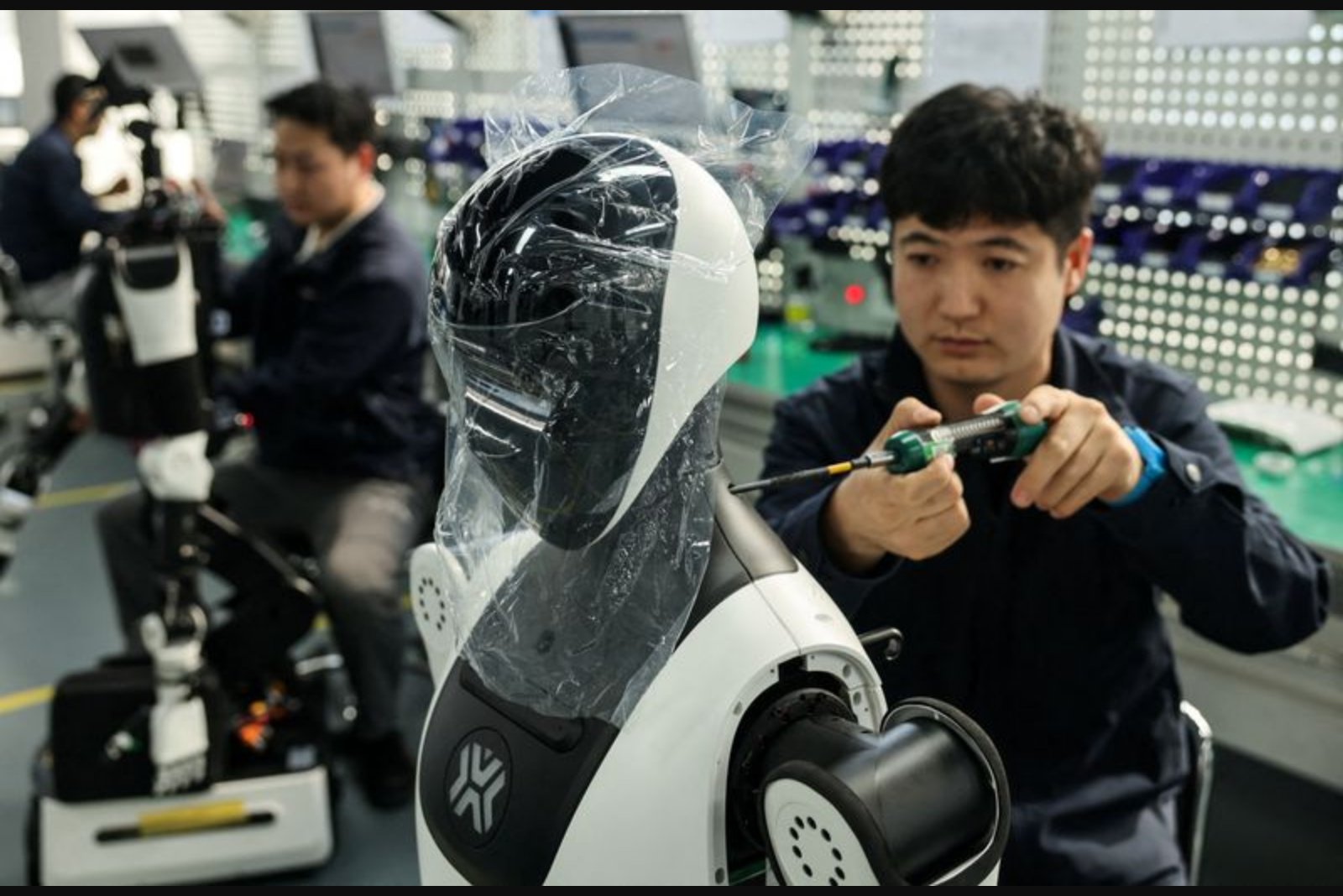
The commission draws particular attention to the shifting frontier of AI research from purely language-based models toward more agentic and embodied AI systems that interact with the physical world. In that shift, it suggests China may have an advantage driven by the scale of its data collection from deployments that can accelerate work on humanoid robotics, autonomous driving software and dual-use technologies.
"There’s a bit of a deployment gap in the embodied AI space between the U.S. and China. That’s something that over time compounds itself ... We’re starting to see that compounding now," Michael Kuiken, the commission’s vice-chair, said in an interview cited with the report. The commission is also monitoring Chinese applications of AI in areas such as biotech, quantum computing and advanced materials.
Beijing has identified embodied AI as a strategic industry for the future, and the report notes that several leading Chinese humanoid robotics companies are planning public listings this year. At the same time, concerns persist among some Western research groups about security risks from heavy reliance on Chinese open-source models and their potential political biases.
Nevertheless, many industrial users are adopting Chinese models for practical reasons. The report quotes Siemens Chief Executive Roland Busch describing no disadvantages to using Chinese open-source AI for the German company’s industrial automation models, citing lower costs and ease of parameter customization as decisive factors.
Implications for markets and sectors: The report underscores potential impacts across manufacturing, robotics, logistics, automotive autonomy, biotech and materials sectors, where data from large-scale deployment can materially affect model development and competitive positioning.