
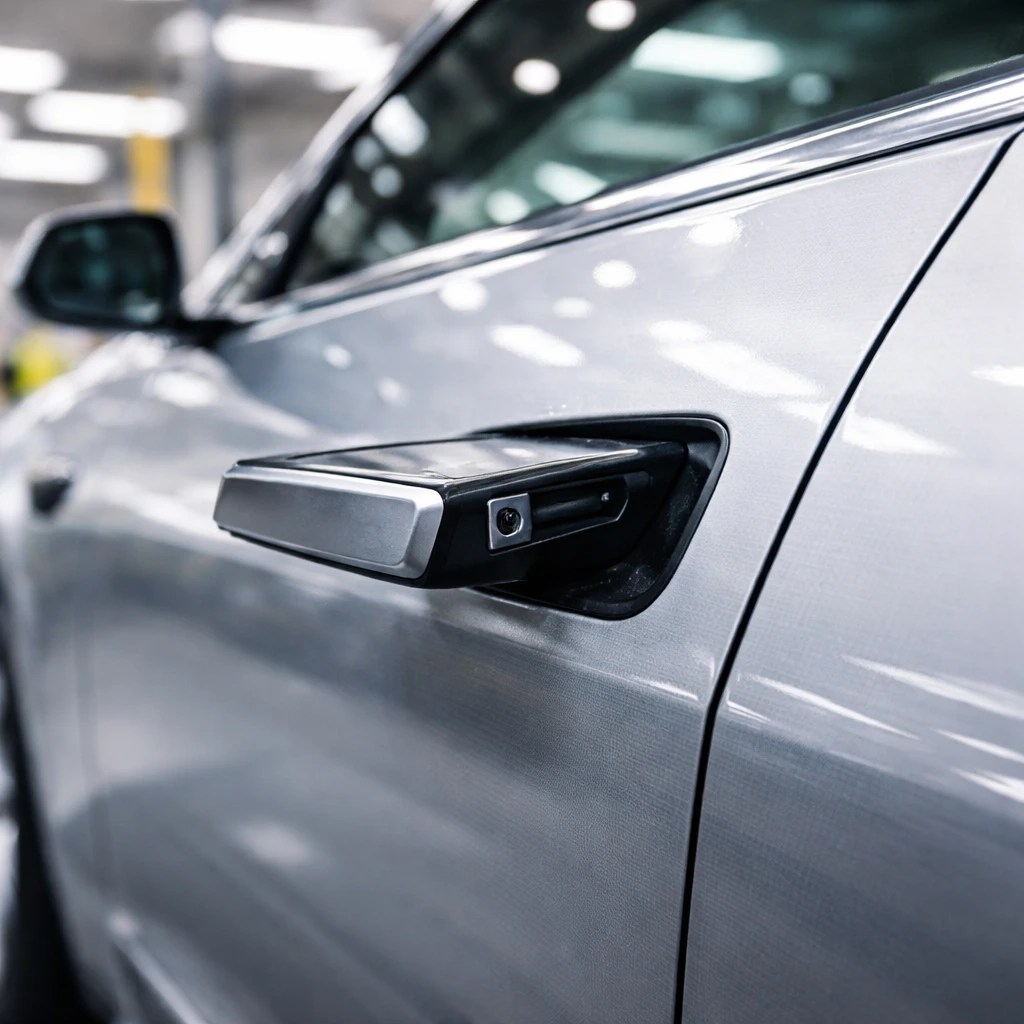
China will ban so-called "hidden" exterior door handles on passenger vehicles beginning in 2027, the country's industry ministry said on Monday, making it the first nation to phase out a design popularized by Tesla and replicated by several Chinese manufacturers, including Xiaomi.
Under the newly announced safety technical requirements, every car door must be fitted with both exterior and interior handles. The regulation specifies that mechanical release mechanisms are compulsory; manufacturers may still offer electrical handle systems at their discretion, but they cannot replace the mechanical requirement.
The handle style targeted by the regulation is one that retracts or sits flush with the car body and operates via a key fob, a mobile phone command, or by pressing the door surface to trigger release. That configuration has attracted growing attention from regulators in both China and the United States because of concerns about possible safety shortcomings.
U.S. authorities have previously examined similar features. In 2025, the U.S. auto safety agency opened a defect investigation into the emergency door release controls on the Tesla Model 3 sedan. At that time, Tesla declined to comment on the probe. Following China's announcement, Tesla did not respond to a request for comment on Tuesday regarding the new Chinese regulations.
The Chinese mandate frames its requirement around clear mechanical functionality for door release, while permitting electrical handle designs as an additional, but not sole, option. The announcement does not detail enforcement mechanisms or the transition steps automakers must follow between now and 2027.
Automakers that have deployed the flush-handle design will need to ensure their future models comply with the dual-handle requirement and incorporate a mechanical release. The rule explicitly applies to car doors and focuses on the method of release rather than other aspects of door design.
Regulatory scrutiny of door-handle mechanisms has occurred in more than one jurisdiction, and this action places China at the forefront of mandating a mechanical fallback for door releases. The industry ministry's statement makes clear the mechanical release is a required baseline even where electrical actuation is offered as an added feature.
Beyond the immediate technical mandate, the announcement raises questions for vehicle designers and suppliers who produce handle assemblies and related actuation components. The new standard fixes a clear requirement for mechanical actuation in addition to any electrical systems.
Summary - China will ban hidden exterior door handles from 2027, requiring both exterior and interior handles with mechanical release designs mandatory; electrical handles remain optional. The rule affects designs pioneered by Tesla and used by Chinese rivals including Xiaomi. The handle design has been under regulatory scrutiny in China and the U.S., and in 2025 the U.S. auto safety agency opened a defect investigation into the Tesla Model 3's emergency door release controls. Tesla did not comment on the earlier investigation and did not respond to a request for comment on Tuesday about China's new rule.