
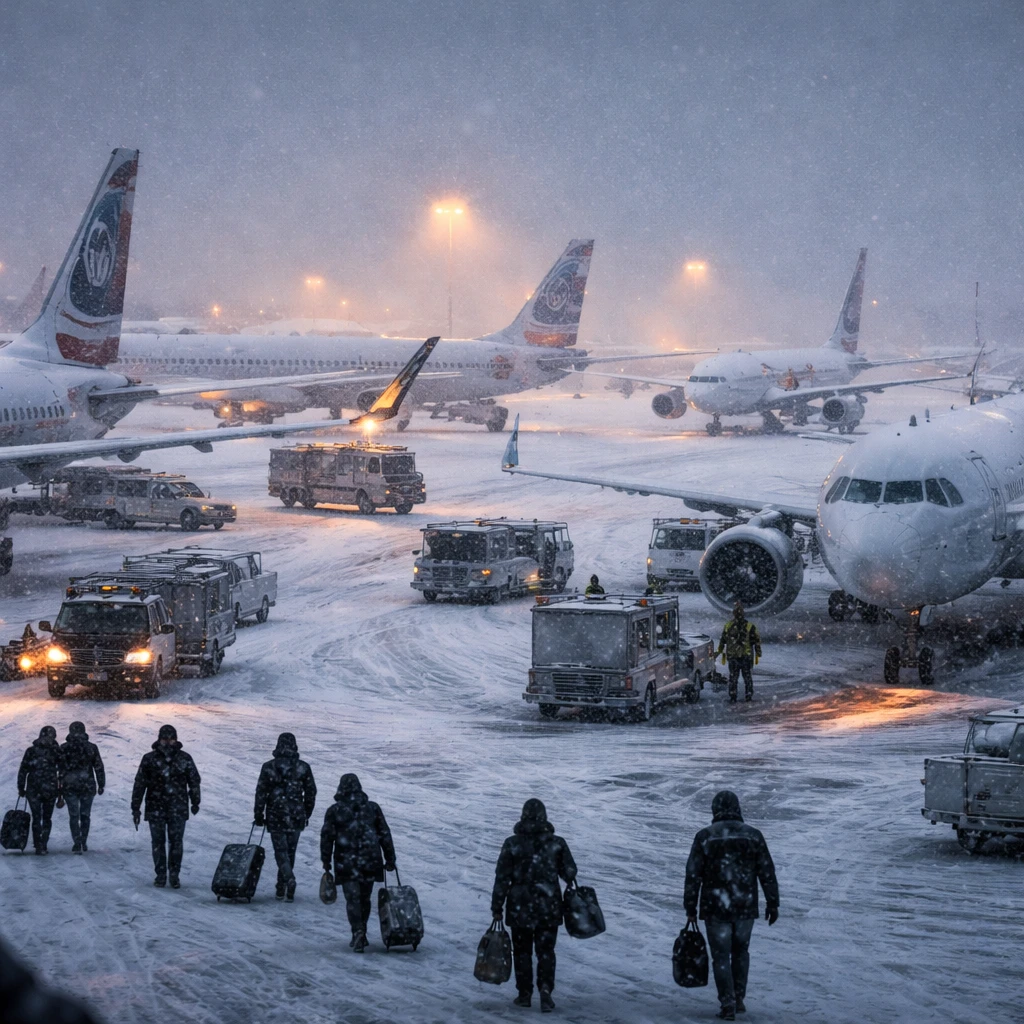
A powerful winter storm that swept across the central and eastern United States left communities under snow and ice and disrupted air travel on a large scale. Analysts at BofA Securities reported that, as of Thursday, the weather event had led to more than 22,000 cancellations across both mainline and regional airline networks.
Among carriers, American Airlines reported the largest operational impact, describing the episode as the most disruptive weather event in its history and cancelling over 11,000 flights. The company put a preliminary financial estimate on the disruption, saying the storm would reduce earnings by roughly $0.20 per share and cost around $190 million in pre-tax income. American, with a significant network presence at multiple airports in the storm-affected region, is the only carrier in this group to have provided a quantified estimate of the cost to date.
BofA analysts used cancellation counts to model the likely pre-tax earnings effects for other major U.S. carriers. Based on their calculations, Delta Air Lines faces an estimated pre-tax income reduction of about $67 million, while United Airlines is projected to see roughly $53 million knocked off income. The analysts placed estimated pre-tax hits for Southwest Airlines and JetBlue at $39 million and $20 million, respectively.
Smaller carriers or those with limited exposure in the storm-impacted U.S. Northeast are expected to feel less of a financial effect. Alaska Air, Frontier Airlines, and Allegiant were singled out by the analysts as having lower anticipated impacts because of their reduced footprint in the hardest-hit markets.
On the broader financial outlook, the analysts noted that while the near-term effects could influence first-quarter results, the calculated impacts appear manageable over a full-year horizon. "All these impacts seem very manageable on a full year basis but could influence first-quarter results," the analysts wrote, adding that equity markets typically look past short-term weather-induced disruptions.
The immediate operational fallout from the storm — extensive cancellations and passenger disruption — translated into discrete, carrier-specific earnings adjustments in the BofA model. Those adjustments vary by network scale and regional exposure, leaving larger national carriers with the largest short-term pre-tax hits and smaller or regionally focused airlines less affected.
Summary
The winter storm caused widespread flight cancellations across the central and eastern U.S., disrupting operations and prompting BofA to estimate multi-million-dollar pre-tax hits to major carriers. American Airlines reported the most significant operational damage and provided an explicit cost estimate; BofA modeled smaller but material impacts for Delta, United, Southwest, and JetBlue. Regionally focused carriers with limited exposure to the storm-affected Northeast are expected to be less affected.