
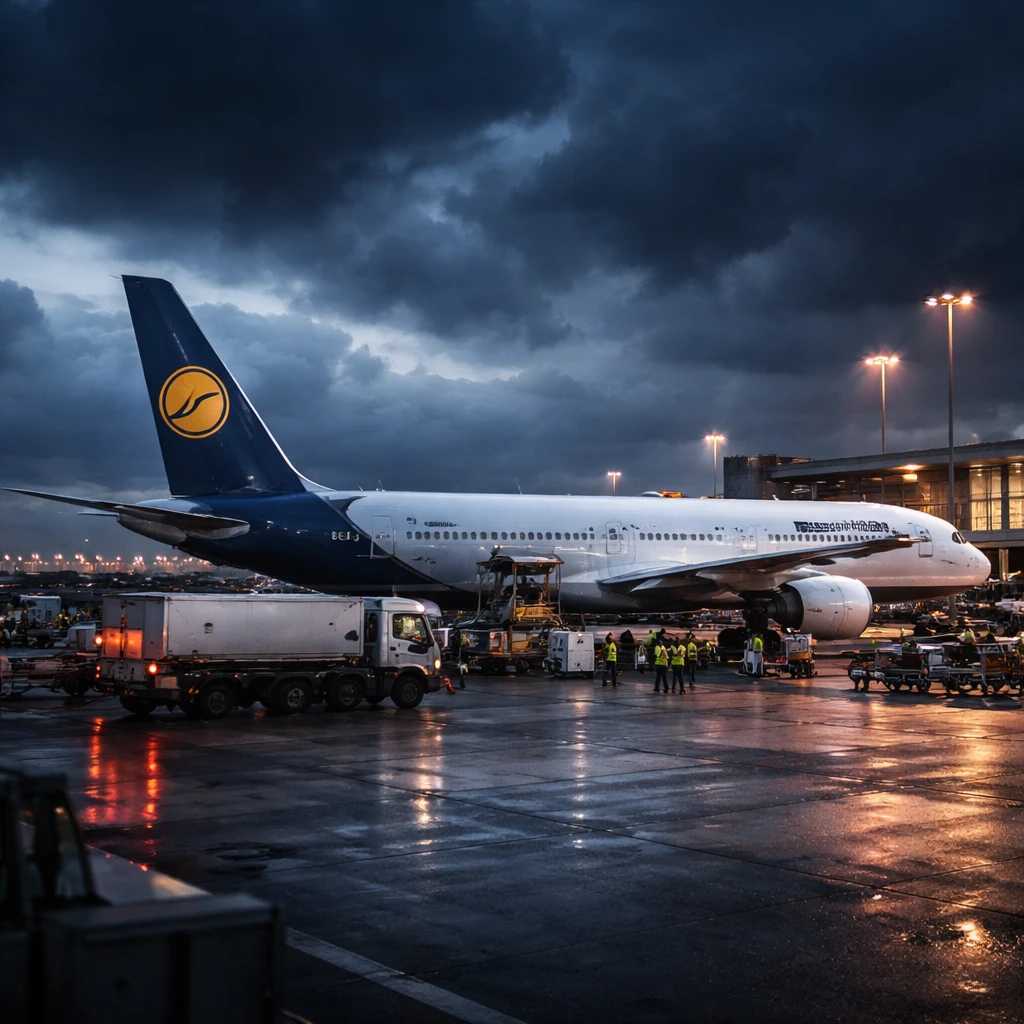
Barclays has shifted its stance on Deutsche Lufthansa AG, moving the stock to an "underweight" recommendation from "equal weight" and cutting its price target to €7.50 from €8. The bank said the airline's guidance provided on its first-quarter results call was overly sanguine given evolving revenue dynamics tied to the Middle East situation and persistent labour tensions.
At the time Barclays published its note, Lufthansa shares were trading at €8.37 on May 7, which the broker calculated implied about a 10.4% downside to the new price target.
The downgrade follows Lufthansa's first-quarter adjusted EBIT loss of €612 million - a 15% improvement year-on-year and about 7% better than a co-consensus loss of €659 million. Barclays attributed part of that outperformance to delayed recognition of fuel costs and short-term windfall revenues in March and April as passengers rerouted away from Gulf hub carriers.
However, Barclays warned those temporary supports are dissipating. Gulf airlines, which had been operating at roughly 20% of their typical capacity in March, had ramped back to around 70% by the end of April without aggressive marketing according to the note, and Fraport's first-quarter disclosure suggested Gulf carrier load factors were returning to normal.
"If we are indeed headed towards peace in the Middle East, we expect the revenue environment on passenger services to Asia and Africa, and on cargo, to weaken dramatically and rapidly," Barclays said, highlighting the sensitivity of Lufthansa's revenue pool to shifts in regional routing patterns.
The bank also modelled a scenario where the conflict continues, noting that under pressure on fuel it would expect Lufthansa's fuel costs to exceed company guidance, which is underpinned by an assumption of $98 crude and a $59 crack spread. Lufthansa had guided full-year 2026 fuel expense up by €1.7 billion year-on-year to €8.88 billion.
Against that backdrop Barclays cut its FY26 adjusted EBIT estimate by 20% to €1.22 billion and trimmed its FY27 forecast by 1% to €1.84 billion, leaving both below a €1.88 billion co-consensus figure that existed prior to the results. The brokerage's FY26 diluted EPS estimate was reduced 49% to €0.42 from €0.83.
Labour developments were another focal point. Barclays flagged the company's industrial relations as a structural drag after six days of strikes in April and ongoing disputes across Lufthansa mainline, cargo, CityLine and Eurowings. The analysts warned that Lufthansa's optimistic trading commentary on the first-quarter call could embolden unions to press for further action.
The new €7.50 price target is derived from a three-stage discounted cash flow model that uses a mid-term EBIT margin of 4.5% and a WACC of 6.4%. Barclays' downside scenario implies a valuation of €4.80 per share while the upside case sits at €11.50.
Context for investors
- The note ties short-term earnings momentum to routing shifts caused by the Middle East conflict and warns those benefits are fading as Gulf carriers restore capacity.
- Fuel cost assumptions and crack spread dynamics are central to Barclays' stressed scenarios; management's fuel guidance already incorporates a significant year-on-year rise.
- Ongoing and recent labour action across multiple operating units is viewed as a persistent operational and financial headwind.