
Barclays moved Domino’s Pizza UK & Ireland to an "equal weight" recommendation from "underweight" on Tuesday and assigned a 190p price objective, compared with the company’s closing share price of 171p on March 27. In its note, the brokerage highlighted a smaller-than-expected decline in franchisee profitability for FY25 and a strategic shift by the interim chief executive away from buying an external chicken brand.
Franchisee earnings were down just 4% in FY25, a significantly smaller hit than the company’s earlier guidance that had anticipated a decline in the range of 20% to 25%. Barclays flagged that outperformance as a material factor supporting its revised stance on the stock.
"Why would I want to spend hundreds of millions of pounds buying a chicken brand when actually I’ve got 1,400 stores. I’ve got a world class supply chain. I need no CapEx whatsoever. We’re not having to invest anything in the store," interim CEO Nicola Frampton said, according to a Bloomberg transcript referenced by Barclays.
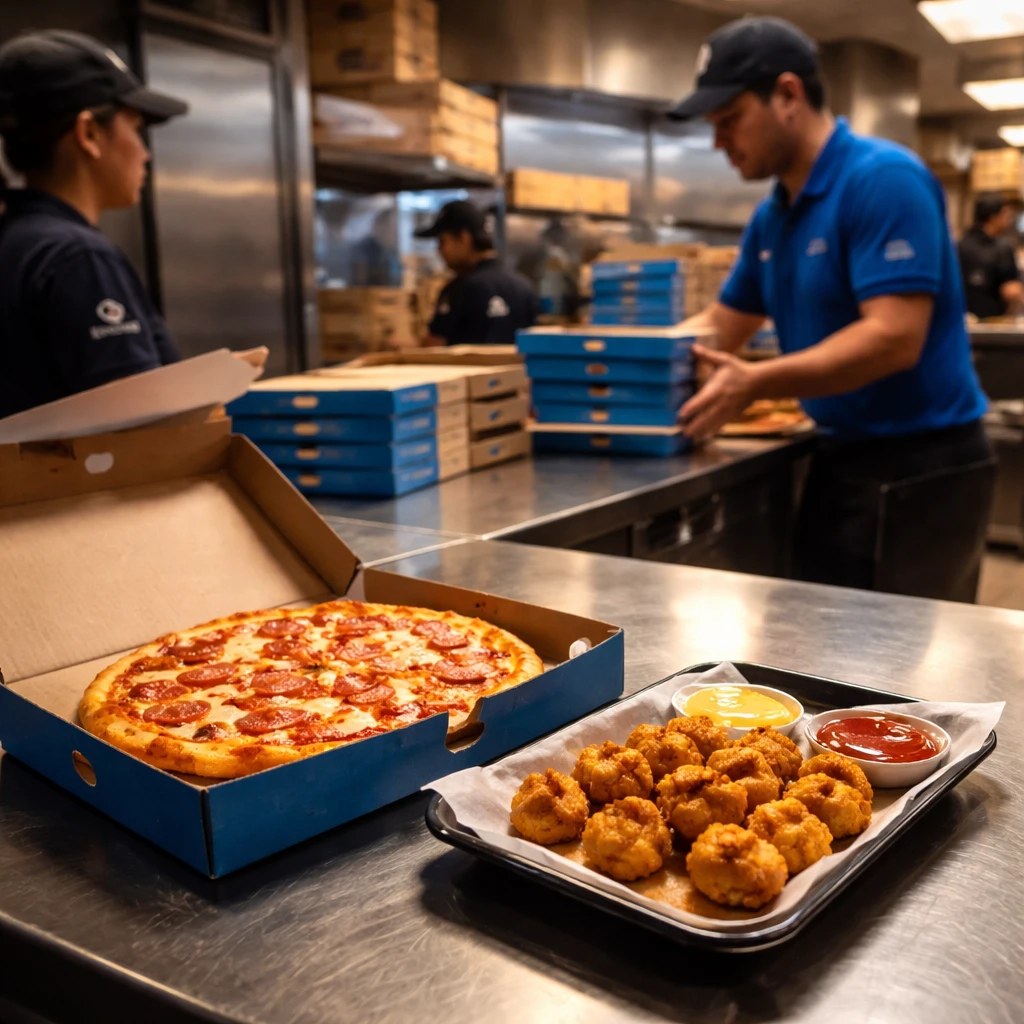
Barclays incorporated the company’s Chick ’N’ Dip rollout into its financial models under multiple scenarios. In the brokerage’s base case, it assumes 1% of Domino’s existing 71 million annual orders will include Chick ’N’ Dip at an average order value of £10, placed alongside a pizza order that averages £22.47. Under those assumptions Barclays calculates £8.9 million of incremental system sales and £0.95 million of additional EBIT, which it notes would represent roughly 1.1% of its FY26 estimated pre-tax profit of £90.3 million. The company has disclosed that 80% of Chick ’N’ Dip orders are being placed together with pizza purchases.
Barclays also benchmarked Domino’s current position in the UK quick service restaurant markets. The firm cited a 3.8% share for Domino’s in the roughly £3 billion UK chicken QSR segment where the company does not operate a distinct chicken brand, compared with an approximate 52.6% share of the roughly £3 billion UK pizza QSR market.
Under a more optimistic, blue sky scenario in which Chick ’N’ Dip system sales reach parity with Domino’s existing chicken-related revenues, Barclays modelled £114 million of additional system sales and a £12.2 million uplift to EBIT, equivalent to about 14% of the FY26 pre-tax profit estimate.
Alongside these scenario analyses Barclays provided updated FY26 projections. The broker forecasts adjusted EBIT of £111.3 million at a 15.1% margin, diluted EPS of 17.3p (4.3% below the Bloomberg consensus of 18.1p), and a dividend of 11.9p per share, which it says implies a forward yield of 6.9% based on the then-current price. Net debt is modelled at £287.5 million at the end of FY26, and net debt to EBITDA of 2.1x.
Barclays laid out both upside and downside valuation cases. The upside scenario, which produces a 305p price level, assumes 5% like-for-like sales growth, the opening of 50 new sites, and 2.5% of existing orders including Chick ’N’ Dip at a £10 average order value; that scenario generates EPS of 20.4p based on a 15x target P/E. The downside case, arriving at a 100p valuation, assumes -2% like-for-like sales, zero new site openings, and a 7x P/E applied to EPS of 14.5p.
The brokerage note also detailed modest near-term contributions from Chick ’N’ Dip in its base case but left open materially higher potential should consumer uptake scale. Barclays’ modelling illustrates a spectrum of outcomes for system sales, profitability and leverage, which together underpin its revised recommendation.
Separately, the brokerage’s note included a reference to an AI-driven stock selection tool and how it evaluates Domino’s alongside other companies, though the core analytical drivers cited by Barclays remained franchisee profitability metrics and management’s strategic choices regarding brand acquisition and in-house product launches.
Contextual takeaways
- Barclays’ upgrade reflects both operational resilience among franchisees and a shift in corporate strategy away from large M&A outlays toward leveraging the existing store base and supply chain.
- The immediate sales impact of Chick ’N’ Dip is modelled as modest in the base case but could be a material earnings driver in a more optimistic adoption scenario.
- Balance sheet and dividend projections signal Barclays’ view that Domino’s can generate positive cash flow while maintaining a moderate net leverage profile through FY26 under its central assumptions.