
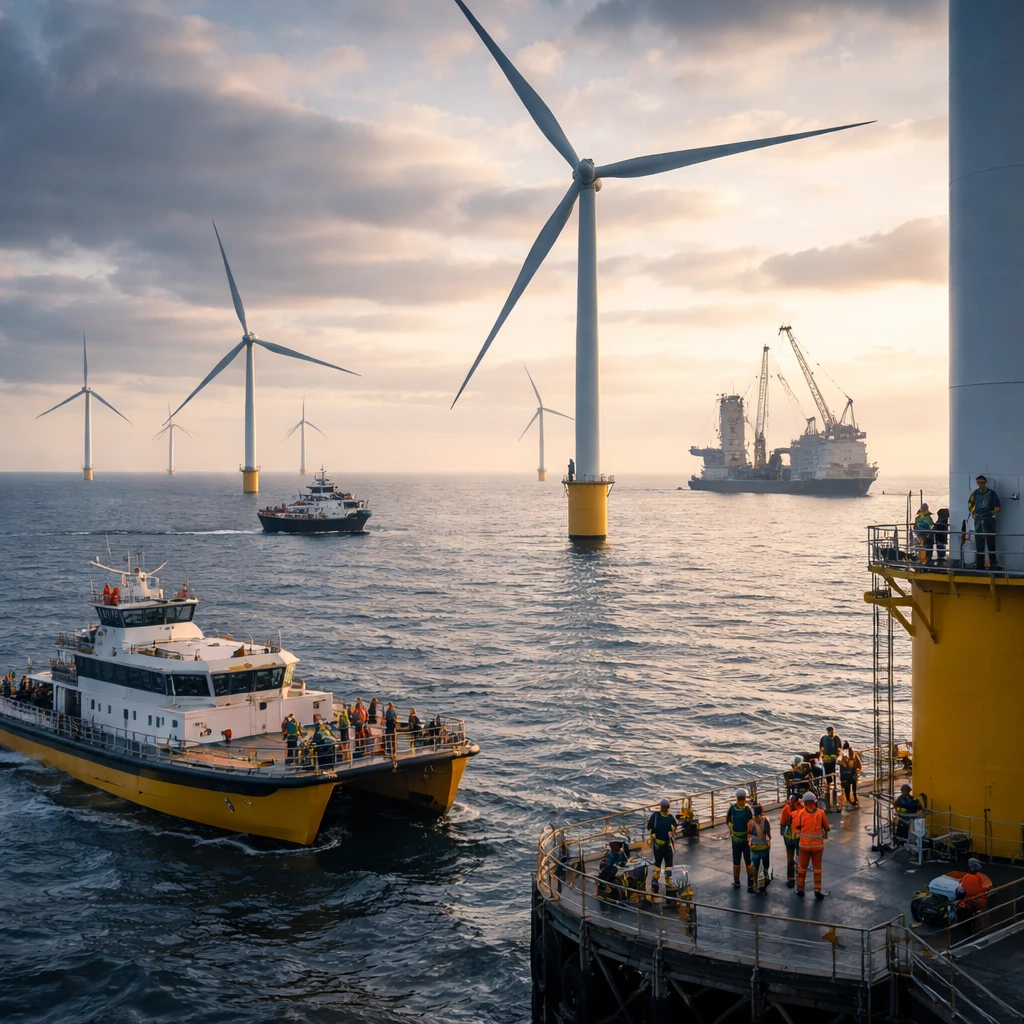
Barclays raised its recommendation on Danish offshore wind developer Ørsted to "equal weight" from "underweight" on Wednesday, and simultaneously lifted its 12-month price target to DKK 160 from DKK 117 - a 37% increase. Ørsted shares responded positively, trading up more than 2% and changing hands at DKK 153, a level described as close to a multi-year low after the stock fell from a peak of DKK 389.06 in March 2023 to a trough of DKK 59.19 in September 2025 before a subsequent recovery.
The upgrade follows a series of balance sheet and portfolio moves the bank says materially de-risk the business. In 2025 Ørsted completed a DKK 60 billion rights issue and embarked on an accelerated asset disposal programme that generated about DKK 46 billion in proceeds, exceeding the company's original DKK 35 billion target. Notable disposals highlighted by Barclays included the sale of a 50% stake in Hornsea 3 for DKK 10 billion and the divestment of its European onshore business to Copenhagen Infrastructure Partners for DKK 10.7 billion in February 2026.
Barclays' analysts noted the change in corporate priorities, writing that "Management have stabilised the balance sheet, rationalised the portfolio and prioritised returns over volume." The bank points to a dramatic reduction in leverage: net debt declined to DKK 3.99 billion in 2026 from DKK 18.98 billion in 2025, and net debt/EBITDA fell to 0.1x.
On the earnings front, Barclays projects EBITDA to rise to DKK 29 billion in 2026 and to DKK 33.77 billion in 2027, up from DKK 25.07 billion in 2025. Adjusted earnings per share are modelled at DKK 9.00 for 2026 and DKK 10.79 for 2027, versus DKK 1.95 in 2025. Those EPS forecasts imply valuation multiples of roughly 17x in 2026 and 14.2x in 2027, which Barclays says sits around the current sector average of 15x.
In its valuation work, Barclays assigns about DKK 30 billion of proportional enterprise value to Ørsted's U.S. offshore business. Of that sum, DKK 26 billion - or 87% - is concentrated in two projects, Revolution Wind and Sunrise Wind. On a per-share basis the bank estimates the U.S. assets represent DKK 20 per share, or 13% of the DKK 160 price target.
Operational developments in the U.S. are cited as positive. Barclays notes that Revolution Wind recently delivered its first power. It also records that U.S. lease suspension orders issued in December 2025 were successfully challenged in court, with injunctions granted to Revolution Wind on January 12 and to Sunrise Wind on February 2. Barclays adds that the appeal window for Revolution Wind has closed without a government response.
Across the U.K. portfolio Barclays values operational and under-construction assets at DKK 61.23 billion, saying the U.K. offshore business accounts for over a third of Ørsted's enterprise value. The broker also quantifies the pipeline: it places a pipeline value of DKK 38 per share based on an 11 GW pipeline and an assumed ROIC-WACC spread of 200 basis points.
Looking at near-term auction opportunity, Barclays expects up to 6.5 GW of offshore wind auctions in 2026 spread across Denmark (1.8 GW), Belgium (700 MW), Taiwan (3.6 GW) and Australia (2 GW). The bank also notes that Hornsea 4, which was discontinued in May 2025, could re-emerge through a future auction process or via a joint venture.
On longer-term growth and returns, Barclays writes that "A second gas crisis in five years should support renewable policy, while an inflection on auction wins could underpin a recovery in growth >2030." The broker's forecast assumes slower EPS growth through 2030 - a 6.6% compound annual growth rate from 2026 to 2030 compared with a sector average of about 9% - before acceleration to an 11.5% CAGR from 2030 to 2035.
Under a sector long-run exit multiple of 14.5x applied to 2035 EPS, Barclays calculates an internal rate of return of 9.5% for Ørsted, noting that the IRR would move above 10% if the company secures new project wins. The sensitivity to discount rates is material in Barclays' work: the bank estimates that every 50 basis point increase in the weighted average cost of capital reduces the valuation by approximately DKK 12.5 per share. Its scenario range places an upside case at DKK 220 and a downside case at DKK 110.
Summary
Barclays upgraded Ørsted to equal weight and raised its price target to DKK 160 after a large rights issue and an aggressive disposal programme materially lowered net debt and improved leverage metrics. The broker forecasts rising EBITDA and adjusted EPS over 2026-27, allocates value to U.S. and U.K. offshore portfolios, and highlights recent legal and operational developments that reduce project risk in the U.S.
Key points
- Barclays upgraded Ørsted to equal weight and increased its price target to DKK 160 from DKK 117, a 37% uplift.
- Net debt fell to DKK 3.99 billion in 2026 from DKK 18.98 billion in 2025; net debt/EBITDA is now 0.1x, with EBITDA forecast at DKK 29 billion in 2026 and DKK 33.77 billion in 2027.
- The U.S. offshore portfolio is valued at roughly DKK 30 billion proportional enterprise value, while U.K. operational and under-construction assets are valued at DKK 61.23 billion.
Risks and uncertainties
- Valuation sensitivity to financing costs - every 50 basis point increase in WACC cuts valuation by about DKK 12.5 per share, affecting investor returns and sector comparisons.
- A slower earnings trajectory before 2030 - Barclays forecasts EPS CAGR of 6.6% from 2026-2030 versus a sector average near 9%, which could influence market sentiment and capital allocation decisions in the renewables sector.
- Project auction outcomes and potential delays - auction success and future project wins materially influence projected IRR and long-term growth, impacting offshore construction and supply-chain sectors.