
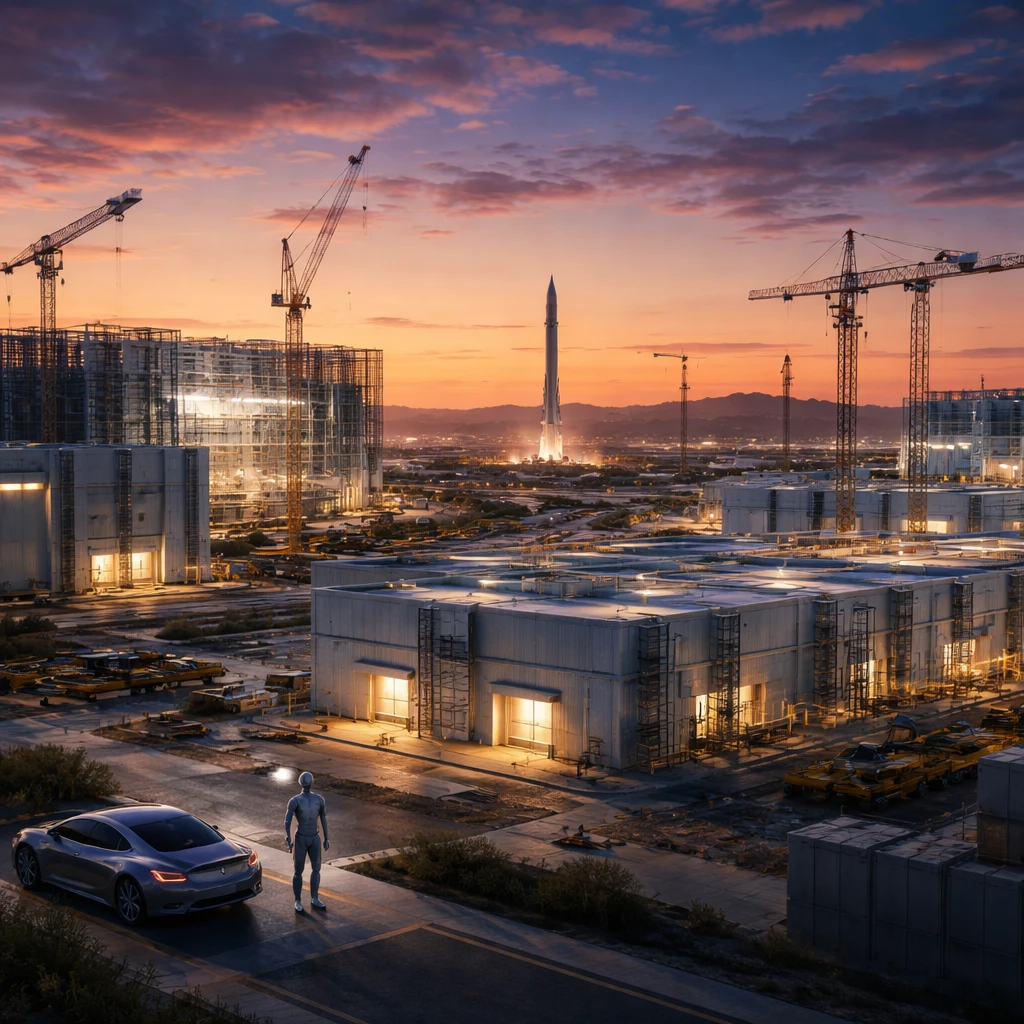
Tesla has placed chip production at the heart of a long-range growth outline, presenting a program dubbed Terafab that targets annual output of 1 terawatt of compute capacity. The proposed scope encompasses logic, memory and packaging components, and would be executed in partnership with SpaceX and xAI.
According to the plan presented by Elon Musk, two cutting-edge chip fabrication facilities would be constructed at a sizeable campus in Austin, Texas. One factory would serve automotive needs and power humanoid robots, while the second would be oriented toward artificial intelligence data centers intended for space-based applications.
Projections tied to Terafab indicate the intended production level would equal roughly 50 times current global AI compute output. Musk has signaled that around 80% of that compute capacity would be allocated to space uses, with the remaining 20% directed to terrestrial functions such as autonomous vehicles and humanoid robotics.
Analysts at Barclays interpreted the announcement as reinforcing Tesla's shift to a so-called physical AI strategy - a positioning in which semiconductor chips become foundational to future products and service offerings. At the same time, Barclays highlighted several operational unknowns, questioning how quickly Tesla can scale advanced semiconductor manufacturing given its limited experience in that industry and the technical complexity involved in next-generation fabs.
Barclays also flagged execution challenges tied to a highly vertically integrated approach. The bank observed that Tesla may need to develop manufacturing competencies that are typically supplied by established semiconductor foundries and integrated device manufacturers, such as those capable of precision process control and high-volume packaging.
On the financial side, Barclays suggested total capital spending for Terafab could materially exceed earlier expectations of $50 billion. That potential uplift in required investment may make phased construction and additional funding support from Tesla and its affiliates necessary to realize the full program.
While some investors may see the initiative as consistent with Tesla's long-term growth narrative, Barclays characterized Terafab as a "show-me" proposition. The bank expects that nearer-term execution will likely fall short of the headline numerical targets until more concrete milestones are achieved.
Sectors mentioned: Semiconductor manufacturing, aerospace/space infrastructure, automotive and robotics, artificial intelligence.