
Market rally and backdrop
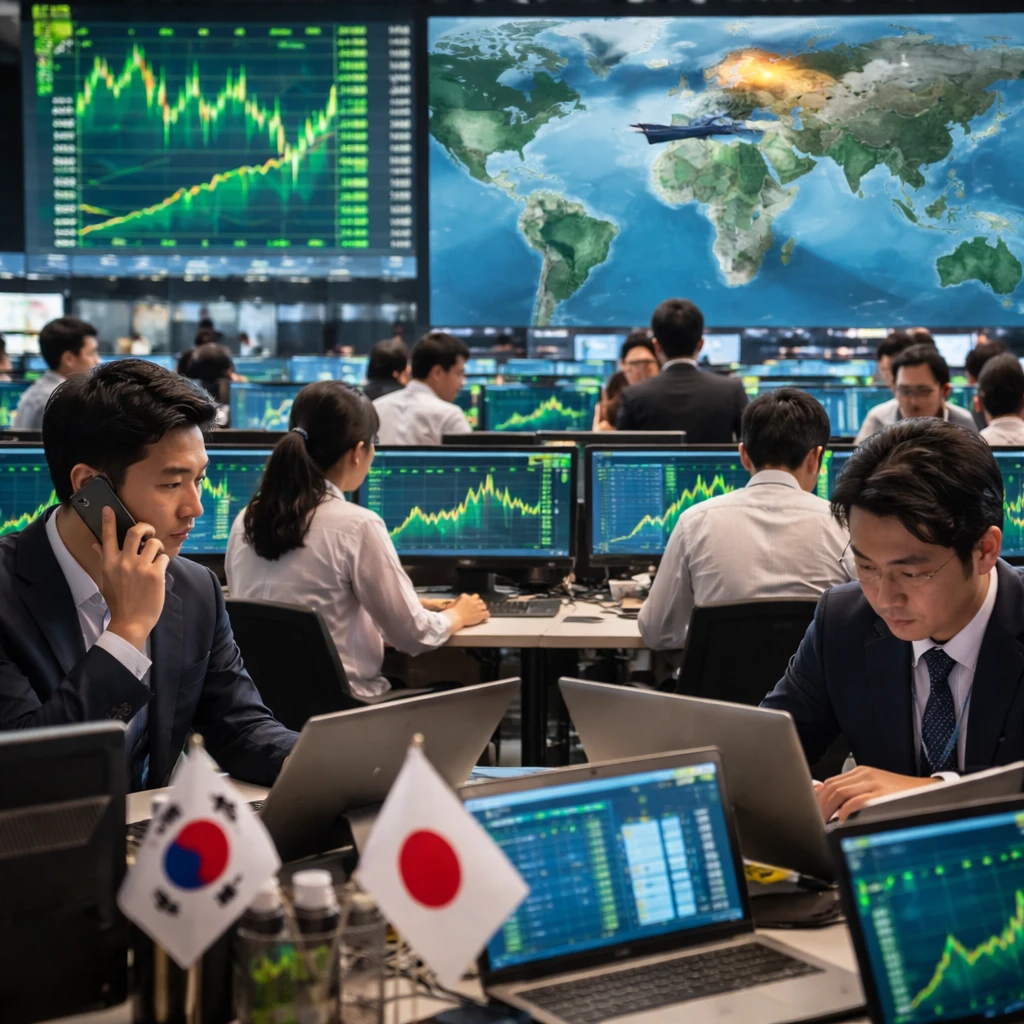
Asian stock markets moved higher on Wednesday after comments from U.S. President Donald Trump suggesting that military action against Iran would be wound down in the next two to three weeks. The president said Washington had achieved its goals of crippling Iran's nuclear ambitions and had achieved regime change in Tehran, and added that Tehran would not need to strike any deal as a condition to end the conflict. The remarks helped lift investor sentiment across the region, adding to buying interest after steep losses in March.
U.S. markets provided a positive lead-in for Asia, with Wall Street stocks rallying overnight as investors pushed back into risk assets. S&P 500 Futures rose 0.2% by 22:05 ET (02:05 GMT), reflecting the cautious optimism that carried into Asian trading hours.
South Korea outperforms
South Korea's KOSPI was the standout market, jumping 6.5% on the day. The index benefited from dip-buying after substantial declines in March, when it lost over 19% of value. Market participants lifted beaten-down names, with Samsung Electronics Co Ltd (KS:005930) and SK Hynix Inc (KS:000660) climbing as much as 10% each after steep March losses. Those two chipmakers had been among the hardest hit amid questions over long-term demand in the memory chip sector linked to artificial intelligence-related spending.
Investor confidence in South Korea was also supported by fresh economic data. Exports in March recorded a strong 48.3% surge, and purchasing managers index readings showed that manufacturing activity expanded further last month. Together, the trade and PMI data provided a near-term boost to local market sentiment and helped underpin the rally.
Regional moves
Elsewhere in the region, Japan's Nikkei 225 and TOPIX climbed 4.0% and 3.9%, respectively, as broader Asian markets recouped some of March's losses. Australia's ASX 200 rose 1.7%, matching gains in Singapore's Straits Times index. China's Shanghai Shenzhen CSI 300 and the Shanghai Composite were up roughly 1.4% each, brushing off private manufacturing PMI figures that showed activity grew less than expected in March. Hong Kong's Hang Seng advanced 1.8%, led by a rebound in technology shares.
Market momentum was shaped by a combination of bargain-seeking after a difficult month and hopes that geopolitical tensions might ease with a U.S. drawdown of military operations.
Geopolitical uncertainty and energy markets
Despite the positive market reaction, uncertainty remains over critical logistics for global energy flows. It was not clear from the statements whether the Strait of Hormuz - a strategic oil shipping lane - would be reopened if U.S. forces pull back. Earlier reports and comments this week suggested the U.S. might leave the passage closed and encourage European, Asian and Gulf partners to take steps to reopen it. The Strait of Hormuz continues to be a major factor for markets, given that it supplies roughly 20% of global oil consumption. Oil prices rose on Wednesday, reflecting the ongoing overhang that the Hormuz situation presents for energy markets.
Outlook
For now, markets are trading on a mix of geopolitical optimism and technical buying after March's declines, with sector-specific dynamics - notably in semiconductors and energy - playing an important role in regional performance. However, several uncertainties remain tied to the durability of the diplomatic and military developments and to how logistical issues around key energy arteries will be resolved.