
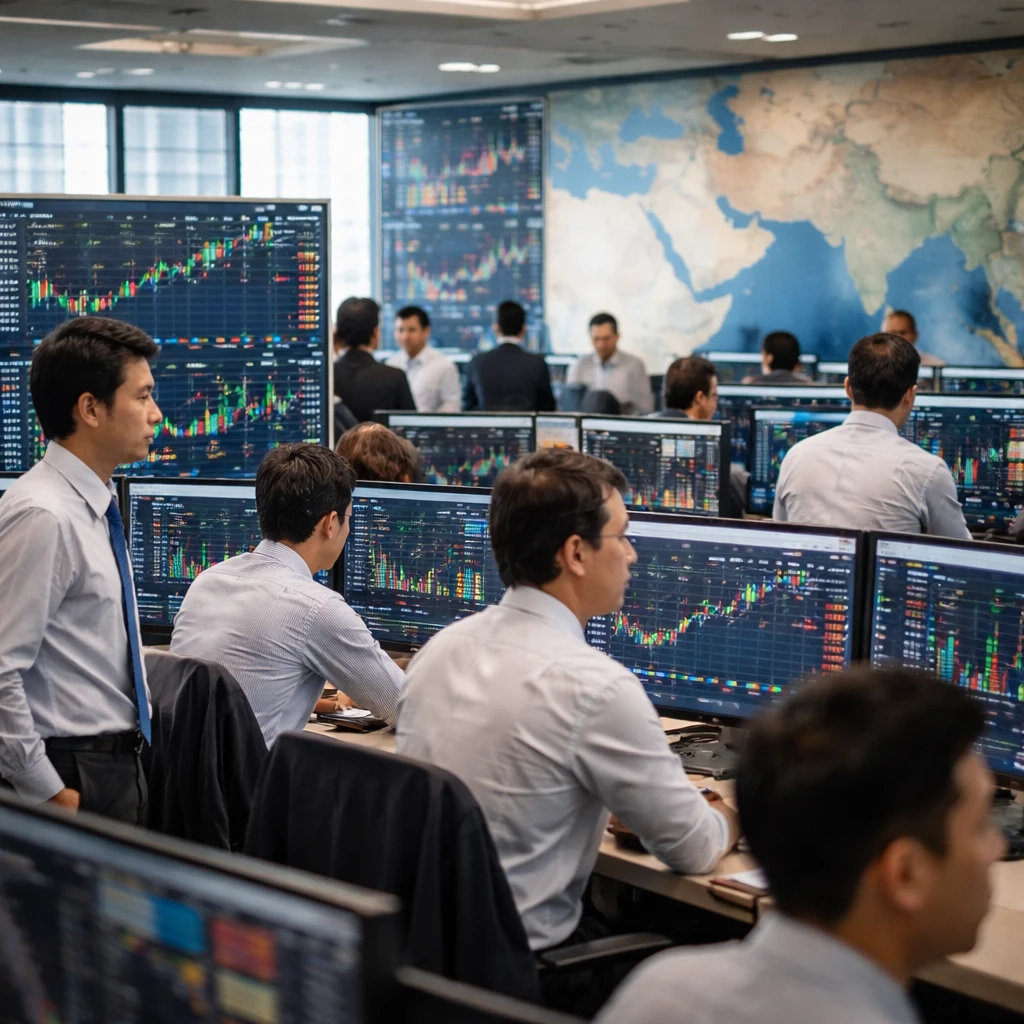
Most Asian stock markets moved higher on Friday as investors weighed the prospect of ceasefire talks between Iran and the United States, while regional exchanges tracked gains on Wall Street and prepared for a strong weekly performance.
Sentiment in the region was bolstered by news that Iran and the U.S. have arranged talks - scheduled to take place in Pakistan - aimed at discussing a ceasefire, though Tehran had not definitively confirmed its participation at the time. The broader backdrop included a solid run on Wall Street, which rose for a seventh straight session on Thursday after Israel indicated it would pursue a ceasefire with Lebanon. Iran had sought for Lebanon to be included in any ceasefire involving the U.S. and Israel.
S&P 500 futures were largely unchanged during Asian trading as markets focused on the upcoming ceasefire discussions. Attention was also directed toward key U.S. consumer price index inflation data due on Friday, which could influence global risk appetites.
Regional market movers
South Korea’s KOSPI led Asian gains on the day, climbing 1.9%. Local technology stocks drew buying interest, and the index was the best-performing market in the region for the week, on course for a nearly 10% weekly advance. That weekly strength was partly driven by outsized bargain buying after the KOSPI had suffered steep losses in March. The Bank of Korea’s decision to hold its key interest rate at 2.50% elicited little reaction from local investors.
Japan’s Nikkei 225 rose 1.5% on Friday and was on track for a roughly 7% weekly rise, while the broader TOPIX was flat. The lack of movement in TOPIX followed data showing a larger-than-expected increase in Japanese producer inflation in March, which raised concern that energy-related price pressures could bolster inflation and potentially lead to tighter policy from the Bank of Japan.
Fast Retailing Co., Ltd. (TYO:9983) was the strongest performer on the Nikkei after the Uniqlo owner reported positive earnings and raised its profit forecast for the fiscal year.
Elsewhere in the region, Australia’s ASX 200 fell 0.3% on Friday but was positioned for a weekly gain of about 4.3%. Singapore’s Straits Times Index was flat on the day and headed for a modest weekly rise of 0.7%. Futures for India’s Nifty 50 slipped 0.2%, although the index was looking at a weekly advance greater than 5%.
China: mixed inflation, modest market gains
Chinese equity benchmarks also advanced. The Shanghai Shenzhen CSI 300 rose 1.2%, while the Shanghai Composite gained 0.7% on Friday. Both indexes were trading higher by between roughly 3% and 4% for the week.
Data released on Friday presented a mixed picture for China’s inflation dynamics in March. Consumer price index inflation contracted from the prior month, a sign that the boost to household spending seen during the Lunar New Year did not extend into March. In contrast, the producer price index rose by more than expected in March, suggesting that higher oil prices were translating into some factory-gate inflation. While the CPI reading indicated that China still faces challenges with deflationary pressures, the stronger PPI pointed to some improvement in wholesale price trends.
Other market context
Regional investors also took encouragement from hopes of a potential ceasefire in the Iran conflict, even as commentators and market participants noted that a durable, long-term peace agreement appeared distant and that oil tanker traffic through the Strait of Hormuz remained limited. The broader regional rally was also supported by bargain hunting after heavy declines in March.
Looking ahead, markets will remain attentive to confirmation of Iran’s participation in the scheduled talks in Pakistan and the U.S. CPI release, both of which have the potential to sway risk sentiment across asset classes.
Note: This article reports market moves, scheduled talks and released inflation data as described above. It does not speculate on outcomes beyond the facts presented.