
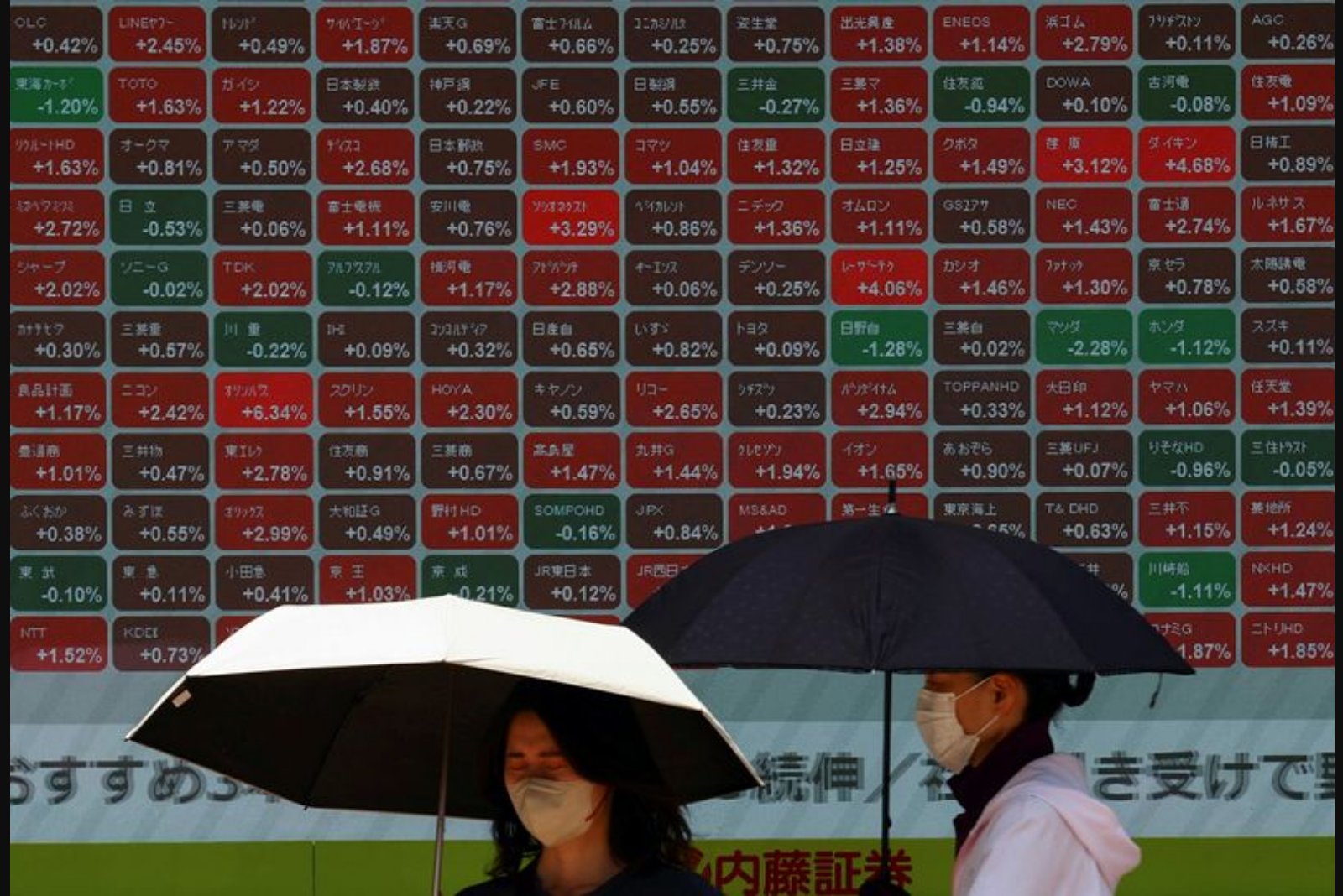
Asian equities retreated on Monday as renewed anxiety over mounting costs tied to artificial intelligence investments weighed on technology stocks, even as U.S. futures showed signs of modest recovery after corporate news and chip-sector moves.
Alphabet, Google's parent, released results after the U.S. market close and said it expects to spend between $175 billion and $185 billion in capital expenditure this year - a figure that came in well above analysts' expectations. The stock reacted sharply in after-hours trade, plunging by more than 6% at one stage before finishing 0.4% lower after-hours.
Investors have been shifting money out of major technology names and into more cyclical areas of the market amid concerns about AI's potential to disrupt employment and the escalating investment required to pursue AI initiatives. Market observers noted that an abrupt market correction tied to a new legal tool developed for Anthropic's Claude large language model has contributed to the recent volatility, erasing about $830 billion in market value since January 28.
Chipmaker Advanced Micro Devices added to the negative tone after reporting disappointing results, with its shares tumbling 17% overnight.
"That increase in (Alphabet) capex was absolutely enormous," said Tony Sycamore, an analyst at IG. "At a time when everyone is hyper-sensitive and hyper-nervous about what's going on with the software companies, with what's going on with CAPEX and AI valuations... I would have thought the reaction would be quite negative, but it's not flowing through to the Nasdaq futures."
Some demand for additional equipment spending supported Nvidia, which rallied almost 2% after the bell, partially offsetting a prior 3.4% drop. That helped nudge Nasdaq futures up about 0.6% and the S&P 500 futures roughly 0.4%.
Despite the late-session stabilization in U.S. futures, regional equity indices in Asia fell broadly. MSCI's broadest index of Asia-Pacific shares outside Japan slid 1%. South Korea's KOSPI dropped 1.7% while Taiwanese equities fell 0.7%. Japan's Nikkei held flat for the session. On the mainland, Chinese blue chips declined 0.7%, and Hong Kong's Hang Seng eased 0.8%.
Market participants are also watching a slate of upcoming reports and policy events. Amazon's results later in the day are drawing attention, and central bank meetings from the Bank of England and the European Central Bank are on the calendar, with both institutions expected to keep policy rates on hold.
The foreign exchange market showed continued pressure on the Japanese yen, which extended losses for a fourth consecutive day ahead of a general election scheduled for Sunday. Polls suggest a decisive victory for Prime Minister Sanae Takaichi, whose spending plans have raised questions about Japan's fiscal strain. The dollar was steady at 156.93 yen, having rallied about 3% from a low of 152.1 yen earlier in recent trading when speculation that the New York Federal Reserve had conducted rate checks briefly strengthened the yen.
In U.S. government debt markets, the benchmark 10-year Treasury yield was essentially unchanged at 4.2715%.
Data timing was also affected by recent U.S. political events: the January nonfarm payrolls report has been rescheduled from its planned release date to February 11 after a four-day partial government shutdown concluded.
Commodities reflected a mixed reaction to geopolitical and market developments. Oil prices eased after two sessions of gains after reports that the United States and Iran agreed to hold talks in Oman - despite unresolved differences over the agenda. U.S. West Texas Intermediate crude fell 1.4% to $64.23 per barrel, and Brent crude futures also dropped 1.4% to $68.47 per barrel.
Precious metals rebounded slightly after a sharp decline last Friday. Gold rose 0.3% to $4,976 an ounce, while silver ticked up 0.2% to $88.20 an ounce.
Looking ahead, market participants will be parsing corporate earnings, central bank commentary and geopolitical developments for further signals on growth, inflation and the pace of technology-driven capital expenditure that is increasingly influencing sector-level rotations.