
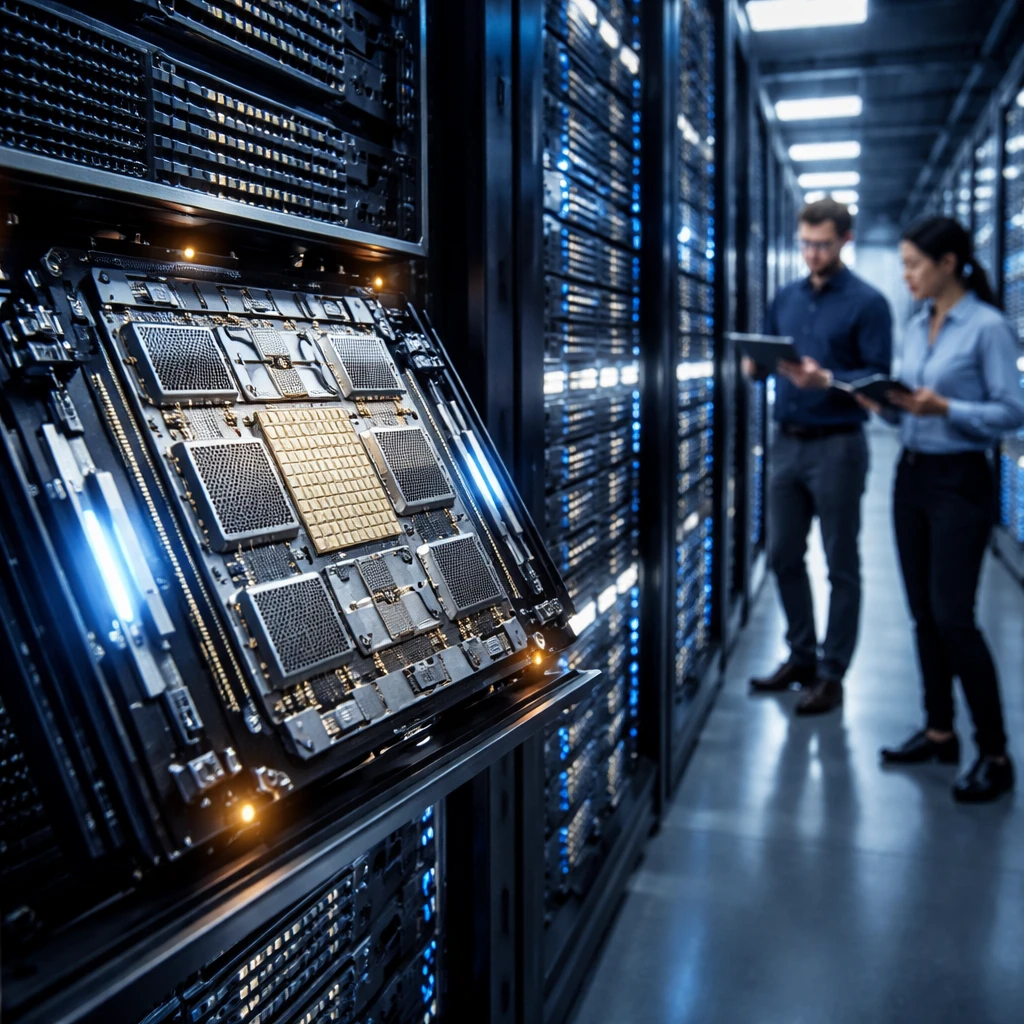
ARM Holdings plc said it is moving beyond its long-standing business model of licensing intellectual property and compute subsystems to other firms by producing silicon itself for the first time. The company introduced the ARM AGI CPU, a processor targeted at AI-focused data center workloads.
The ARM AGI CPU is built around ARM Neoverse V3 cores, offering up to 136 cores per CPU and a thermal design power of 300 watts. ARM says the new processor delivers more than 2x performance per rack when compared with x86 platforms and can scale to support up to 8,160 cores per rack in air-cooled deployments.
Meta is named as the lead partner and co-developer on the project. Santosh Janardhan, head of infrastructure at Meta, commented on the collaboration: "We worked alongside ARM to develop the ARM AGI CPU to deploy an efficient compute platform that significantly improves our data center performance density."
ARM listed a set of early customers committed to deploying the CPU, including Cerebras, Cloudflare, F5, OpenAI, Positron, Rebellions, SAP, and SK Telecom. Hardware partners identified as lead OEMs and ODMs supporting systems built around the new chip are ASRock Rack, Lenovo, Quanta Computer, and Supermicro. According to the company, early systems are available now, with broader availability expected in the second half of the year.
The announcement drew support from a wide cross-section of the technology ecosystem, with more than 50 companies backing the new silicon platform. ARM specifically named AWS, Broadcom, Google, Marvell, Micron, Microsoft, NVIDIA, Samsung, SK Hynix and TSMC among supporters.
Manufacturing for the ARM AGI CPU will be performed by TSMC using its 3-nanometer process technology.
Financial market reaction to the news was modest but positive. ARM shares traded roughly 1.2% higher on the day of the announcement and spiked as much as 2.3% higher in intraday trading.
Summary
ARM is entering silicon production with the ARM AGI CPU, a high-core-count processor designed for AI data centers. Meta co-developed the chip, which ARM says doubles rack-level performance versus x86 and can scale to thousands of cores in air-cooled configurations. The initiative has broad industry backing and will be manufactured on TSMC's 3-nanometer node. Early systems are available now, with wider availability expected in the second half of the year. ARM's shares rose modestly on the announcement.
Key points
- ARM unveiled the ARM AGI CPU - up to 136 ARM Neoverse V3 cores per CPU and a 300-watt thermal design power - positioned for AI data centers.
- Meta is the lead partner and co-developer; customers committed to deploy include Cerebras, Cloudflare, F5, OpenAI, Positron, Rebellions, SAP, and SK Telecom. Lead OEMs/ODMs include ASRock Rack, Lenovo, Quanta Computer, and Supermicro.
- More than 50 companies across the ecosystem support the new platform; TSMC will manufacture the CPU on its 3-nanometer process. Market reaction was a roughly 1.2% rise in ARM shares, with an intraday spike up to 2.3%.
Risks and uncertainties
- The shift from a licensing-focused business model to producing silicon represents a structural change for ARM - execution risk exists as the company moves into manufacturing and systems integration roles previously handled by partners.
- Broad availability is expected in the second half of the year, creating timing uncertainty for when deployments will scale beyond early systems that are currently available.
- The initiative relies on external manufacturing capacity - TSMC is named as the foundry partner using a 3-nanometer process, making manufacturing execution and supply constraints a potential uncertainty.
Impacted sectors
- Semiconductors and chip manufacturing
- AI infrastructure and data center operations
- Original equipment manufacturers and cloud service providers